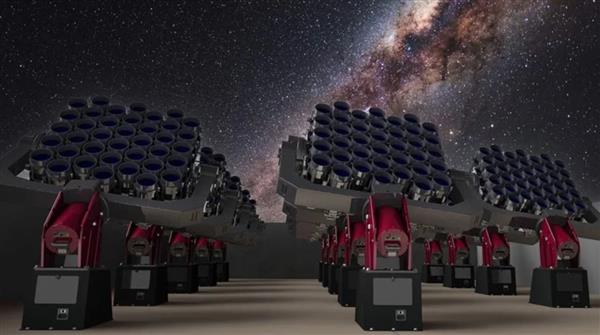
The quest to unravel the universe’s deepest mysteries has taken a giant leap forward with the construction of MOTHRA, a revolutionary telescope poised to become the world’s largest. Located in the El Sauce Observatory in Chile, this ambitious project aims to map the “cosmic web”—the vast network of galaxies and dark matter that shapes the cosmos—with unprecedented detail. The telescope’s innovative design, relying on a massive array of lenses rather than a traditional mirror, promises to redefine our understanding of the universe’s hidden structure.
Unlike conventional telescopes that utilize a single, large mirror to collect light, MOTHRA employs a groundbreaking approach: a mosaic of 1,140 telephoto lenses manufactured by Canon. This distributed aperture system, effectively functioning as a single 4.7-meter lens, is designed to capture faint signals from the universe’s most elusive components. The project builds upon the success of the “Dragonfly Telephoto Array,” demonstrating the efficiency of multiple telephoto lenses in detecting dim cosmic objects. This innovative approach is expected to reveal the distribution of dark matter, a substance that makes up approximately 85% of the universe’s mass but remains largely invisible to current observational methods. Egyptke.com reports that the telescope is expected to begin full scientific operations by the end of 2026.
A New Lens on the Cosmic Web
The “cosmic web” isn’t simply a metaphor; it’s a scientifically observed structure. Galaxies aren’t randomly scattered throughout the universe but are interconnected by vast filaments of gas and dark matter. These filaments form a network resembling a spiderweb, with galaxies clustered at the nodes where the filaments intersect. Understanding the structure of this web is crucial to understanding how galaxies form and evolve, and how matter is distributed throughout the universe. MOTHRA is specifically designed to detect the faint light emitted by the hydrogen gas within these filaments, a signal that has historically been demanding to observe with traditional telescopes. Fuchsia details that the project aims to map this dark matter, which is believed to be the scaffolding upon which the cosmic web is built.
The telescope’s design isn’t just about the number of lenses; it’s about precision. MOTHRA will utilize highly accurate optical filters to isolate the faint light emitted by hydrogen gas, the primary signal scientists are seeking. This gas, spread thinly between galaxies, provides a crucial clue to the distribution of dark matter. Peter van Dokkum, an astronomer and one of the founders of the Dragonfly initiative, explained that the telescope’s design is based on a simple yet ambitious idea: maximizing the chances of capturing the extremely weak glow of gas between galaxies, light that has long eluded traditional astronomical instruments.
From Dragonfly to MOTHRA: An Evolutionary Leap
The MOTHRA project isn’t starting from scratch. It’s building on the foundation laid by the Dragonfly Telephoto Array, a smaller-scale experiment that proved the viability of using multiple telephoto lenses for astronomical observation. The Dragonfly array, as reported by various sources including Akhbarona, demonstrated that this approach could be more efficient at capturing extremely faint cosmic objects than some conventional telescopes. MOTHRA represents a significant expansion of this concept, scaling up the number of lenses and the overall size of the array to achieve unprecedented sensitivity and resolution.
The success of the Dragonfly array highlighted a key advantage of this design: its ability to gather light over a large area, effectively increasing the telescope’s light-collecting power. Here’s particularly critical for observing faint, diffuse objects like the gas filaments that make up the cosmic web. The larger aperture achieved by combining the light from numerous lenses allows MOTHRA to detect signals that would be too weak to be detected by smaller telescopes. The project’s ambition is to provide scientists with one of the clearest pictures yet of the hidden structure that forms the invisible framework of the universe.
Funding and Future Prospects
The construction of MOTHRA is being funded by a combination of private and institutional support. Entrepreneur Alex Grecco, founder and CEO of XTX Markets, is a major benefactor, providing significant financial backing through his support of the Convergent Research Foundation. This funding model reflects a growing recognition that accelerating scientific innovation requires new organizational and financial approaches. The Convergent Research Foundation emphasizes the need for faster development of groundbreaking scientific tools, and MOTHRA is a prime example of this philosophy.
XTX Markets, a global market maker specializing in foreign exchange, has committed substantial resources to the project, recognizing the potential for fundamental discoveries about the universe. The company’s investment underscores a growing trend of private sector involvement in large-scale scientific endeavors. This collaborative approach, combining the expertise of astronomers, engineers, and financial backers, is essential for tackling the most challenging questions in cosmology.
What MOTHRA Could Reveal
If successful, MOTHRA’s observations could revolutionize our understanding of the universe’s evolution. By mapping the cosmic web in detail, scientists hope to gain insights into the formation of galaxies, the distribution of dark matter, and the ultimate fate of the cosmos. The telescope’s ability to detect faint signals from the early universe could likewise provide clues about the conditions that existed shortly after the Big Bang.
The data collected by MOTHRA will be invaluable for testing cosmological models and refining our understanding of the fundamental laws of physics. The project has the potential to address some of the most pressing questions in astronomy, such as the nature of dark energy, the origin of cosmic structure, and the evolution of galaxies over cosmic time. The telescope’s observations will be publicly available to the scientific community, fostering collaboration and accelerating the pace of discovery.
The completion of MOTHRA, anticipated by the end of 2026, marks a pivotal moment in astronomical research. This innovative telescope, with its unique design and ambitious goals, promises to unlock new secrets of the universe and reshape our understanding of our place within it. The next major milestone will be the commencement of scientific observations, eagerly awaited by astronomers worldwide.
Stay tuned to World Today Journal for further updates on the MOTHRA project and other groundbreaking developments in the field of astronomy. We encourage you to share your thoughts and questions in the comments below.