
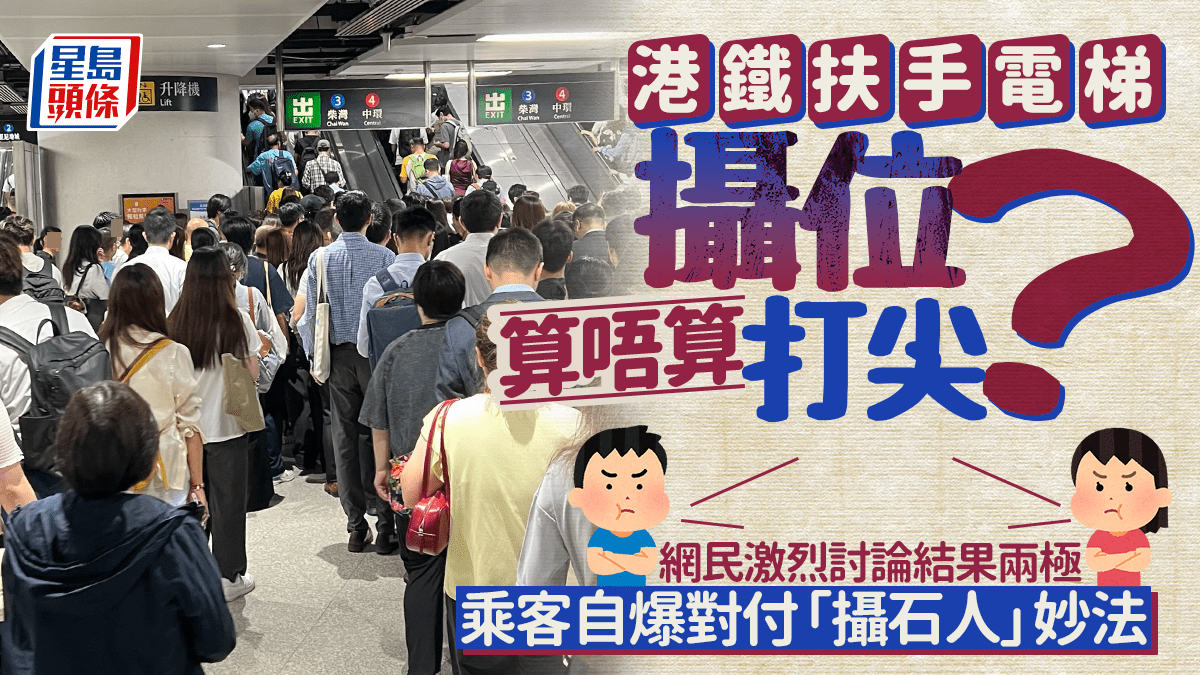
For millions of commuters in Hong Kong, the daily journey through the Mass Transit Railway (MTR) system is a masterclass in urban efficiency. In a city where seconds matter and passenger density is among the highest in the world, a set of unwritten social contracts governs how people move through stations. However, a recent viral debate has exposed a rift in these social norms, centering on a controversial habit known as “spot-saving” on escalators.
The controversy revolves around the practice of passengers intentionally leaving gaps or positioning themselves to “reserve” space for friends or colleagues who are slightly behind them in the queue. To some, this is a harmless gesture of camaraderie; to others, it is a blatant form of “queue jumping” (known locally as da jin) that disrupts the flow of traffic and infringes on the rights of other commuters.
As the discussion trends across social media platforms, it has sparked a wider conversation about the evolution of public etiquette in one of the world’s most crowded metropolises. The tension highlights a clash between personal loyalty and the collective efficiency that the Mass Transit Railway (MTR) system relies upon to move millions of people daily.
The Mechanics of ‘Spot-Saving’
In the context of the Hong Kong MTR, “spot-saving” occurs when a person reaches the escalator first but refuses to move forward or stand closely, instead creating a physical buffer to ensure their companion can stand directly beside or behind them. This often involves blocking the natural progression of the line, forcing subsequent passengers to wait or navigate around the “reserved” space.
Critics of the practice argue that the escalator is a first-come, first-served utility. By reserving a spot, the individual is effectively granting their friend a priority position they did not earn by waiting in line. In the high-pressure environment of a morning rush hour, where platforms can become dangerously overcrowded, these small disruptions can have a ripple effect, slowing down the boarding process and increasing frustration among passengers.
Conversely, defenders of the practice suggest that staying with a travel companion is a matter of convenience and social cohesion. They argue that as long as the delay is minimal, it should be viewed as a minor courtesy between friends rather than a violation of public order.
The ‘Stand Right, Walk Left’ Conflict
The debate over spot-saving is further complicated by the established “stand right, walk left” etiquette prevalent in Hong Kong. This system is designed to separate passive passengers from those in a hurry, maximizing the throughput of the escalator.

When a passenger attempts to save a spot, they often violate this fundamental rule. By standing in the middle or shifting their position to signal a “reserved” space, they block the left-hand lane used by those walking up or down. This transforms a social disagreement into a functional obstacle, directly impeding the movement of commuters who are adhering to the city’s efficiency standards.
For many Hong Kongers, the “walk left” rule is not merely a suggestion but a critical component of urban survival. When this rule is ignored for the sake of social convenience, it is often perceived as a lack of civic-mindedness, leading to the heated exchanges seen in recent online forums.
Netizen Reactions and ‘Counter-Strategies’
The online discourse has seen a sharp divide in opinions. On one side, a vocal group of commuters has expressed outrage, labeling spot-savers as selfish and demanding stricter adherence to queueing etiquette. Some users have gone as far as to describe the act as a psychological trigger for “commuter rage,” given the claustrophobic nature of the MTR during peak hours.
In response to these “spot-savers,” some passengers have shared their own methods for dealing with the situation. These range from the passive-aggressive—such as politely but firmly filling the gap before the friend arrives—to the more direct approach of reminding the individual that the escalator is a public space. These “counter-strategies” reflect a growing intolerance for behaviors that are perceived to undermine the collective efficiency of the transit system.
Interestingly, this debate mirrors similar tensions found in other global hubs like Tokyo or London, where the balance between individual desire and public duty is constantly negotiated in shared spaces. In Hong Kong, where the MTR is the principal mode of railway transportation, these tensions are magnified by the sheer scale of ridership.
The Broader Context of Hong Kong’s ‘Civilized City’ Image
The debate over escalator etiquette is a microcosm of a larger discussion regarding Hong Kong’s identity as a “civilized” and orderly city. The city is often praised by visitors for its systemic organization and the discipline of its citizens. However, as social dynamics shift and the pressures of urban living increase, these standards are frequently tested.

The MTR system, which integrates various lines including the Kwun Tong, Tsuen Wan, and Island lines, serves as the circulatory system of the city. Any disruption to this flow—whether it is a technical fault or a social faux pas—is felt immediately across the urban landscape. The “spot-saving” controversy suggests that while the infrastructure is world-class, the “social infrastructure” of etiquette is subject to constant renegotiation.
While the MTR Corporation provides official maps and layout guidance to help passengers navigate stations efficiently, it rarely issues mandates on the minutiae of social etiquette, such as spot-saving. Instead, these norms are enforced through social pressure and the shared expectation of mutual respect among commuters.
Key Takeaways on MTR Etiquette
- The Core Conflict: “Spot-saving” is viewed by some as a friendly gesture and by others as a form of queue jumping that disrupts public flow.
- Efficiency Impact: Blocking the “walk left” lane to save a spot creates functional delays for other passengers.
- Social Norms: The debate highlights the high value Hong Kong society places on efficiency and civic discipline in public spaces.
- Commuter Response: There is a growing trend of passengers actively discouraging spot-saving to maintain the integrity of the queue.
As Hong Kong continues to evolve, the tension between personal convenience and public courtesy will likely persist. For now, the consensus among the majority of commuters remains clear: in a city that moves as fast as Hong Kong, the most “civilized” act is to keep the line moving.
There are currently no official policy changes announced by the MTR Corporation regarding escalator queuing, meaning the resolution of this debate remains in the hands of the passengers themselves.
Do you think saving a spot on an escalator is acceptable, or is it a breach of public etiquette? Share your thoughts in the comments below.