The Enduring Legacy of Mudéjar Architecture in Aragón, Spain
Aragón, a region in northeastern Spain, stands as a remarkable testament to a unique cultural fusion. It’s a place where the architectural style known as Mudéjar—born from the coexistence of Muslim and Christian cultures following the Reconquista—has reached a particularly distinctive and recognizable form. This isn’t a matter of isolated examples; rather, over a hundred monuments, primarily churches, towers, palaces, and former monasteries, dot the landscapes of the Ebro, Jalón, and Jiloca valleys, shaping the urban character of cities like Zaragoza and Teruel, as well as smaller towns where brick, plaster, ceramics, and wood define the historic centers. The artistry and historical significance of this architectural heritage led UNESCO to recognize it as a World Heritage site, initially focusing on Teruel in 1986, and later extending the designation to other prominent monuments in the community in 2001.
The term ‘Mudéjar’ originally referred to Muslims who remained in Christian territories after the Reconquista, the centuries-long process by which Christian kingdoms reclaimed the Iberian Peninsula from Muslim rule. The architecture that bears this name is a direct result of this coexistence, blending Islamic techniques and forms with buildings commissioned by Christian society. This unique synthesis created a style that is both distinctly Iberian and demonstrably influenced by Islamic artistic traditions. The Mudéjar style in Aragón isn’t simply an imitation of Islamic architecture; it’s a creative adaptation, incorporating local materials and responding to the specific needs and aesthetic preferences of the Christian patrons.
A History Rooted in Cultural Exchange
The origins of Aragonese Mudéjar architecture can be traced back to the 12th century, a period marked by complex political and social conditions in Spain. Following the Reconquista, a significant Muslim population remained in Christian lands, continuing their traditional crafts and building techniques. This presence, coupled with a relative scarcity of stone as a building material in many parts of Aragón, led to the widespread use of brick, plaster, and ceramics – materials readily available and easily worked. The early manifestations of the style emerged in two distinct areas: royal palaces, notably the Aljafería in Zaragoza, and vernacular architecture, particularly in churches.
The Aljafería Palace, originally built in the 11th and 12th centuries by the Banu Hud dynasty, served as a crucial point of departure. Christian monarchs, upon taking control of the palace, continued to expand and renovate it, preserving the Islamic ornamental traditions and employing Muslim artisans – known as ‘alarifes’ – in the process. UNESCO notes that this palace exemplifies the initial integration of Islamic artistic elements into Christian structures. Simultaneously, a more popular form of Mudéjar architecture began to develop, influenced by the Romanesque style but utilizing brick instead of stone masonry, often incorporating intricate geometric patterns derived from Islamic art. Examples of this early brickwork can be seen in churches in Daroca, which were initially constructed in stone but later completed with Mudéjar brickwork in the 13th century.
Key Characteristics of Aragonese Mudéjar
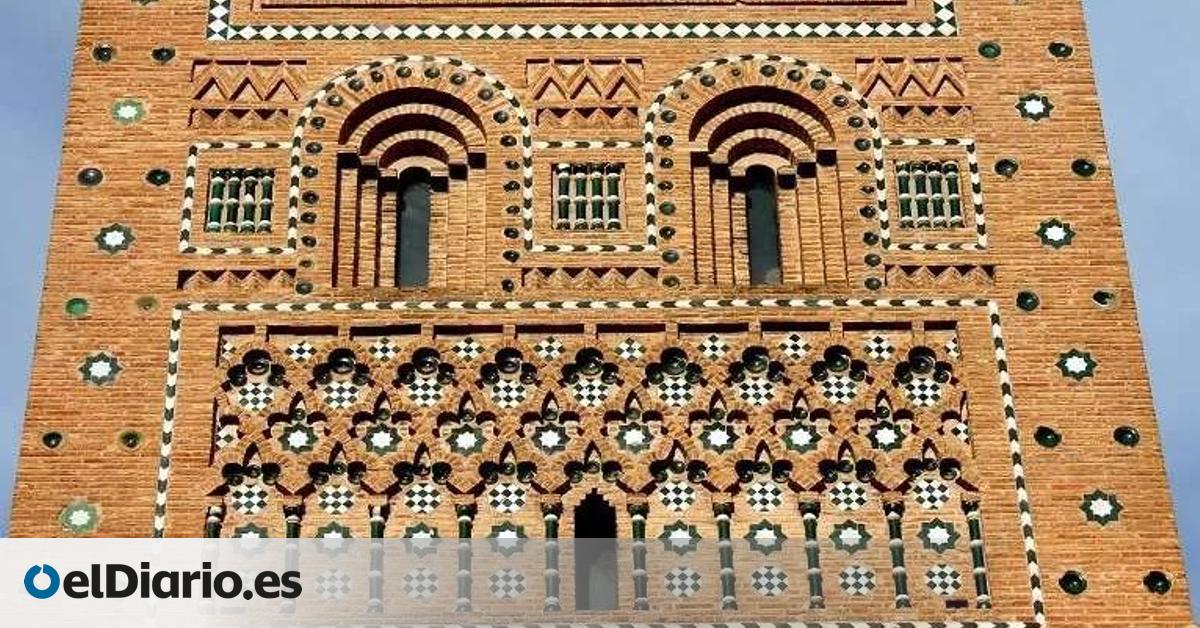
Aragonese Mudéjar architecture is characterized by a distinctive aesthetic that sets it apart from other Mudéjar styles found in Spain. Although sharing common roots in Islamic art, the Aragonese variant developed unique features. The use of brick as the primary building material is paramount, often laid in elaborate geometric patterns and traceries. These patterns, inspired by Hispano-Islamic traditions, adorn facades, towers, and interior spaces. Plasterwork, known as ‘yeserías’, is another defining element, featuring intricate carvings and decorative motifs. Ceramic tiles, known as ‘azulejos’, are frequently used to add color and detail, particularly in decorative bands and panels.
Towers are a particularly prominent feature of Aragonese Mudéjar architecture. These towers, often associated with churches, are typically constructed of brick and adorned with elaborate geometric patterns. The towers of Teruel are particularly renowned for their intricate brickwork and decorative details. Beyond towers, the style is also evident in the decorative elements of church ceilings, doorways, and windows. The use of wooden ceilings, often intricately carved and painted, is another characteristic feature. The combination of these elements creates a visually striking and harmonious aesthetic that reflects the cultural exchange at the heart of the Mudéjar style.
UNESCO Recognition and Notable Sites
The exceptional quality and coherence of Aragonese Mudéjar architecture led to its recognition by UNESCO in 1986, with the initial designation focusing on the Mudéjar structures of Teruel. This recognition highlighted the importance of the style as a unique expression of cultural interaction and artistic innovation. In 2001, the UNESCO World Heritage designation was expanded to include other significant monuments throughout the Aragón region. According to Wikipedia, this expansion acknowledged the widespread presence and enduring legacy of the Mudéjar style across the region.
Several sites exemplify the beauty and diversity of Aragonese Mudéjar architecture. The towers of El Salvador in Teruel are perhaps the most iconic example, showcasing the intricate brickwork and decorative details that define the style. The Aljafería Palace in Zaragoza, with its blend of Islamic and Christian architectural elements, provides a glimpse into the origins of the style. Other notable sites include the church of Santa María in Albarracín, the collegiate church of Santa María la Mayor in Alquézar, and numerous churches and towers scattered throughout the valleys of the Ebro, Jalón, and Jiloca. The website ARAGONMUDEJAR.COM provides a comprehensive catalog of Mudéjar monuments across the region, organized by locality, offering a valuable resource for exploring this architectural heritage.
Preserving a Cultural Treasure
The preservation of Aragonese Mudéjar architecture is crucial for safeguarding a unique cultural legacy. Ongoing conservation efforts are essential to protect these monuments from the effects of time, weather, and human activity. These efforts involve careful restoration work, utilizing traditional techniques and materials to maintain the authenticity of the structures. Raising awareness about the importance of Mudéjar architecture is also vital, encouraging both local communities and international visitors to appreciate and support its preservation.
The Mudéjar style in Aragón represents a remarkable chapter in Spanish history, a testament to the power of cultural exchange and artistic innovation. Its enduring legacy continues to inspire and captivate, offering a glimpse into a past where different cultures coexisted and created something truly extraordinary. As tourism to the region grows, the continued preservation of these architectural treasures will be essential to ensure that future generations can experience the beauty and significance of Aragonese Mudéjar architecture.
Looking ahead, ongoing research and documentation of these monuments will be crucial for understanding their historical context and ensuring their long-term preservation. The Aragón region continues to invest in the conservation and promotion of its Mudéjar heritage, recognizing its importance as a cultural and economic asset. Further exploration of this architectural style promises to reveal even more about the rich history and artistic traditions of Aragón.
What are your thoughts on the architectural fusion of cultures? Share your comments below and help us spread awareness of this unique heritage!
Related reading