
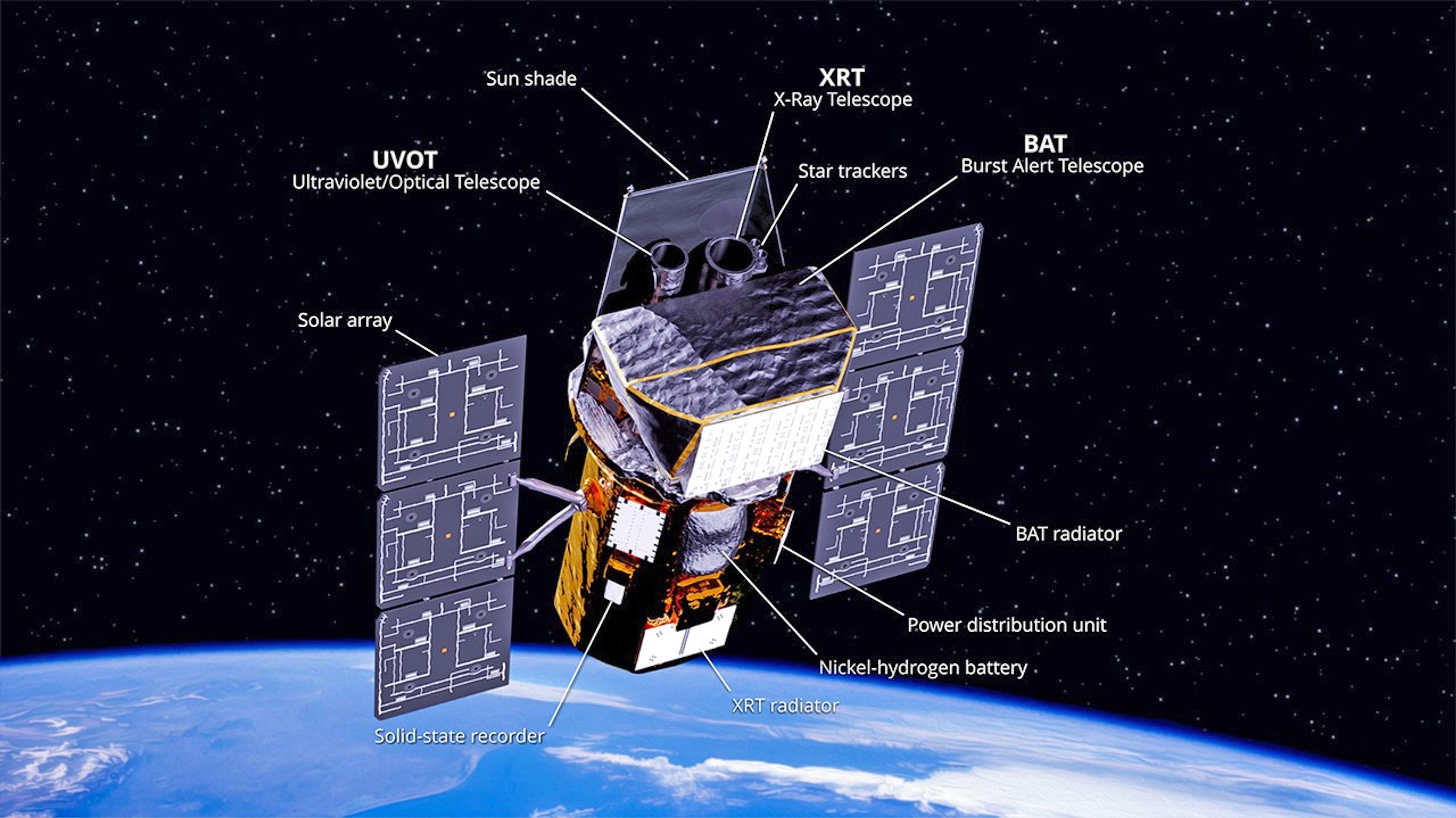
NASA is coordinating efforts to stabilize the orbit of the Neil Gehrels Swift Observatory to prevent the telescope from prematurely re-entering Earth’s atmosphere, according to official mission updates. The space-based observatory, which detects gamma-ray bursts and other high-energy transients, has experienced orbital decay due to atmospheric drag, prompting the agency to implement maneuvers to extend its operational lifespan.
The Neil Gehrels Swift Observatory operates in a low Earth orbit (LEO), making it susceptible to the thin layers of the upper atmosphere. When solar activity increases, the atmosphere expands, increasing the drag on the spacecraft and causing its altitude to drop. According to NASA, maintaining the telescope’s altitude is critical to ensure it continues providing data on cosmic explosions and black holes without risking an uncontrolled descent.
This orbit-raising effort is part of a broader strategy to preserve the mission’s capability to alert ground-based telescopes to transient events in real-time. If the orbit continues to decay, the telescope would eventually burn up upon re-entry, ending its primary scientific mission prematurely.
How does NASA prevent the Swift telescope from falling?
To counteract orbital decay, NASA utilizes the spacecraft’s onboard propulsion system to perform “orbit-raising” maneuvers. These maneuvers involve firing thrusters to increase the telescope’s velocity, which pushes the spacecraft into a higher, more stable orbit. According to NASA’s mission documentation, these burns are carefully timed to optimize fuel consumption while maximizing the altitude gain.

The process is a constant battle against atmospheric drag. During periods of high solar activity, the Earth’s thermosphere heats up and expands, creating more friction for objects in low Earth orbit. This phenomenon, known as atmospheric drag, effectively “slows down” the satellite, causing it to spiral inward toward Earth. By executing periodic burns, NASA engineers can offset this drag and keep the observatory in its designated operational zone.
Why is the Swift Observatory critical for science?
The Swift Observatory is uniquely designed to detect and locate gamma-ray bursts (GRBs)—the most powerful explosions in the universe—within seconds of their occurrence. According to the Swift mission page, the telescope employs three instruments: the Burst Alert Gamma-Ray Burst Detector, the X-ray Telescope, and the Ultraviolet/Optical Telescope.

The mission’s primary value lies in its speed. Once the gamma-ray detector identifies a burst, the spacecraft autonomously slews to point its other telescopes at the source. This allows astronomers to study the “afterglow” of the burst across different wavelengths of light, providing data on the distance and nature of the event. This capability has allowed scientists to study the early universe and the formation of the first stars.
The loss of Swift would create a significant gap in the global astronomical network. While other telescopes exist, Swift’s ability to rapidly respond to transients makes it the primary “trigger” for many other observatories worldwide. A premature end to the mission would limit the community’s ability to capture the immediate aftermath of cosmic events.
What are the risks of orbital decay for satellites?
Orbital decay is a natural process for any object in low Earth orbit, but it becomes a critical risk when a satellite lacks sufficient fuel or propulsion to maintain its height. When a satellite’s altitude drops below a certain threshold, the atmospheric density becomes high enough to cause rapid deceleration. This leads to a “re-entry” phase where the object enters the denser parts of the atmosphere at extreme speeds.
Most satellites, including the Swift Observatory, are designed to burn up during re-entry due to the intense heat generated by friction. However, larger components can occasionally survive and reach the surface. To mitigate this, space agencies track “debris” and calculate re-entry windows to ensure that any surviving fragments do not pose a risk to populated areas.
The current mission to save Swift is a proactive measure. By raising the orbit now, NASA avoids the uncertainty of a natural decay timeline and ensures the telescope remains a viable scientific tool for as long as its fuel reserves allow.
Comparing the impact of solar cycles on orbit stability
The stability of the Swift orbit is closely tied to the 11-year solar cycle. During solar maximum—the period of peak magnetic activity—the Sun emits more extreme ultraviolet radiation, which heats the Earth’s upper atmosphere. This causes the atmosphere to expand outward, increasing the density of the air at the altitude where Swift orbits.
| Solar Phase | Atmospheric Effect | Impact on Swift Orbit |
|---|---|---|
| Solar Minimum | Contracted thermosphere; lower density | Lower drag; slower orbital decay |
| Solar Maximum | Expanded thermosphere; higher density | Increased drag; accelerated decay |
This cyclical pressure means that NASA must adjust the frequency and intensity of its orbit-raising maneuvers based on the current state of the Sun. As the current solar cycle progresses toward its peak, the demand for these corrective burns is expected to increase.
What happens if the rescue maneuvers fail?
If the propulsion system fails or fuel is exhausted, the Swift Observatory will eventually follow a predictable path of orbital decay. According to standard aerospace protocols, the agency would then transition the mission from “operational” to “deorbit” status. This involves ensuring the spacecraft is in a stable orientation to maximize the likelihood that it burns up completely in the atmosphere.

While the scientific community would lose a vital tool, the primary concern for NASA during an uncontrolled re-entry is public safety. The agency uses the Orbital Debris Program Office to monitor the trajectory of decaying objects to predict the landing zone of any surviving debris.
Current reports indicate that the rescue maneuvers are the priority to avoid this scenario and extend the telescope’s ability to monitor the high-energy universe. The mission continues to operate and provide data while these orbital adjustments are managed.
NASA will continue to provide updates on the telescope’s altitude and the success of subsequent orbit-raising burns via its official mission portals. Readers can monitor the latest astronomical alerts and mission status on the official Swift observatory website.
Do you follow the tracking of space debris or the latest in gamma-ray research? Share your thoughts in the comments below.