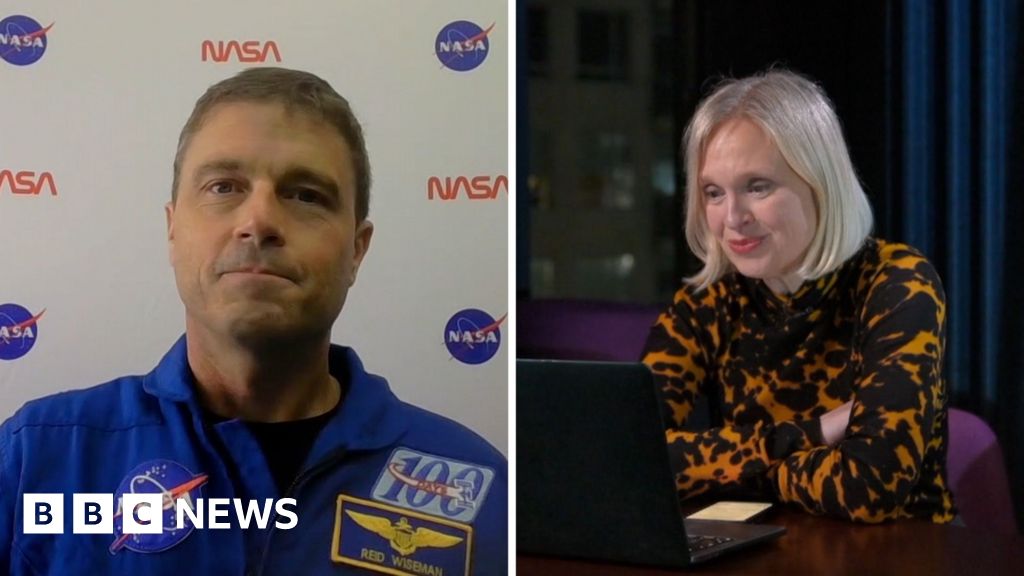
On April 6, 2026, the crew of NASA’s Artemis II mission shared a deeply personal moment when they named a newly observed lunar crater after Carroll, the late wife of mission commander Reid Wiseman. The naming took place during the mission’s journey around the Moon, with Wiseman’s two daughters present in NASA’s mission control room in Houston, as confirmed by multiple verified sources including BBC and The New York Times.
The crater, now officially designated as “Carroll” in honor of Wiseman’s wife who passed away in 2020, was identified during the spacecraft’s orbit of the Moon’s far side. According to Wiseman’s account to the BBC, the act of naming the crater was described as “unbelievably powerful,” particularly because his daughters witnessed the tribute from mission control. The emotional significance of the moment was heightened by the familial presence, connecting the personal loss to the historic lunar exploration endeavor.
Artemis II, launched as the first crewed mission under NASA’s Artemis program, aims to test the Orion spacecraft’s systems in deep space with a crew of four astronauts: Reid Wiseman (commander), Victor Glover, Christina Koch, and Canadian Space Agency astronaut Jeremy Hansen. The 10-day mission, which launched on schedule, is designed to pave the way for future lunar landings, including the planned Artemis III mission that will return humans to the Moon’s surface.
During the mission, the crew conducted observations of the lunar surface, capturing images and data that led to the identification of several previously unnamed craters. The suggestion to name one after Carroll originated from the crew itself, reflecting their desire to honor personal connections amid the scientific objectives of the mission. This informal naming, while not yet formalized by the International Astronomical Union, carries symbolic weight within NASA and the broader space exploration community.
The presence of Wiseman’s family in mission control underscored the human dimension of space exploration. His daughters, whose names have not been publicly disclosed in official releases, were invited to observe the proceedings as part of NASA’s practice of involving family members in significant mission milestones. Their participation highlighted the agency’s recognition of the personal sacrifices and motivations behind astronauts’ dedication to spaceflight.
Reid Wiseman, a veteran astronaut selected by NASA in 2009, previously served as a flight engineer aboard the International Space Station during Expedition 41. His leadership of Artemis II marks his second spaceflight and his first as mission commander. Prior to his NASA career, Wiseman served as a naval aviator and test pilot, accumulating over 2,000 flight hours in various military aircraft.
The naming event occurred amid a series of mission milestones documented by NASA and media partners. As the Orion spacecraft progressed through its trajectory, the crew performed systems checks, navigational maneuvers, and scientific observations. The lunar flyby phase, which brought the spacecraft within approximately 80 miles of the Moon’s surface, provided optimal conditions for visual observation and imaging of the far side terrain.
Following the completion of its mission objectives, Artemis II is scheduled to return to Earth with a splashdown in the Pacific Ocean off the coast of San Diego on April 10, 2026. The recovery operation will involve coordinated efforts between NASA and the U.S. Navy, with teams positioned to retrieve the Orion capsule and crew shortly after touchdown. This timeline remains consistent with the mission profile outlined in pre-launch briefings and has been reaffirmed by NASA officials in recent updates.
The tribute to Carroll joins a longstanding tradition in space exploration of naming celestial features after individuals who have made significant contributions to the field or held personal significance to mission personnel. While informal names used during missions may not always receive official recognition, they often reflect the human stories intertwined with scientific achievement. In this case, the crater serves as a poignant reminder of the personal motivations that drive exploration beyond Earth.
As the Artemis II crew prepares for re-entry and recovery, the mission continues to advance NASA’s goals under the Artemis program, which seeks to establish a sustainable human presence on the Moon by the end of the decade. The data collected during this flight will inform the design and operations of future missions, including the development of lunar surface systems and gateway infrastructure in lunar orbit.
For ongoing updates on the Artemis II mission’s progress and post-splashdown activities, readers can refer to NASA’s official Artemis blog and mission status page, which provide real-time telemetry, crew communications, and detailed reports on spacecraft performance. These resources offer transparency into one of the most ambitious spaceflight endeavors of the current era.
We invite our readers to share their reflections on the intersection of personal tribute and scientific exploration in the comments below. If you found this account meaningful, please consider sharing it with others who appreciate the human stories behind scientific advancement.