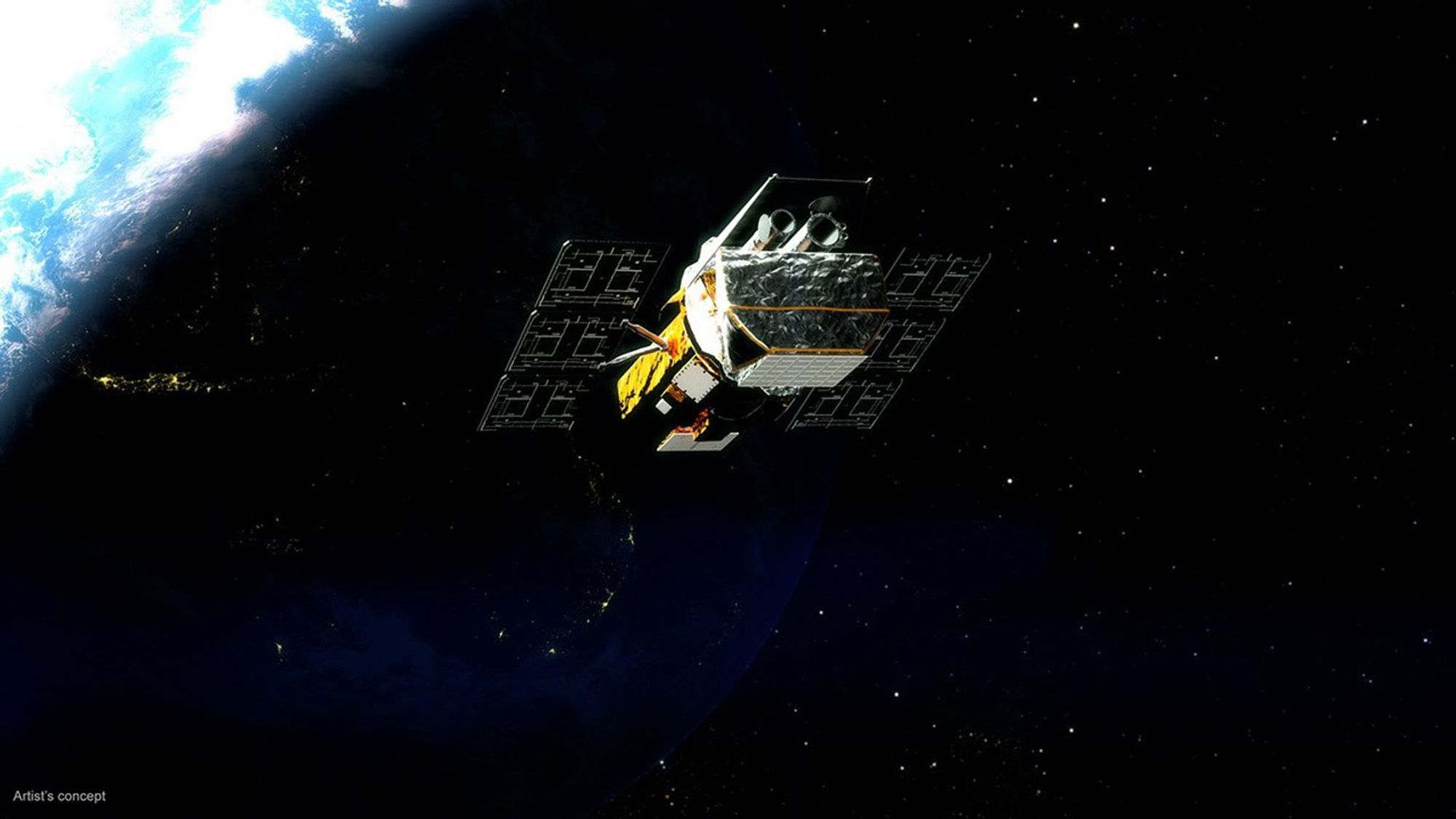
A private aerospace mission designed to rescue NASA’s aging Neil Gehrels Swift Observatory is facing its own orbital crisis after the interceptor spacecraft began spinning out of control weeks after launch. Katalyst Space, the private company behind the interceptor vehicle known as LINK, is scrambling to correct electrical power issues that crippled most of the spacecraft’s orientation control mechanisms. The unexpected spin threatens to delay a critical rendezvous that must happen before the veteran gamma-ray hunting telescope falls back into Earth’s atmosphere this autumn.
Katalyst launched its LINK spacecraft on July 3, using a mid-air Northrop Grumman Pegasus XL rocket mounted aboard a modified Lockheed Martin L-1011 airliner. The entire vehicle moved from concept to liftoff in less than a year, aimed squarely at intercepting the nearly 22-year-old Neil Gehrels Swift Observatory. NASA leadership maintains that the schedule adjustments do not spell doom for the endeavor. “We are not giving up yet,” NASA administrator Jared Isaacman wrote late Thursday on X. “This remains a very cool, very low-cost, high-potential, high-reward mission, and another step toward a more autonomous future where missions like this routinely upgrade, repair, service, and boost satellites.”
Originally, LINK was scheduled to rendezvous with the legacy space telescope roughly one month after its early July liftoff. That timeline has now slipped. According to the latest mission projections, late August marks the earliest possible window for an approach. The delay stems from a sudden failure in the spacecraft’s reaction control system (RCS) wheels, which govern its orientation in space. Electrical power issues knocked out two of the three onboard RCS devices, leaving engineers with only a single operational wheel to manage the tumbling vehicle.
By late July, the unexpected rotation rate reached alarming levels before engineering teams intervened. Katalyst’s mission blog reported that ground operators commanded engine fires from the spacecraft to bleed off momentum, successfully dropping LINK’s rotation speed from nine degrees per second down to four degrees per second. “Over the last 48 hours, the Katalyst team has worked to reduce LINK’s rotation while assessing current spacecraft functionality and its control system,” Katalyst representatives stated in a project update.
The Race Against Atmospheric Drag and Orbital Decay
While the private rescue craft battles its stability issues, time is running out for the target observatory. The Neil Gehrels Swift Observatory must stay above a minimum rescue altitude of 185 miles, or 298 kilometers, for any orbital boost to succeed, according to agency flight models. For perspective, the International Space Station typically operates much higher at an altitude of about 250 miles, or 400 kilometers.

To prevent premature orbital decay from atmospheric drag during the active summer months, operators already trimmed the observatory’s routine science operations, putting the spacecraft into a streamlined configuration. If LINK cannot stabilize its attitude and execute an intercept by autumn, atmospheric drag will drag the telescope too low for any spacecraft to safely match orbits and provide assistance.
Despite the propulsion setbacks, NASA officials emphasize that the rescue vehicle’s remaining core subsystems continue to operate normally. “The spacecraft remains power positive and in communication with the Katalyst team,” NASA officials wrote in a Tuesday update. Once attitude control is fully restored and telemetry confirms the vehicle remains healthy, mission managers will evaluate revised plans to approach and capture Swift.
Preserving a Vital Multitool for Astrophysics
The mission targets an asset of immense scientific value to the international astronomical community. The Neil Gehrels Swift Observatory carries a historical price tag of $250 million from its 2004 launch, which translates to roughly $450 million today when adjusted for inflation. That investment remains modest compared to modern flagships like the $10 billion James Webb Space Telescope launched almost five years ago.
Swift was primarily engineered to detect gamma-ray bursts—massive explosions triggered when dying, massive stars collapse into black holes. Over more than two decades in orbit, the observatory expanded its portfolio to track supernovas, X-ray flares, comets, and passing asteroids. Researchers rely on its rapid-pointing capabilities to catch transient cosmic phenomena across a wide range of light spectra.
“Swift is NASA’s multitool when it comes to studying the cosmos,” S. Bradley Cenko, Swift’s principal investigator and an astrophysicist at NASA’s Goddard Space Flight Center, said in an agency statement. “It observes the sky using a wide range of light, and rapidly points at short-lived outbursts, alerting other facilities in space and on the ground to help coordinate follow-up observations.”
A successful docking by the Katalyst vehicle could refuel and reboost the legacy platform, extending its observational lifespan by years or even decades. As engineering teams in mission control work through the weekend to steady the drifting hardware, the astronomy community waits to see if private enterprise can pull off an orbital save.