
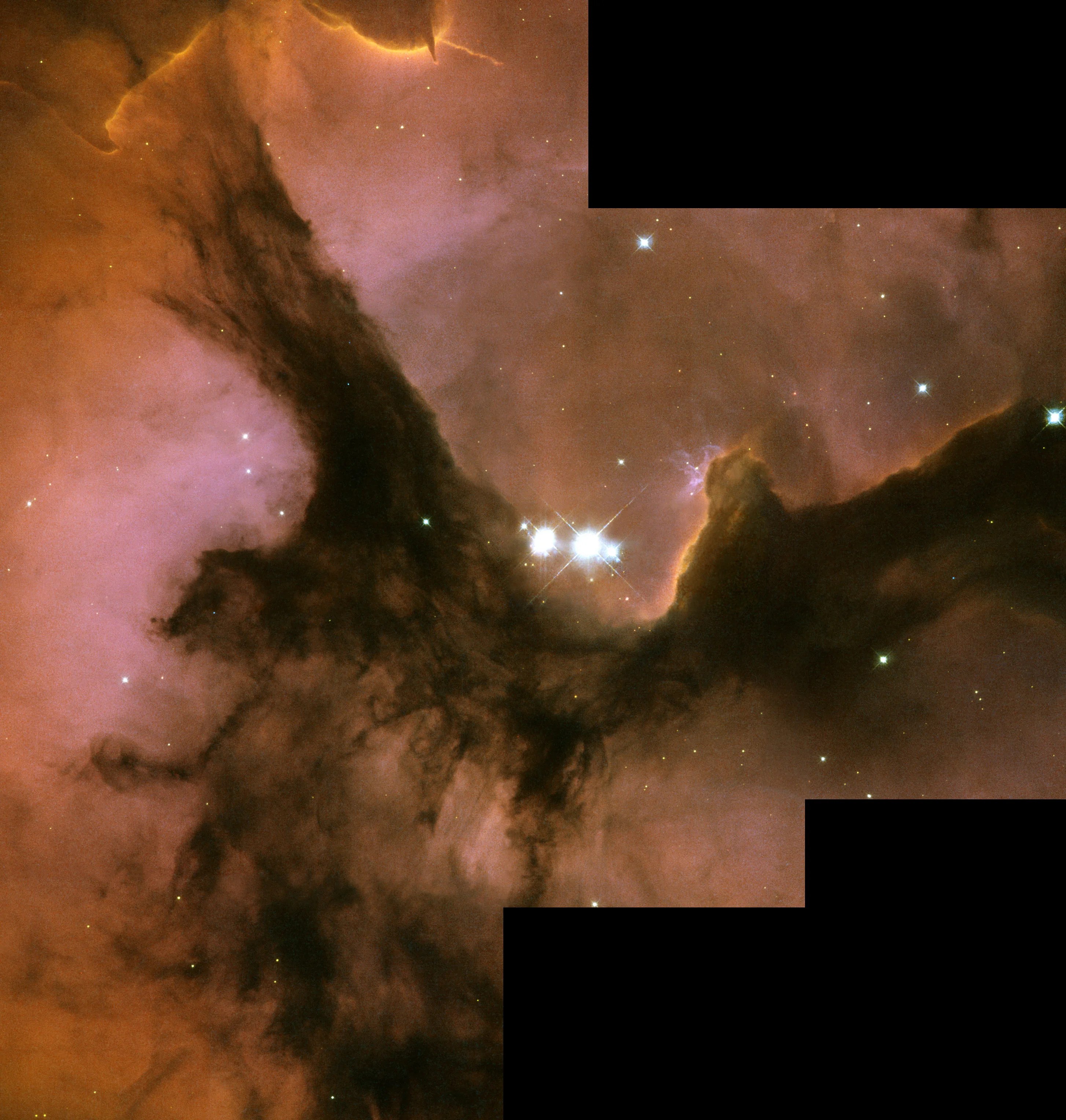
On April 20, 2026, NASA and the European Space Agency (ESA) released a new image of the Trifid Nebula captured by the Hubble Space Telescope to mark the observatory’s 36th anniversary since its launch on April 24, 1990. The image highlights a star-forming region approximately 5,000 light-years from Earth in the constellation Sagittarius, officially known as Messier 20 or M20. This latest observation builds on Hubble’s initial view of the same region taken in 1997, allowing scientists to study changes over nearly three decades.
The Trifid Nebula, whose name comes from the Latin word for “divided into three lobes,” is a dynamic cloud of gas and dust where new stars are born. The nebula’s distinctive appearance arises from three types of nebulae combined: an emission nebula (red, from ionized hydrogen), a reflection nebula (blue, from scattered starlight), and a dark nebula (obscuring dust lanes). The recent Hubble image focuses on a section resembling a marine creature, informally dubbed the “Cosmic Sea Lemon” due to its shape and coloration, which evokes a sea slug gliding through cosmic waters.
Massive stars located outside the camera’s field of view have shaped the Trifid Nebula for at least 300,000 years through their powerful stellar winds and ultraviolet radiation. These forces carve out a vast bubble within the nebula, compressing surrounding gas and dust and triggering new episodes of star formation. One feature visible in the image is Herbig-Haro 399, a jet of plasma ejected from a young protostar embedded in the nebula’s “head,” which appears to expand over time as observed by Hubble.
The 2026 image was made possible by Hubble’s advanced instrumentation, particularly the Wide Field Camera 3 installed during the fourth servicing mission in 2009. This upgrade provides a wider field of view and greater sensitivity compared to the instruments used in 1997, enabling more detailed observations of the nebula’s evolving structure. According to ESA, the side-by-side comparison of the 1997 and 2026 images demonstrates changes occurring on human timescales, a rare opportunity in astronomy where most processes unfold over millions of years.
Hubble’s 36th anniversary marks nearly four decades of continuous operation since its deployment by the Space Shuttle Discovery in 1990. Despite initial challenges with its primary mirror, the telescope has been serviced and upgraded five times by astronaut crews, extending its scientific lifespan far beyond the original 15-year design goal. As of 2026, Hubble remains a vital tool for astrophysics, contributing to discoveries ranging from exoplanet atmospheres to the acceleration of the universe’s expansion.
The Trifid Nebula observation underscores Hubble’s enduring role in monitoring cosmic change. By revisiting the same celestial objects over years or decades, astronomers can detect subtle shifts in star formation, jet dynamics, and nebular evolution. Such long-term studies are essential for understanding how stars and planetary systems emerge from interstellar clouds.
For the public, the anniversary image serves as both a scientific milestone and a visual invitation to wonder. The vivid colors and intricate structures visible in Hubble’s view of the Trifid Nebula illustrate the beauty and complexity of the Milky Way’s star-forming regions. As ESA noted in its release, the image “instills a sense of awe and wonder about our ever-changing Universe.”
Looking ahead, Hubble continues to operate alongside newer observatories like the James Webb Space Telescope, with complementary strengths in different wavelengths. While James Webb excels in infrared observations of early galaxies and protostars, Hubble’s ultraviolet and visible-light capabilities remain unmatched for studying hot stars, nebulae, and planetary atmospheres. Together, these telescopes provide a more complete picture of cosmic evolution.
The Space Telescope Science Institute in Baltimore, which manages Hubble’s science operations, confirmed that the telescope remains in good health and continues to schedule observations through a competitive peer-review process. No major technical issues have been reported that would impede its function in the near term.
As Hubble moves beyond its 36th year, each new image adds to a legacy of discovery that has transformed humanity’s understanding of the cosmos. The Trifid Nebula observation stands as a testament to the value of long-term astronomical monitoring and the enduring power of a single observatory to reveal the universe’s secrets across generations.
For more information about Hubble’s mission, latest images, and scientific findings, visit the official NASA Hubble website or the ESA Hubble portal.
We welcome your thoughts on this anniversary observation. Share your reflections in the comments below and aid spread awareness of Hubble’s ongoing contributions to science.