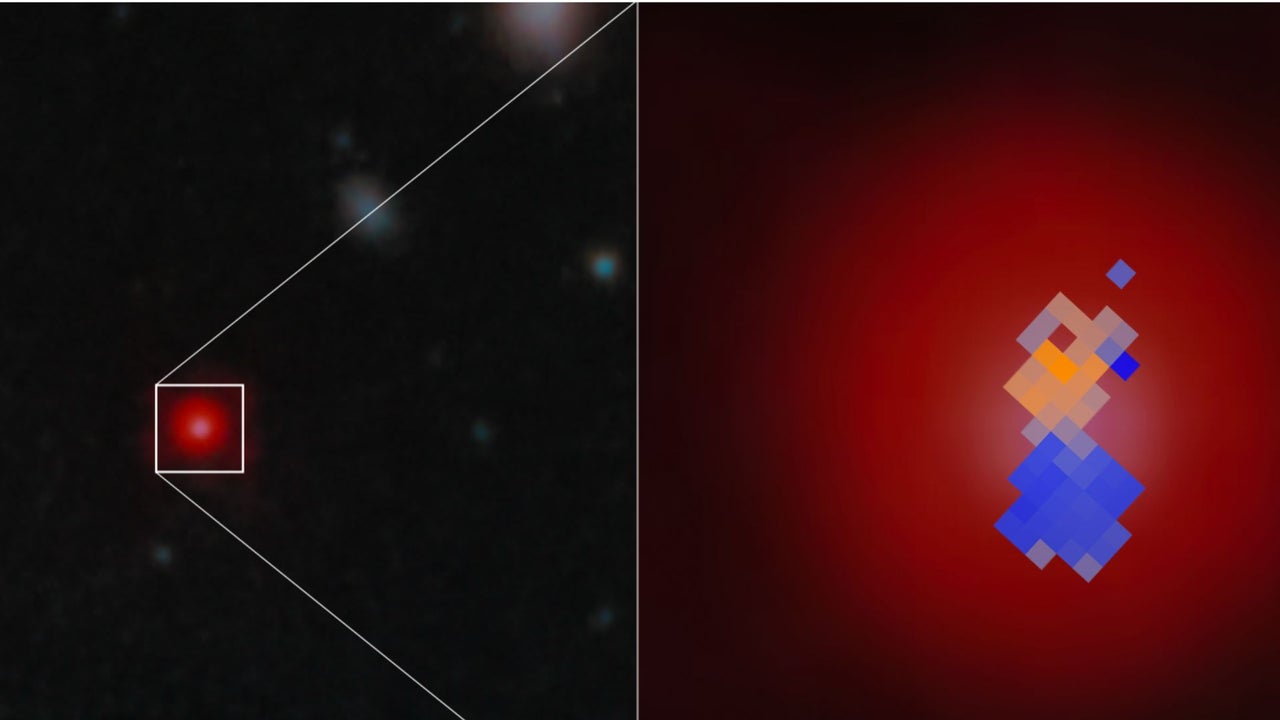
In the vast, silent expanse of the early universe, astronomers using the James Webb Space Telescope (JWST) have identified a phenomenon that challenges our fundamental understanding of cosmic evolution: a “little red dot” that appears to be a supermassive black hole existing in an era when it arguably shouldn’t exist. This discovery, centered on the galaxy GS-9209, has ignited a significant debate among astrophysicists regarding the timeline of galaxy formation and the growth of black holes.
For years, the prevailing model suggested that galaxies formed first, with black holes accumulating mass over billions of years at their centers. However, this observation, detailed in research published in Nature, suggests that some black holes may have reached gargantuan proportions far earlier than previously thought, potentially influencing the highly structure of their host galaxies. As we peer back over 12 billion years into the past, we are essentially rewriting the biography of the cosmos.
Challenging the Cosmic Timeline
The “little red dot”—a compact, intensely luminous object—was captured by the JWST’s Near-Infrared Spectrograph (NIRSpec). When researchers analyzed the light, they found that the galaxy GS-9209 had already ceased forming stars just 800 million years after the Big Bang. According to the National Aeronautics and Space Administration (NASA), the presence of such a massive, quiescent galaxy so early in the universe’s history is highly unexpected. Typically, galaxies in the early universe are teeming with star formation. a “dead” galaxy at this stage suggests that something—likely a supermassive black hole—halted the process.
This discovery provides a missing link in how we understand the “co-evolution” of galaxies and black holes. The black hole within GS-9209 is estimated to be approximately five times more massive than what would be predicted based on the stars within its galaxy. This disproportionate size implies that the black hole grew rapidly, releasing enough energy to blow away the gas required for new star formation, effectively “quenching” the galaxy early in its life.
The Physics of the “Impossible” Black Hole
The term “impossible” is often used in popular media to describe these findings, but for scientists, it represents an opportunity to refine the Standard Model of Cosmology. The direct measurement of the mass of these early black holes is a technical feat, made possible only by the JWST’s unprecedented infrared sensitivity. By measuring the velocity of gas clouds swirling around the black hole, researchers can calculate its gravitational pull and, its mass.
Recent studies, including findings published by the Monthly Notices of the Royal Astronomical Society, corroborate the idea that these “red dots” are not merely distant, dusty galaxies, but active galactic nuclei (AGN) powered by supermassive black holes. The red color is caused by the extreme redshift of the light, stretching as it travels across the expanding universe, combined with dust obscuration that filters out bluer wavelengths.
Why the “Little Red Dot” Matters
- Galaxy Quenching: It provides a potential mechanism for how galaxies stop growing, a process that has remained one of the biggest mysteries in extragalactic astronomy.
- Black Hole Seeding: It forces theorists to reconsider how black holes start. Did they form from the collapse of massive stars, or were there “direct collapse” black holes that formed from primordial gas clouds?
- Technological Validation: It proves that the JWST is capable of performing precise spectroscopy on objects that were previously considered too faint or too distant to study in detail.
Future Observations and Scientific Consensus
While the data from the JWST is robust, the scientific community is maintaining a cautious approach. Further observations are currently being scheduled to confirm these initial mass estimates and to look for similar objects in other regions of the sky. The goal is to determine whether GS-9209 is an outlier or if the early universe was populated by a significant number of these over-massive black holes.

NASA and its international partners, including the European Space Agency (ESA) and the Canadian Space Agency (CSA), continue to release data from the JWST’s ongoing deep-field surveys. As the telescope continues its mission, we expect to see more of these “red dots” analyzed, which will help create a statistical map of early black hole growth. You can track the latest updates and raw data releases through the official Webb Telescope portal.
The study of these cosmic giants is far from over. As we refine our instruments and our models, we move closer to solving the mystery of how the universe transitioned from a dark, gaseous soup to the complex, structured cosmos we inhabit today. The “little red dot” is not just a point of light; it is a signal from the dawn of time, waiting for us to decipher its story.
What are your thoughts on these findings? Does the idea of “impossible” black holes change how you view the history of our universe? Share your insights in the comments below, and stay tuned to World Today Journal for further developments on this unfolding story.
Related reading