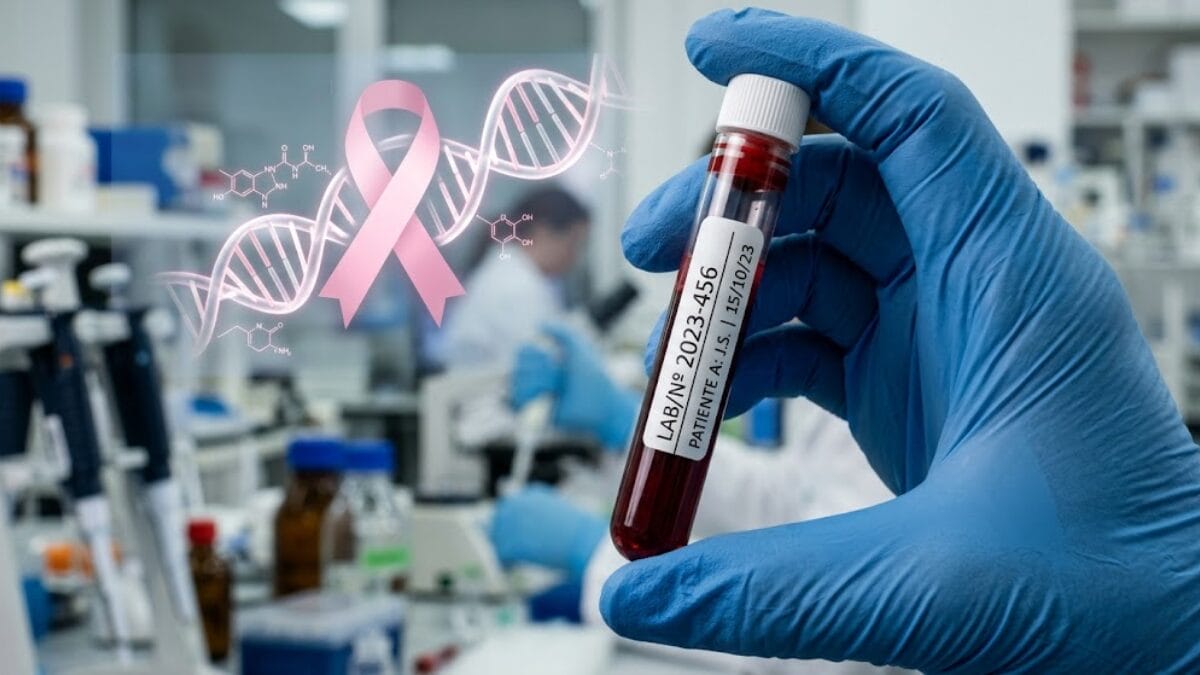
Early detection remains the most critical factor in surviving breast cancer, yet for millions of women in remote or underserved regions, the path to a timely diagnosis is often blocked by a lack of infrastructure. In a significant leap for medical innovation, Brazilian scientists have developed a blood test for early breast cancer detection that promises to bridge this gap by identifying the disease through a simple sample of blood.
The technology, known as RosalindTest®, was created through a decade of research involving the Faculdade de Medicina do ABC (FMABC) and the Brazilian biotech company LiqSci, which is part of the Sthorm deep tech ecosystem [Source]. By analyzing molecular signals and biomarkers tied to the metabolism of cancer cells, the test can identify the presence of tumors in the body without the immediate need for imaging equipment.
In initial clinical studies, the test demonstrated a precision of approximately 95% in identifying the disease during its early stages [Source]. This level of accuracy is particularly vital due to the fact that roughly 95% of breast cancer cases are curable when detected early, significantly reducing the need for invasive treatments and hospitalizations.
While the medical community emphasizes that this blood test is not a replacement for mammography, it serves as a powerful complementary tool. It allows health professionals to screen patients more broadly and quickly, directing those who test positive toward confirmatory imaging exams, even in areas where mammograms are not readily available.
The Science Behind RosalindTest®: Biomarkers and Metabolism
The core of the innovation lies in the study of cellular metabolism. According to Fernando Luiz Affonso Fonseca, a scientist-chief and co-founder of LiqSci, the team focused on the metabolic changes that occur within a cancer cell. By identifying specific biomarkers—biological molecules that signal the presence of a disease—the test can detect the “molecular footprint” of breast cancer in the bloodstream [Source].
This approach is designed to be less invasive than traditional biopsies and more accessible than high-tech imaging. Because the test relies on a standard blood collection, it can be performed by any health professional in the field, making it an ideal solution for “mutirões” (health drives) and rural clinics where medical infrastructure is limited.
the FMABC notes that the test has no known contraindications and can be administered to women of any age group [Source]. Here’s a critical development, as breast cancer is increasingly appearing in younger women, a demographic that often falls outside the standard screening age brackets for public health systems.
Addressing the Screening Gap in Brazil
The urgency for such a tool is underscored by the epidemiological reality in Brazil. The Instituto Nacional de Câncer (Inca) estimates that approximately 20,000 women die from breast cancer annually in the country, making it the third deadliest type of cancer in Brazil [Source]. Looking forward, some projections suggest that global cases of breast cancer could reach 3.5 million per year by 2050 [Source].
In Brazil, the Unified Health System (SUS) generally recommends screening for women aged 50 to 69. While the Ministry of Health expanded access to mammography for women starting at age 40 in 2025 (subject to medical evaluation), the disparity in access remains a hurdle [Source]. Many women in remote regions only receive a diagnosis in advanced stages, where the chances of cure are significantly lower.
The RosalindTest® aims to decentralize this process. By allowing a professional to collect blood in the field and send it for analysis, the system can identify high-risk patients who must be prioritized for mammography, effectively optimizing the use of limited imaging resources in the public sector.
Path to Public Access and the SUS
Currently, the blood test is not being sold directly to individual consumers. Instead, it is being implemented through health drives organized by private companies, operating under the regulations of Anvisa, the Brazilian Health Regulatory Agency [Source].
The ultimate goal of the developers, including LiqSci co-founder Thiago Sakamoto, is the full integration of the test into the SUS. This would ensure that the entire population, regardless of socioeconomic status or location, has access to early molecular screening [Source].
Key Takeaways of the RosalindTest®
- High Precision: Approximately 95% accuracy in detecting breast cancer in early stages [Source].
- Non-Invasive: Requires only a small blood sample, making it accessible for all age groups.
- Complementary Tool: Does not replace mammograms but identifies who needs them urgently.
- Logistical Advantage: Can be collected in the field by any health professional, aiding remote areas.
- Future Integration: Currently in testing and private drives, with the goal of joining the SUS public health system.
What This Means for Global Public Health
From a public health perspective, the shift toward “liquid biopsies”—tests that detect cancer markers in blood—represents a paradigm shift in oncology. The ability to screen populations without requiring expensive, stationary machinery like mammography units could save countless lives in developing nations.
The impact is twofold: it reduces the psychological and physical burden on the patient by providing a less invasive first step, and it reduces the economic burden on healthcare systems by catching the disease when it is most treatable. When 95% of early-detected cases are curable, the cost-benefit of widespread screening becomes undeniable [Source].
As the test continues its rollout through Anvisa-regulated drives, the next critical milestone will be its official adoption by the Brazilian government for nationwide use within the SUS. This transition will determine how quickly the technology can move from a clinical success to a public health reality.
For those seeking more information on breast cancer screening guidelines, it is recommended to consult official health portals such as the Ministry of Health or the Instituto Nacional de Câncer (Inca).
Do you believe blood-based screening should be the first line of defense in cancer detection? Share your thoughts in the comments below and share this article with others who may benefit from this medical update.
Worth a look