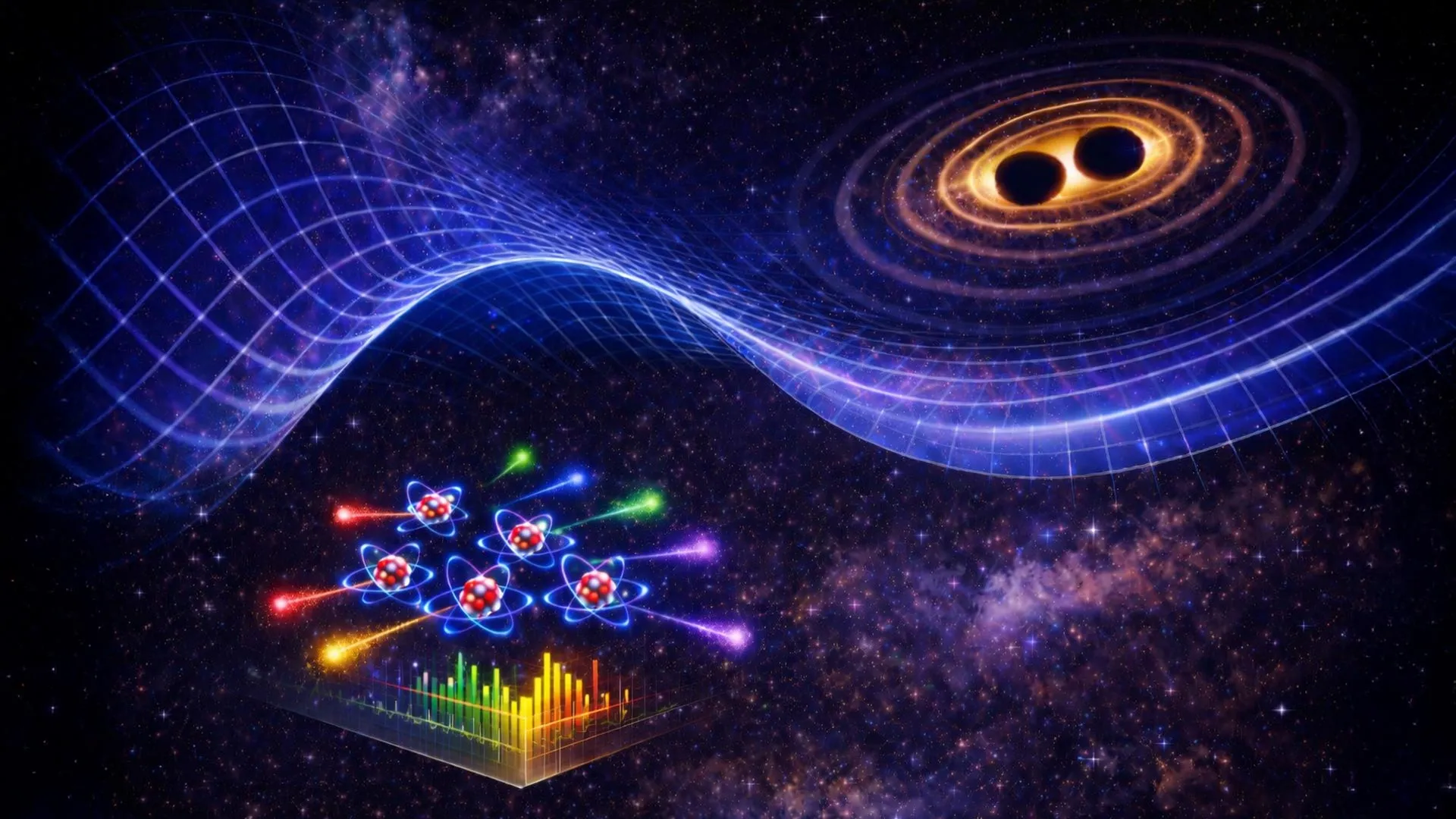
For decades, the hunt for gravitational waves—those elusive ripples in the fabric of spacetime—has required some of the largest machines ever built by humans. To catch a glimpse of these cosmic tremors, scientists have relied on massive interferometers that stretch for kilometers to measure the tiniest changes in distance. Still, a new theoretical breakthrough suggests we might uncover these signals in a much smaller, more unexpected place: the light emitted by single atoms.
Researchers from Stockholm University, Nordita, and the University of Tübingen have proposed a method to detect gravitational waves by observing how they alter the frequency of light during spontaneous emission. This unconventional approach shifts the focus from measuring distance to analyzing the “color” or frequency of photons, potentially opening the door to ultra-compact detectors that could fit in a fraction of the space required by current observatories.
The study, which has been accepted for publication in Physical Review Letters, suggests that gravitational waves exit a distinct imprint on the quantum electromagnetic field. By tracking how this field modulates the light atoms release, scientists may be able to identify the direction and polarization of cosmic waves without the need for kilometer-scale infrastructure.
How Gravitational Waves Alter Atomic Light
To understand this discovery, one must first look at the process of spontaneous emission. When an atom absorbs energy, it enters an excited state. Because atoms do not stay excited for long, they quickly return to a lower energy state by releasing a photon of light at a specific frequency. This process is governed by the atom’s interaction with the quantum electromagnetic field.
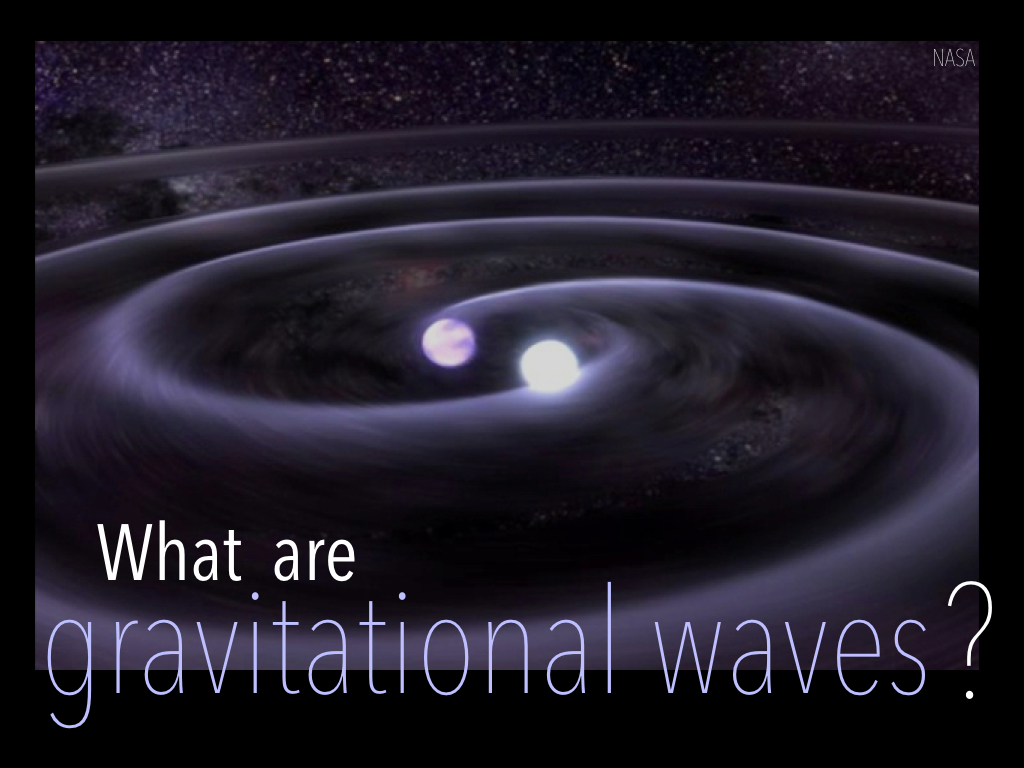
According to Jerzy Paczos, a PhD student at Stockholm University, gravitational waves modulate this quantum field, which in turn affects how the atom emits light. “Gravitational waves modulate the quantum field, which in turn affects spontaneous emission,” Paczos explained. This interaction causes the frequencies of the emitted photons to shift compared to a scenario where no gravitational wave is present.
A critical aspect of this phenomenon is that the gravitational waves do not change the overall rate at which atoms emit light. Because the total amount of light remains constant, the effect has gone unnoticed until now. Instead, the impact is directional. The waves cause the photon frequencies to vary depending on the direction of emission, creating a directional spectral pattern that encodes the wave’s specific characteristics.
The Potential for Ultra-Compact Detectors
The current gold standard for detecting gravitational waves involves measuring the distance between mirrors with extreme precision. While successful, these instruments are immense and expensive to maintain. The proposal by the team at Stockholm University and its partners offers a theoretical path toward much smaller hardware.
The researchers highlight cold-atom systems as a particularly promising testbed for this technology. In these systems, atoms are cooled to temperatures near absolute zero, which reduces thermal noise and allows for more precise measurements. Specifically, the team notes that narrow optical transitions—the kind used in high-precision atomic-clock platforms—offer long interaction times, which could make the subtle frequency shifts of gravitational waves easier to detect.
If the theory is experimentally confirmed, it could lead to the development of detectors that are significantly more compact than existing facilities. This would not only reduce the cost and scale of gravitational wave research but could also allow for new types of observatories capable of targeting low-frequency gravitational waves, which are a primary goal for future space-based missions.
Bridging Theory and Experimental Reality
While the mathematical framework for this detection method is now established in the Physical Review Letters study, the transition to a physical device is still in the future. The researchers acknowledge that the approach has not yet been tested experimentally. The challenge lies in the extreme precision required to isolate the frequency shifts caused by gravitational waves from other environmental noise.
The team uses a music player analogy to describe the effect: the atoms emit light like a steady tone, but a gravitational wave changes how that note sounds depending on which direction you are listening from. By mapping these “notes” across different directions, scientists could theoretically reconstruct the properties of the cosmic event—such as the merging of black holes—that created the ripple in spacetime.
Key Technical Summary
| Feature | Traditional Detection | Proposed Atomic Detection |
|---|---|---|
| Measurement Metric | Changes in distance (interferometry) | Changes in photon frequency (spectral shift) |
| Scale | Kilometer-scale instruments | Potential for ultra-compact cold-atom systems |
| Mechanism | Spacetime stretching/squeezing | Modulation of the quantum electromagnetic field |
| Key Signature | Phase shift in laser light | Direction-dependent emission spectrum |
As the scientific community looks toward the next generation of space-based observatories, this theoretical shift toward atomic-scale detection could redefine how we listen to the universe. For now, the focus remains on moving this research from the pages of theoretical physics into a laboratory setting to see if these “hidden” signatures can be captured in real-time.
The next major milestone for this research will be the development and execution of an experimental demonstration to verify these theoretical predictions. We will continue to monitor updates from Stockholm University and the University of Tübingen as they move toward testing this system.
Do you think atomic-scale detectors will eventually replace massive interferometers, or will they serve as complementary tools? Share your thoughts in the comments below.
Related reading