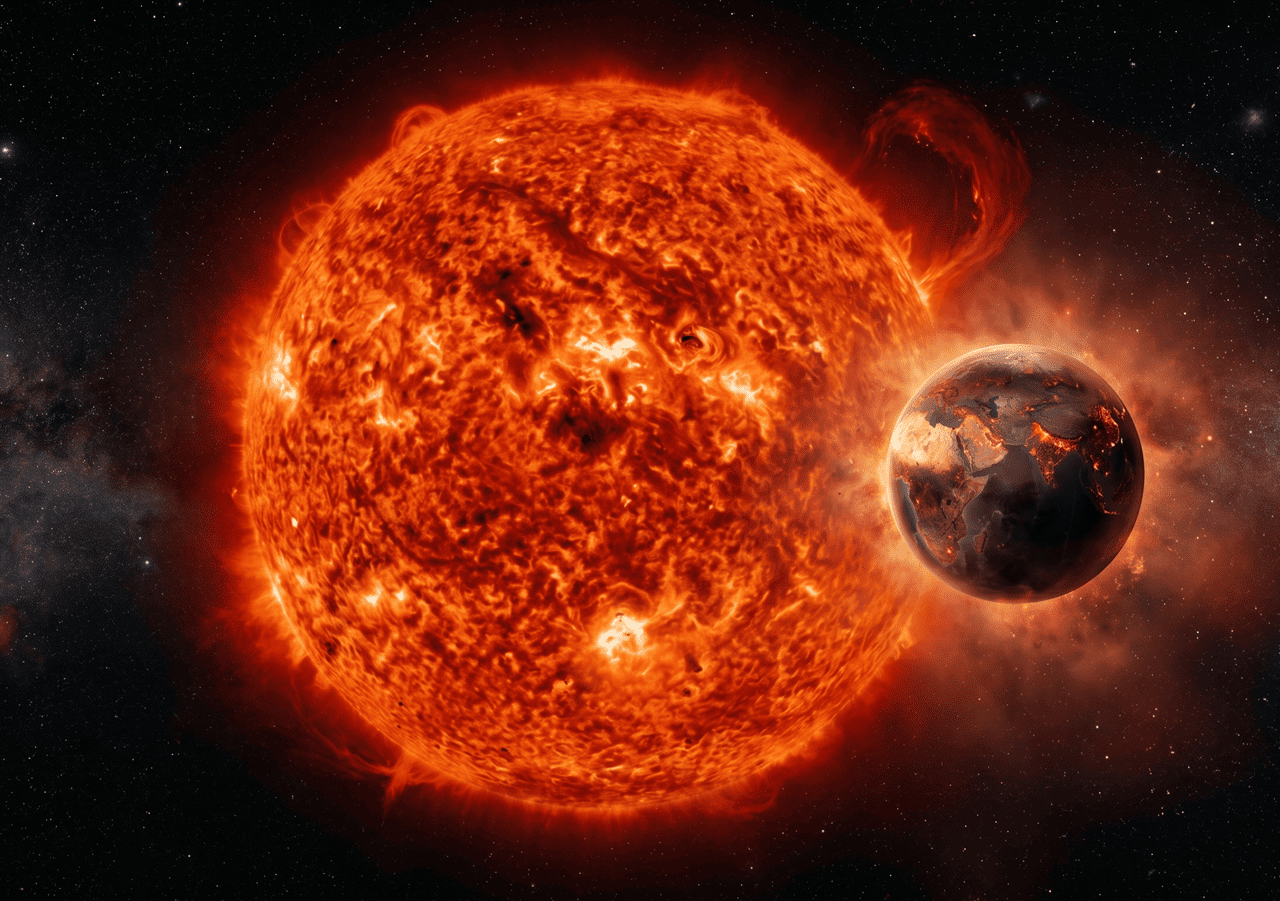
Earth may avoid being consumed by the Sun during its final red giant phase, according to a revised stellar evolution model published by a team of international astrophysicists. While long-standing scientific consensus suggested that the Sun’s expansion would inevitably engulf the inner planets—Mercury, Venus, and potentially Earth—nearly 5 billion years from now, recent calculations regarding solar mass loss suggest a more complex orbital outcome.
The research, which focuses on the intricate relationship between stellar mass loss and planetary orbital migration, indicates that as the Sun sheds its outer layers, its gravitational pull on the Earth will weaken. This loss of mass causes the Earth’s orbit to expand, potentially allowing the planet to migrate outward fast enough to escape the Sun’s expanding photosphere. This finding challenges the deterministic view of the solar system’s end-of-life scenario, as reported in Monthly Notices of the Royal Astronomical Society.
Understanding the Red Giant Expansion Mechanism
The Sun is currently in the middle of its life cycle, fueled by hydrogen fusion. As the hydrogen in its core is depleted, the core will contract and heat up, while the outer layers will expand significantly, transforming the Sun into a red giant. Historically, models predicted that the friction between the Earth and the Sun’s outer atmosphere—known as tidal drag—would cause the Earth to spiral inward, leading to its destruction.
However, the updated model highlights the significance of mass loss. As the Sun enters its red giant phase, it is expected to lose a substantial portion of its total mass through stellar winds. According to data from the NASA Solar Physics branch, this mass loss occurs over millions of years, fundamentally changing the gravitational balance of the entire solar system. As the Sun becomes less massive, the gravitational tether holding the Earth in its current orbit loosens, pushing the planet into a wider, safer trajectory.
Orbital Migration and Planetary Survival
Whether Earth is ultimately consumed depends on a precise race between two competing forces: the expansion rate of the Sun’s radius and the rate at which the Earth migrates outward. If the Earth’s orbital expansion is sufficiently rapid, it could maintain a distance that keeps it outside the Sun’s reach. This mechanism is similar to how other exoplanetary systems have been observed to persist despite their host stars evolving into giant phases.
Research published in the Astronomy & Astrophysics journal notes that while Mercury and Venus are almost certainly doomed to be swallowed, the “habitable zone” will shift significantly outward. This shift suggests that while Earth might avoid physical destruction, the surface conditions would become inhospitable long before the Sun reaches its maximum expansion, due to the extreme increase in solar luminosity.
The Impact of Solar Mass Loss
The core of this new research relies on accurately modeling the mass-loss rate of the Sun. Astronomers utilize sophisticated computer simulations to track how the Sun’s transition from a main-sequence star to a white dwarf will redistribute the mass of the solar system. The European Space Agency’s Gaia mission has provided unprecedented data on stellar movements and mass characteristics, which researchers use to refine these evolutionary models.
It is important to distinguish between “avoiding consumption” and “remaining habitable.” Even if the Earth is not physically engulfed, the intense radiation and heat from a red giant Sun would strip the atmosphere and boil the oceans. The scientific community generally agrees that terrestrial life would be unable to survive these changes long before the solar radius reached the Earth’s current orbit.
Current Scientific Consensus and Future Observations
Current models remain theoretical, as they rely on estimates of how much mass the Sun will lose during its final stages. Different research teams utilize varying parameters for stellar wind intensity, leading to slight discrepancies in the predicted final radius of the Sun. For instance, some simulations suggest a more conservative expansion, while others align with the traditional view of total planetary destruction.
Ongoing observations of distant red giants, facilitated by the James Webb Space Telescope (JWST), continue to provide empirical data that helps calibrate these models. By observing the interaction between aging stars and their orbiting bodies in other systems, astrophysicists can verify the accuracy of the simulations applied to our own solar system. These observations are scheduled to continue as part of long-term stellar evolution studies conducted by international consortia.
While the prospect of Earth escaping the Sun’s grasp provides a new perspective on solar system dynamics, it does not alter the long-term outlook for biological life on the planet. Future updates regarding the Sun’s mass-loss rates and their effect on orbital mechanics will be documented in upcoming peer-reviewed publications within the astronomical community. Readers interested in the latest findings can follow updates from major space agencies and academic journals to stay informed on how our solar system will evolve over the next several billion years.
We welcome your thoughts on these findings. Please share your perspective or questions in the comments section below.
Worth a look
- Sony May Expand Non-Endemic Advertising Across PlayStation Consoles
- Sendy Audio Egret Review: High-End Planar Magnetic Perfection?
- Curiosity Mars Rover Marks 14th Anniversary With Discovery of Giant Honeycombs (time.news)
- Australia’s AI Data Centre Boom: Investment, Infrastructure, and Challenges (archyde.com)