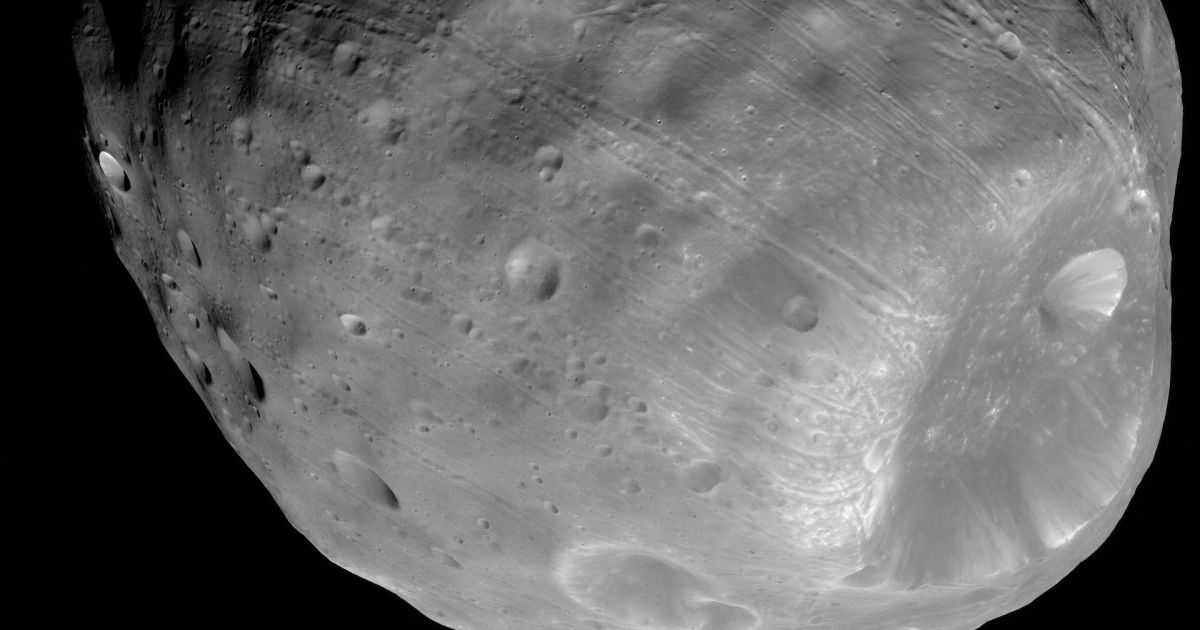
New computational models are currently being used by planetary scientists to determine whether Phobos, the largest moon of Mars, originated as a captured asteroid or as a fragment created by a massive impact on the Martian surface. These simulations track orbital history and gravitational interactions to solve the long-standing mystery of the moon’s formation and its eventual collision with Mars.
The origin of Phobos has remained one of the most debated topics in Martian science for decades. While traditional observations have provided clues regarding its composition and unusual orbit, researchers are now turning to high-fidelity N-body simulations to bridge the gap between theoretical possibilities and physical reality. These new models aim to replicate the gravitational environment of the early solar system to see which formation scenario—capture or impact—best aligns with Phobos’s current position and movement.
Understanding Phobos is not merely an exercise in celestial history; it is essential for understanding the evolution of the inner solar system. Because Phobos is located so close to Mars, its orbital dynamics are heavily influenced by tidal forces, which are currently pulling the moon closer to the planet. By solving the mystery of its origin, scientists can better predict the moon’s final fate and the impact it will eventually have on the Martian environment.
The Two Primary Theories: Capture vs. Impact
For years, the scientific community has been divided between two competing explanations for how Phobos came to orbit Mars. Each theory carries distinct implications for the composition of the moon and the history of the Red Planet.

The capture theory suggests that Phobos was originally a Near-Earth Object (NEO) or a D-type asteroid that wandered too close to Mars. As the object entered the planet’s gravitational well, a combination of atmospheric drag or gravitational interactions with other bodies slowed it down enough to be trapped in orbit. Proponents of this theory often point to Phobos’s low density and dark, carbon-rich surface, which are characteristics commonly found in asteroids located in the outer reaches of the asteroid belt.
Conversely, the impact theory proposes that Phobos is a piece of Mars itself. This model suggests that a massive celestial body struck Mars billions of years ago, ejecting a large amount of debris into orbit. Over time, this debris coalesced into the small, irregular moon we see today. This theory is supported by the fact that Phobos’s orbit is remarkably close to the Martian surface, a position that is difficult to achieve through simple gravitational capture.
To help visualize these competing scientific perspectives, the following table compares the primary characteristics of both theories:
| Feature | Capture Theory | Impact Theory |
|---|---|---|
| Primary Origin | External asteroid or NEO | Martian crust/mantle debris |
| Compositional Evidence | Carbon-rich, low density (asteroid-like) | Silicate-rich (Martian-like) |
| Orbital Difficulty | Requires complex slowing mechanisms | Natural result of debris coalescence |
| Current Scientific Standing | Supported by spectral data | Supported by orbital proximity |
How New Computational Models Resolve the Mystery
The limitations of previous research stemmed from the inability to simulate the chaotic gravitational environment of the early solar system over billions of years. New models utilize advanced N-body simulations, which calculate the gravitational pull of the Sun, Mars, and other major planets on Phobos simultaneously. This allows researchers to run “virtual histories” of the moon’s orbit.
These simulations focus on tidal dissipation—the process by which the gravitational pull of Mars creates internal friction within Phobos, causing it to lose energy. By inputting different starting parameters, scientists can see which origin story results in the specific, decaying orbit Phobos occupies today. If a captured asteroid were to arrive at Phobos’s current location, the models must explain how it lost enough velocity to avoid flying past Mars or crashing immediately.
Furthermore, these models incorporate the “Roche limit,” the critical distance within which a celestial body, held together only by its own gravity, will disintegrate due to a second celestial body’s tidal forces. Because Phobos is approaching this limit, the precision of these models is vital. They must account for the moon’s irregular shape and non-uniform density, factors that significantly affect how tidal forces act upon it.
The “Death Spiral” and the Future of Mars
Regardless of how Phobos formed, its future is mathematically certain. Phobos is currently caught in a “death spiral.” Because it orbits Mars faster than Mars rotates, tidal forces are constantly stripping orbital energy from the moon, causing it to spiral inward.
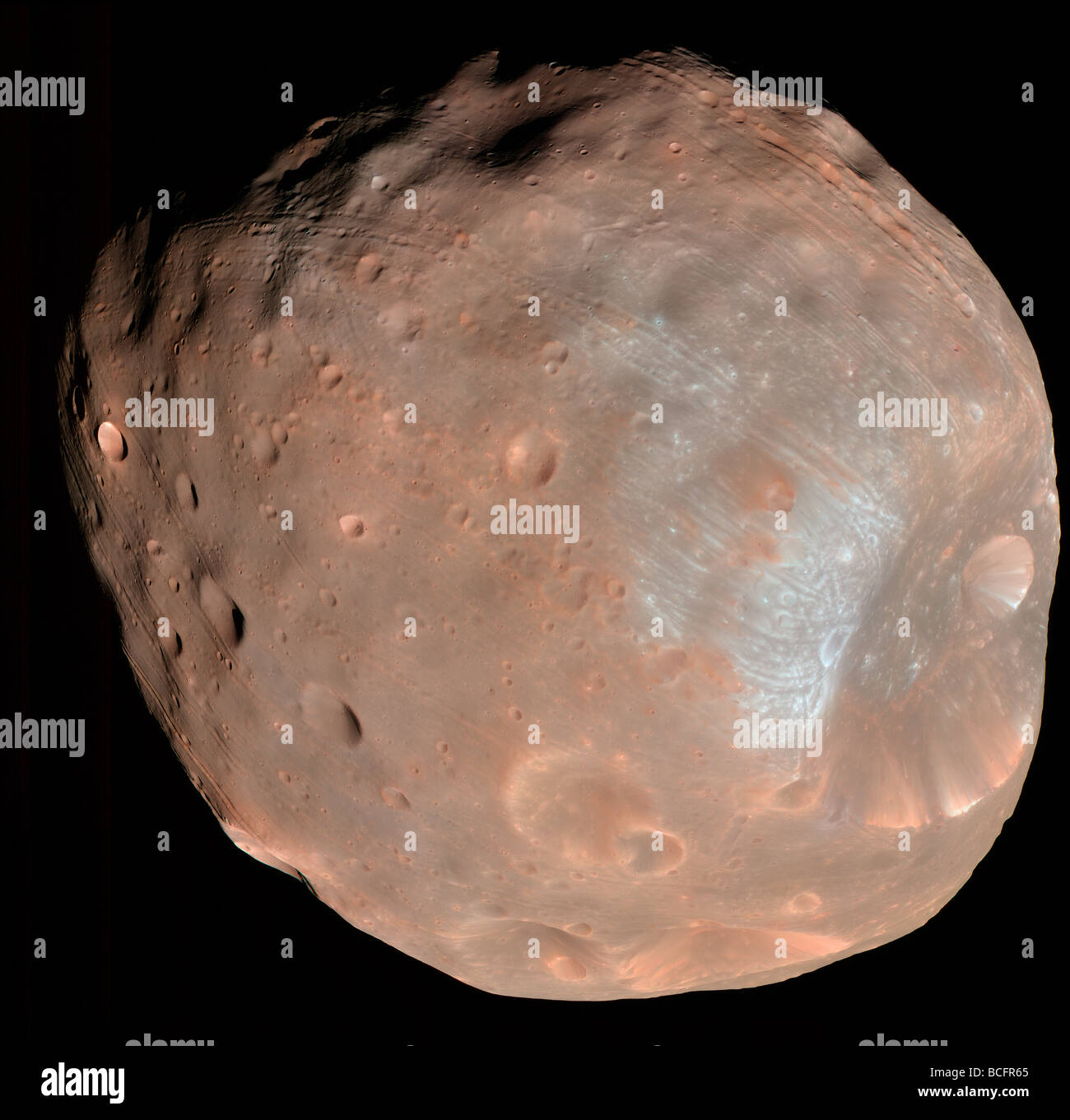
Current measurements indicate that Phobos is moving closer to the Martian surface at a rate of approximately 1.8 to 2 meters per century. While this may seem negligible on a human timescale, on a geological scale, it is a rapid descent. Eventually, Phobos will cross the Roche limit. At that point, the tidal forces exerted by Mars will become stronger than the gravity holding the moon together, causing Phobos to shatter.
Scientists suggest two possible outcomes for this eventual destruction:
- The Ring Scenario: The debris from the shattered moon could spread out along the Martian equator, forming a ring system similar to those seen around Saturn.
- The Impact Scenario: Large fragments of the moon may survive the disintegration process and strike the Martian surface, creating massive impact craters and potentially altering the planet’s atmosphere.
The ability to model this process accurately depends on knowing Phobos’s exact internal structure. If the moon is a “rubble pile”—a loose collection of rocks held together by weak gravity—it will behave very differently during disintegration than if it were a solid, monolithic body.
Why This Research Matters for Space Exploration
The resolution of the Phobos mystery has practical applications for future Mars missions. NASA and other space agencies have long eyed Phobos as a potential staging ground or “low-gravity depot” for human exploration of the Red Planet. A moon with low gravity requires far less fuel for spacecraft to land on and take off from compared to the surface of Mars itself.
However, the safety and feasibility of using Phobos depend on understanding its stability. If the moon is a fragile rubble pile, landing heavy equipment on its surface could trigger landslides or structural collapses. If the models confirm that Phobos is an asteroid-like object, it may provide valuable data on the types of materials available for “in-situ resource utilization” (ISRU), where astronauts use local materials to create fuel or building supplies.
As researchers continue to refine these simulations, the scientific community awaits more data from upcoming Mars-focused missions. Precise measurements of Phobos’s gravity field and surface composition will provide the necessary constraints to validate whether these new models are tracking the true history of the Martian moon.
The next major checkpoint for Phobos research will involve new orbital data from upcoming Mars reconnaissance missions, which are expected to provide higher-resolution gravity maps. We will continue to monitor updates from planetary science institutes as these findings are peer-reviewed and published.
What do you think about the possibility of Phobos forming a ring around Mars? Share your thoughts in the comments below and share this article with your fellow space enthusiasts.
Related reading