
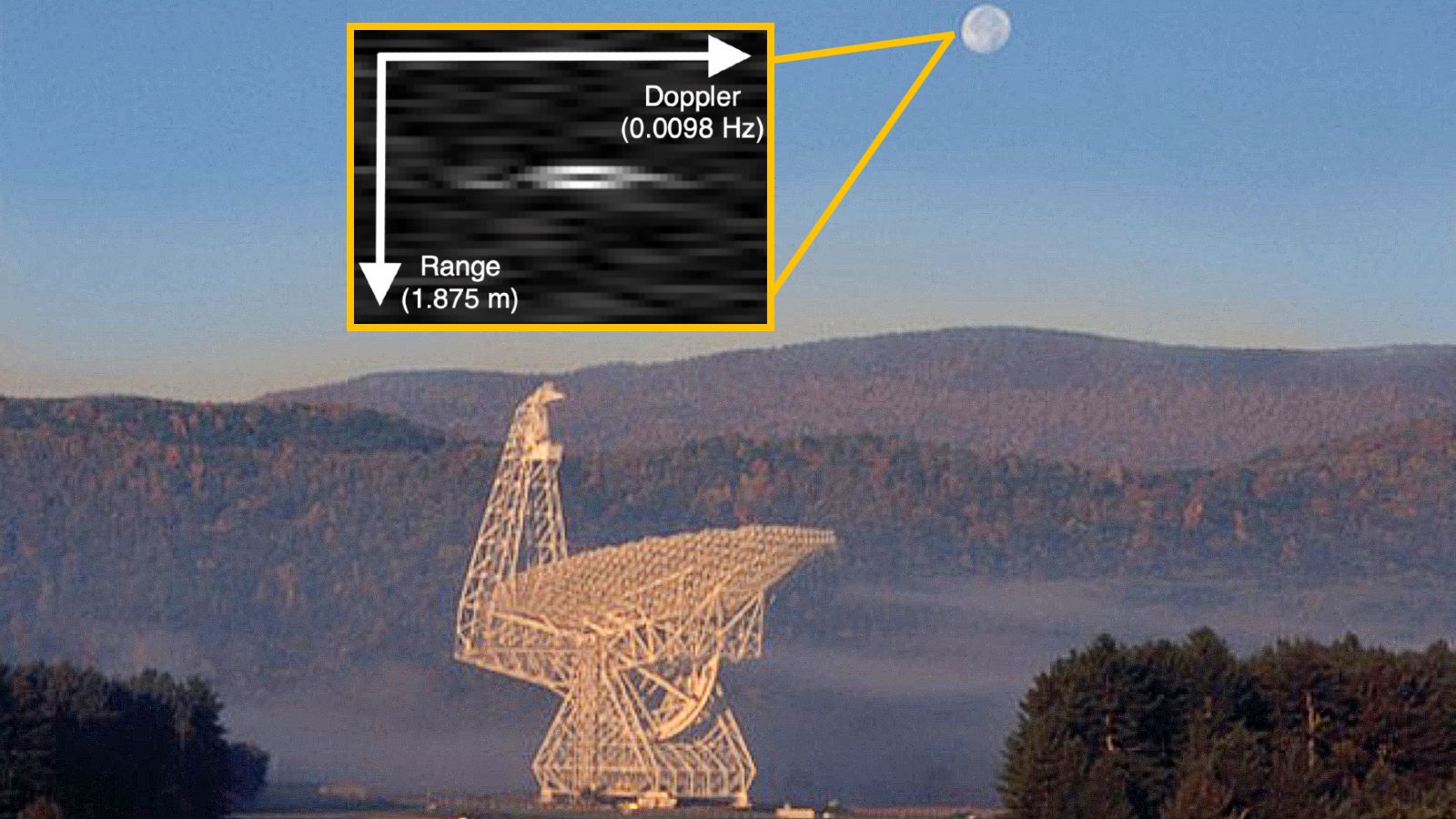
In the vast, silent expanse between Earth and the Moon, a tiny, shimmering speck of data has emerged, carrying with it the weight of human history. It is a grainy, nearly unrecognizable image—a collection of scattered, indistinct pixels—but for those watching from the ground, it represents a profound leap in our ability to observe the furthest reaches of human presence. The image, captured by the Green Bank Telescope in West Virginia, appears to show the Orion spacecraft, the vessel carrying the Artemis II crew, as it orbits the Moon, more than 200,000 miles from our home planet.
While the image lacks the crisp clarity of a high-definition photograph, its significance is immeasurable. As one observer poignantly noted, “There are four people in those pixels.” This sentiment captures the essence of the moment: the transition of deep-space exploration from a distant, automated endeavor into a deeply human one. For the first time in over half a century, we are not just looking at the Moon; we are looking at ourselves, reflected in the technology that carries us into the void.
The capture of this data represents a landmark achievement for Earth-based observation. Positioned at a distance that makes traditional optical imaging nearly impossible for a vessel of this scale, the ability to reconstruct the presence of the Orion capsule via radio-derived imaging marks a new frontier in how we track and visualize crewed deep-space missions. It is a candidate for the longest-distance image of humans ever successfully captured from Earth, bridging the gap between the terrestrial and the celestial.
The Science of Seeing Through the Void
To understand why this image is so significant, one must first understand the immense technical challenge of observing a spacecraft at lunar distances. At over 200,000 miles away, even our most powerful optical telescopes struggle to resolve the fine details of a spacecraft like the Orion capsule. The “blurry” nature of the recent capture is not a failure of technology, but rather a testament to the limits of physics and the incredible sensitivity of the instruments involved.

The Green Bank Telescope (GBT), located in the National Radio Quiet Zone in West Virginia, is one of the most sensitive radio telescopes in the world. Unlike optical telescopes that capture visible light, the GBT detects radio waves. The image in question is a sophisticated reconstruction—a visualization of the radio signatures and signals emitted by the Orion spacecraft and its communication systems. By processing these signals, scientists can create a visual representation of the capsule’s position and movement, effectively “seeing” the spacecraft through the electromagnetic spectrum.
This method of imaging is crucial for the Artemis program. As NASA pushes further into deep space, relying solely on optical cameras becomes increasingly difficult due to light scattering, distance, and the sheer scale of the environment. Radio-based reconstruction provides a reliable, continuous way to monitor the health and position of crewed vessels, ensuring that even when the spacecraft is lost in the glare of the sun or the darkness of the lunar shadow, its presence remains known to Earth.
A Crew Carving a New Path
The “four people” mentioned in the context of these pixels are not merely passengers; they are the pioneers of a new era of lunar exploration. The Artemis II mission, a cornerstone of NASA’s Artemis program, is designed to test the life-support systems and navigation capabilities required for a sustained human presence on and around the Moon. This crewed lunar flyby is the essential precursor to the eventual Artemis III mission, which aims to land humans on the lunar surface for the first time since the Apollo era.
The crew of Artemis II represents an international coalition of expertise and courage. The mission includes:

- Reid Wiseman (NASA): Serving as the mission commander, bringing extensive experience from previous orbital missions.
- Victor Glover (NASA): Serving as the pilot, a veteran of spaceflight with critical expertise in complex system management.
- Christina Koch (NASA): A mission specialist who holds records for the longest single spaceflight by a woman, providing vital perspective on long-duration space habitation.
- Jeremy Hansen (CSA): A mission specialist from the Canadian Space Agency, highlighting the global cooperation essential to modern space exploration.
From a physiological and psychological standpoint, the mission is a monumental undertaking. As a physician, I find the human element of this mission particularly compelling. These four individuals are operating in a high-radiation, microgravity environment, hundreds of thousands of miles from the nearest medical facility. The success of Artemis II depends not only on the integrity of the Orion capsule but on the biological and mental resilience of the crew as they navigate the psychological isolation of deep space.
Why This Milestone Matters for Humanity
The capture of this image serves as a powerful reminder of why we continue to reach for the stars. It is easy to view space exploration through the lens of cold mathematics, fuel consumption, and orbital mechanics. However, the emotional resonance of seeing those “four people in the pixels” reminds us that the ultimate goal of these missions is the expansion of human experience.
This achievement has several layers of impact:
1. Technological Validation: The ability to image a crewed vessel at such distances validates the use of radio-derived imaging for future missions to Mars and beyond. It proves that our “eyes” on Earth are capable of following humanity as we leave low Earth orbit.
2. International Collaboration: The presence of the Canadian Space Agency in the crew and the use of global scientific assets like the GBT underscore that the Moon is no longer the playground of a single nation, but a shared destination for all of humanity.
3. Inspiration and Connection: For the general public, seeing a visual confirmation of the crew—even a blurry one—creates a tangible connection to the mission. It transforms an abstract scientific goal into a relatable human story.
As we move closer to the era of permanent lunar bases and eventual Mars colonization, these small, pixelated glimpses of our explorers will become more frequent. They serve as the breadcrumbs of our progress, marking each step we take into the unknown.
Key Takeaways: The Artemis II Imaging Milestone
- The Achievement: The Green Bank Telescope captured a signal-based image of the Orion capsule during its lunar orbit.
- The Distance: The spacecraft was located more than 200,000 miles away from Earth at the time of capture.
- The Method: The image was reconstructed using radio wave data rather than traditional optical photography.
- The Significance: It is a candidate for the longest-distance image of humans ever taken from an Earth-based observatory.
- The Mission: Artemis II is a critical crewed flyby intended to prepare for future lunar landings.
Looking Ahead: The Path to the Lunar Surface
The successful orbit and observation of the Artemis II crew mark the end of one chapter and the beginning of another. While the crew celebrates the completion of their flyby, the eyes of the scientific community are already turning toward the next major milestone: the Artemis III mission. This upcoming endeavor will attempt the much more complex task of descending from lunar orbit to the surface, requiring even more precise tracking and even more robust life-support technologies.

The data gathered during the Artemis II mission, including the signals used to create this historic image, will be analyzed for months. Engineers will look at every telemetry point to ensure that the Orion spacecraft and the SLS rocket are ready for the rigors of landing. For now, the “four people in those pixels” have completed their task, proving that humanity is once again a spacefaring species capable of reaching across the void and touching the Moon.
Next Scheduled Milestone: NASA is expected to release a full mission debrief and detailed telemetry analysis following the conclusion of the Artemis II recovery phase. Stay tuned for official updates regarding the timeline for the Artemis III lunar landing preparations.
What do you think about this historic achievement? Does seeing the “pixels” of our explorers change how you view the future of space travel? Share your thoughts in the comments below and share this article with your fellow space enthusiasts.