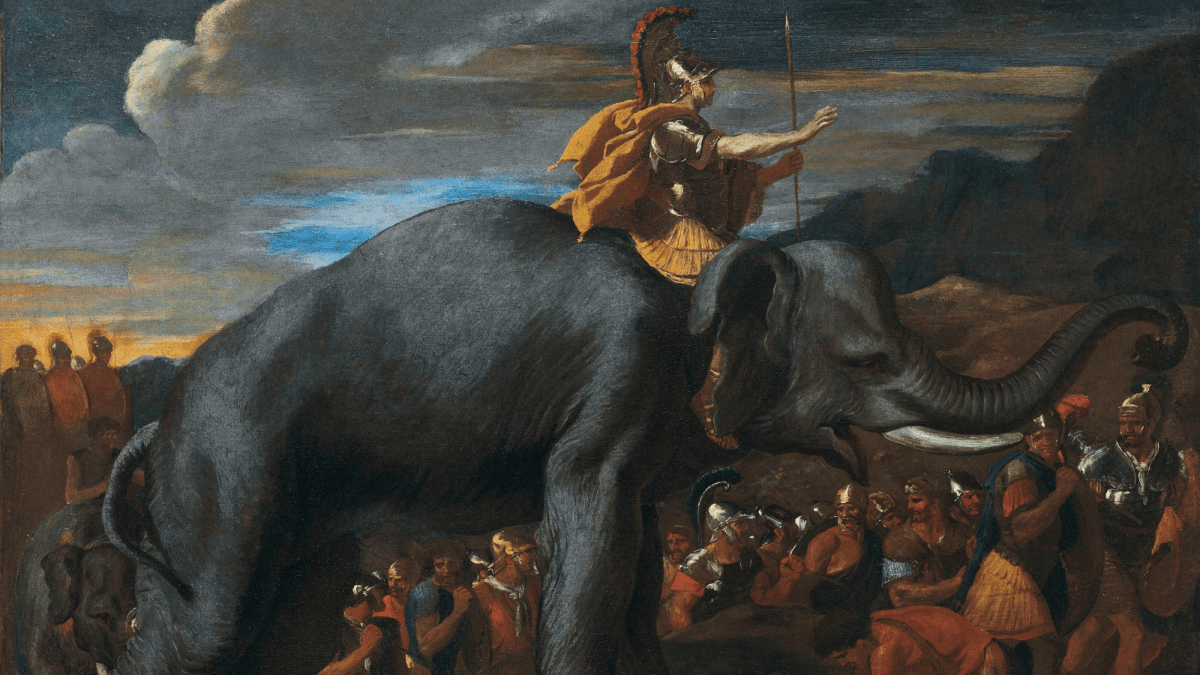
A new study suggests the Col de la Traversette was the most likely route used by Hannibal during his 218 BCE crossing of the Alps, according to research published in the journal Proceedings of the National Academy of Sciences (PNAS).
The research team, comprising scientists from the University of Oxford, the German Centre for Integrative Biodiversity Research (iDiv), and Friedrich Schiller University Jena, utilized route modeling and elevation data to calculate the energy costs of various potential crossings. Their findings challenge previous historical theories that favored the Col du Clapier, a pass reaching 8,127 feet between Savoy, France, and Piedmont, Italy.
Hannibal’s decision to traverse the Alps was a strategic maneuver during the Second Punic War to bypass Roman naval dominance in the Mediterranean and avoid land garrisons. By bringing the conflict directly to the Italian peninsula, Hannibal sought to surprise the Roman Republic, though the journey resulted in significant losses. According to the account of the historian Livy, the march across the mountains took 16 days, though the broader campaign lasted roughly two months and cost the lives of upwards of 20,000 men.
How did researchers determine the most likely route?
The research team focused on the metabolic demands of the army, specifically the energy expenditure of the 37 war elephants. Because no archaeological evidence of the crossing exists, the team used data from modern African elephants to estimate how body mass and rugged terrain would affect energy reserves. The study compared the Col de la Traversette against three other prominent theories: the Col du Clapier, the Col de Montgenèvre, and the Col du Mont Cenis.
The results showed that the Traversette route was the shortest and most energy-efficient option. According to the PNAS study, traveling via the Col de Montgenèvre would have required 11 percent more energy, while the Col du Clapier would have required 16 percent more. The Col du Mont Cenis was the most taxing, requiring 19 percent more energy than the Traversette path.
Dr. Emilio Berti, a study co-author and biologist at the German Centre for Integrative Biodiversity Research and the Friedrich Schiller University Jena, stated that while the analysis does not remove all ambiguity, it strengthens the case for the Traversette route by showing it could better accommodate the demands of moving a large army and elephants through difficult alpine terrain.
Why did the elephants survive better than the soldiers?
The energy modeling revealed a stark contrast in how the crossing affected humans versus elephants. The researchers found that if the army took the Traversette route, the human soldiers would have lost approximately 19 percent of their body fat reserves. This extreme physical depletion may have contributed to the high mortality rate experienced by the infantry during subsequent battles.
In contrast, the models suggest the war elephants would have only lost about 4 percent of their fat reserves. This relative stability in energy levels likely explains why many, if not most, of the elephants survived.
Historians remain divided on why Hannibal insisted on bringing elephants across the Alps. Some suggest the animals provided a tactical element of surprise to intimidate Roman legions, while others believe the spectacle of the creatures was intended to help recruit Celtic tribes in Northern Italy to the Carthaginian cause.
What historical evidence exists for the crossing?
The mystery of the route persists because only two primary written sources survive, both produced long after the events. One account was written 20 years after the crossing, and the other 160 years later. These texts, primarily from Polybius and Livy, rely on place names—such as Island, Skaras, and Allobroges—that do not always align perfectly with modern maps.

Because there is no surviving archaeological record of the march, scholars have spent generations comparing ancient tribal locations and geographical descriptions with current Alpine topography. The PNAS study adds a biological and physical layer to this debate, shifting the focus from linguistic interpretation to the physiological limits of the animals and men involved.
Hannibal’s campaign, while tactically brilliant in its initial stages, ultimately failed to secure a permanent Carthaginian victory. Despite the successful crossing and early triumphs in Italy, Carthage eventually lost the Second Punic War.
Further research into the Traversette region may continue to seek physical markers or soil anomalies that could provide the first definitive archaeological proof of the crossing. Readers interested in the intersection of biology and ancient history can find the full data set in the latest issue of the Proceedings of the National Academy of Sciences.
Do you believe the energy models provide a definitive answer to this historical mystery? Share your thoughts in the comments below.