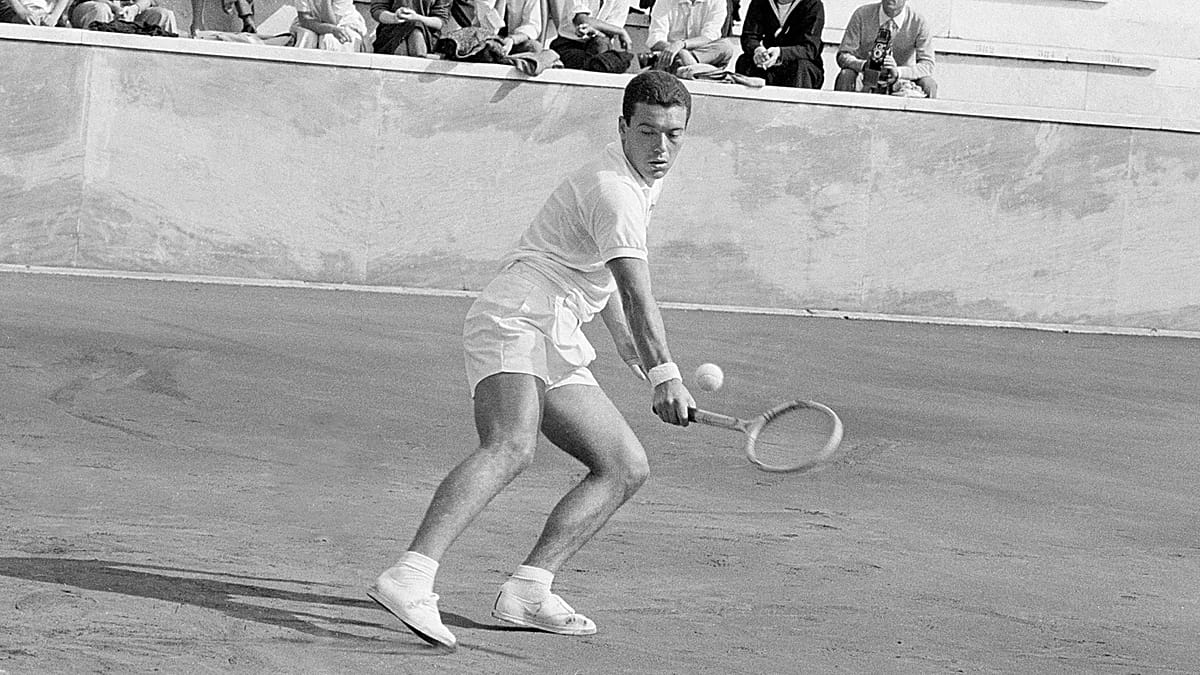
Nicola Pietrangeli: A Legacy Forged in Clay and National Pride
The world of tennis mourns the loss of Nicola Pietrangeli, a true pioneer of Italian tennis and a Grand slam champion. News of his passing prompted an outpouring of grief, including a heartfelt X post from a fellow Italian champion, expressing condolences too his family and the entire Italian tennis community. PietrangeliS impact extends far beyond his notable trophy collection; he fundamentally shaped the sport in Italy and inspired generations of players.
This article delves into the remarkable life and career of Pietrangeli, exploring his groundbreaking achievements, his enduring influence on the Davis Cup, and the legacy he leaves behind for players like jannik Sinner.
A Champion Emerges: Early Success and Grand Slam Glory
Pietrangeli wasn’t just a talented player; he was a trailblazer. He became the first Italian to capture a Grand Slam singles title, winning the French Open in 1959. He successfully defended his Roland Garros crown in 1960,a feat that stood as the benchmark for Italian men’s singles players for decades.
It wasn’t until Jannik Sinner‘s breakthrough, winning back-to-back Australian Open titles in 2024 and 2025 (bringing his major tally to four), that Pietrangeli’s record of two Grand Slam singles titles was surpassed. This highlights the sheer longevity and significance of Pietrangeli’s early success.
Beyond the French Open, Pietrangeli consistently demonstrated his prowess on the biggest stages. He reached the Wimbledon semifinals in 1960 and the Australian Open quarterfinals in 1957. He was also a finalist at Roland Garros in 1961 and 1964,falling to the legendary Manuel Santana on both occasions. He did,though,secure the French Open doubles title in 1959 alongside Orlando Sirola.
Interestingly, the financial rewards of the era were vastly different. Pietrangeli once recounted winning $150 (equivalent to roughly €3,787 in 2025) for his 1960 French Open title - enough to cover two months’ rent in Rome.
The King of Rome: A Record That Still Stands
Pietrangeli’s dominance wasn’t limited to Grand Slams. He holds an unparalleled record at the Rome Masters, winning the tournament a remarkable ten times.This enduring legacy cemented his status as a national hero in Italy.
His competitive spirit extended beyond the court. A story illustrates his playful rivalry with Santana: after losing the 1964 Roland Garros final, thay bet the loser would pay for dinner.Pietrangeli honored the agreement, hosting a lavish evening for ten people, including their wives and even Spanish soccer star Luisito Suárez, ultimately spending his entire tournament earnings.
A Davis Cup Icon: Wins, Leadership, and Courage
Pietrangeli’s contributions to the Davis Cup are arguably as significant as his individual achievements. He holds the record for most total wins (164 matches) and most singles wins (78) in the competition. His partnership with orlando Sirola was equally dominant, winning 34 of their 42 doubles matches together.
He led Italy to two Davis Cup finals as a player, both ending in defeat against formidable Australian teams featuring Rod Laver and Roy Emerson. Though, his greatest Davis Cup triumph came as captain in 1976.
Facing political pressure and calls to boycott the final, Pietrangeli courageously insisted the team travel to Chile, then under the military dictatorship of Augusto Pinochet. His leadership inspired Adriano Panatta, Corrado Barazzutti, Paolo Bertolucci, and Antonio Zugarelli to secure the title, a victory Pietrangeli considered his most significant contribution to Italian tennis.
Italy wouldn’t taste Davis Cup glory again until Jannik Sinner spearheaded victories in 2023 and 2024, followed by a third consecutive title in 2025 led by Matteo Berrettini and Flavio Cobolli on home soil in Bologna. This recent success is built upon the foundation Pietrangeli laid decades ago.
A Lasting Legacy
Nicola Pietrangeli’s impact on Italian tennis is immeasurable. As Angelo Binaghi, president of the Italian federation, eloquently stated, he “was not only the first to teach us what it really meant to
Related reading