
The corporate landscape is currently witnessing a cold transition. For years, the narrative surrounding artificial intelligence was one of “augmentation”—the idea that AI would act as a co-pilot, freeing human workers from mundane tasks to focus on high-level strategy. However, as we move through the first quarter of 2026, that narrative is shifting toward replacement. The arrival of “agentic AI” is no longer a theoretical roadmap; It’s a corporate reality that is actively reshaping payrolls across the globe.
The human cost of this pivot is becoming starkly visible. In recent weeks, reports have surfaced of thousands of employees receiving termination notices via email in the early hours of the morning, often as early as 6:00 AM. These are not the typical cyclical layoffs driven by market downturns or over-hiring during a pandemic. Instead, these reductions appear to be strategic realignments, where human roles are being phased out in favor of autonomous AI agents capable of executing complex business processes without oversight.
Nowhere is this tension more palpable than in the high-density corporate hubs that have long served as the engine rooms for global outsourcing and tech services. In the Pipera district of Bucharest, Romania—a region defined by its concentration of multinational corporations and shared service centers—the anxiety is mounting. Once considered a safe haven for white-collar professionals in finance, HR, and IT, the area is becoming a primary example of how AI-driven job losses in the corporate sector are manifesting in real-time.
The shift is exemplified by the current trajectory of industry giants like Oracle. While the company continues to expand its technological footprint, the internal restructuring suggests a move toward a leaner, AI-centric operational model. By integrating generative and agentic AI directly into the software environments that power global business, the demand for the vast “middle-office” layers of human coordination is diminishing. This is not merely about automating a spreadsheet; it is about automating the decision-making and execution roles that previously required a degree and a decade of experience.
The Pivot to Agentic AI: From Assistants to Autonomous Agents
To understand why roles that were once considered “safe” are now vulnerable, one must distinguish between generative AI and agentic AI. Generative AI, such as early chatbots, can draft an email or summarize a report. Agentic AI, however, can take an objective and independently coordinate the actions required to achieve it. This is the core of Oracle Cloud Infrastructure (OCI) Enterprise AI, which unifies the capabilities needed to build and manage these autonomous solutions.
In a traditional corporate setting, a process like accounts payable requires a chain of human intervention: receiving an invoice, classifying the data, checking it against company policy, and matching it to a purchase order. Oracle has now introduced the Payables AI Agent within its Fusion Cloud ERP, which is designed to classify and extract invoice data, apply tax and policy checks, and match invoices to receipts automatically . When a single agent can handle the finish-to-end automation of a department, the requirement for a large team of human processors evaporates.
This trend extends beyond finance into supply chain management and human resources. For instance, the Design-to-Source Agentic App in Oracle SCM is now capable of surfacing urgent risks and flagging stalled supplier negotiations while providing instant recommendations . Similarly, the Team Sync AI Agent is designed to foster feedback and enable high-performing teams through data-driven action, potentially reducing the need for traditional middle-management oversight.
The “Invisible” Layoffs and the Human Toll
The method of these terminations has sparked significant ethical debate within the business community. The reported trend of “overnight” layoffs—where employees discover their employment has ended via a cold, automated email before the workday begins—reflects a corporate culture that is increasingly mirroring the efficiency of the AI it implements. This detachment is particularly jarring for professionals who have spent years building careers within these corporate ecosystems.
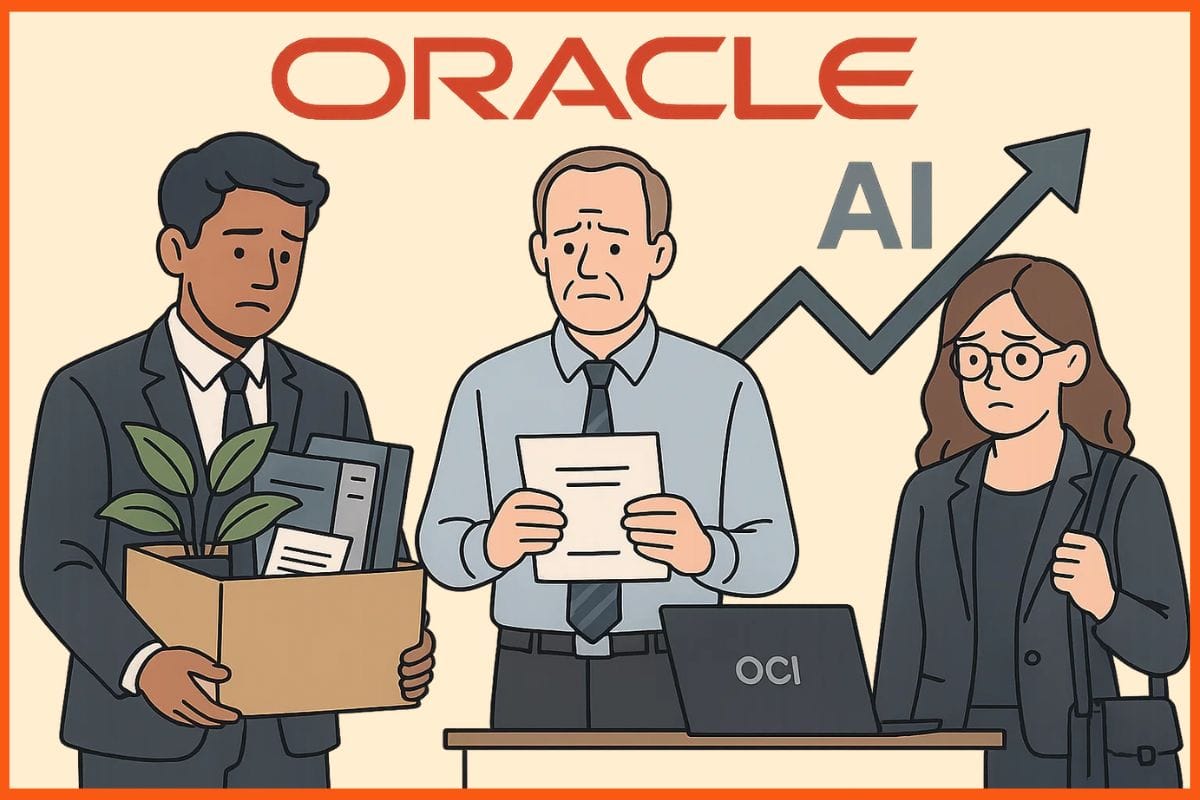
While official company figures are often guarded, some reports suggest the scale of these shifts is massive. There have been unconfirmed reports indicating that as many as 30,000 people may have been affected by recent restructuring efforts at Oracle, though these figures have not been officially verified by the company. The pattern is not isolated to a single firm; the broader tech sector is seeing a similar hemorrhage. Some data suggests that in a period of just three months, AI implementation may have contributed to the loss of 50,000 engineering roles in the United States alone, while these numbers remain subject to debate among labor economists.
The Pipera Effect: A Warning for Global Service Hubs
The situation in the Pipera area of Bucharest serves as a microcosm for the global “Shared Service Center” (SSC) model. For two decades, cities like Bucharest, Manila, and Bangalore have attracted multinational investment by offering high-skill labor at a lower cost than in New York or London. However, the “cost” of an AI agent is now lower than the cost of the cheapest high-skill human worker.
When a company like Oracle or its peers embeds AI agents directly into their Fusion Applications, the value proposition of a remote service center in Eastern Europe changes. If the AI can handle the “Design-to-Source” process or the “Payables” workflow autonomously, the geographical advantage of the SSC disappears. The roles being eliminated in Pipera are not low-skill jobs; they are the roles of analysts, accountants, and project managers—the very people who thought their specialized knowledge protected them.
This transformation creates a “hollowing out” of the corporate ladder. Entry-level and mid-level roles are the most susceptible to agentic automation, leaving a gap between the remaining executive leadership and the highly specialized AI architects who maintain the systems. For the thousands of professionals in the corporate zones of the world, the message is clear: technical proficiency in a specific software tool is no longer a moat; the tool is now the worker.
Economic Implications of the AI Workforce Shift
From an economic perspective, this shift represents a massive increase in productivity—but a precarious shift in labor distribution. The ability to turn “objectives into outcomes” via proactive agentic applications allows companies to scale their operations without scaling their headcount. While this improves margins and shareholder value, it creates a systemic risk to the middle class of the digital economy.
The transition is being accelerated by the accessibility of these tools. Oracle, for example, offers a Free Tier for most of its AI services and a 30-day free trial with US$300 in credit, lowering the barrier to entry for companies to start replacing human workflows with AI agents . This democratization of AI means that the “wave” of layoffs is not limited to the tech giants but is trickling down to mid-sized enterprises that can now afford the same automation capabilities.
Comparative Impact: Generative vs. Agentic Automation
| Feature | Generative AI (2023-2024) | Agentic AI (2025-2026) |
|---|---|---|
| Primary Function | Content creation & summarization | End-to-end task execution |
| Human Role | Editor / Prompt Engineer | Supervisor / Exception Handler |
| Impacted Roles | Copywriters, Basic Coders | Analysts, Accountants, Project Managers |
| Corporate Goal | Increased individual speed | Reduction of operational headcount |
What Happens Next: The Survival Strategy for the Corporate Professional
As the “hype curve” of generative AI settles, the reality of the “implementation curve” begins. The future of work in the corporate sector will likely be defined by a move toward “Human-in-the-Loop” (HITL) systems. In this model, the AI agent executes 95% of the work, and the human professional is retained only to handle the 5% of cases that are too complex, ambiguous, or ethically sensitive for the AI to resolve.
For those currently working in corporate hubs like Pipera, the strategy for survival is no longer about learning how to use AI, but about mastering the areas where AI fails. This includes high-stakes negotiation, complex cross-functional leadership, and ethical oversight. The “safe” roles of the future are those that require genuine empathy, nuanced judgment, and the ability to manage the AI agents themselves.
The current volatility is a signal that the corporate world is undergoing a fundamental rewrite of the social contract between employer and employee. The efficiency gains promised by the “Enterprise AI” era are being realized, but they are being realized through subtraction rather than addition.
The next critical checkpoint for the industry will be the upcoming quarterly earnings reports and workforce disclosures from the major cloud providers, which will reveal whether these layoffs are a one-time correction or a permanent shift in the operational model of the global corporation. As companies further integrate their “Agentic Apps,” the industry will be watching to observe if new roles are created to replace those lost, or if the corporate office is simply becoming a shell for autonomous software.
Do you believe agentic AI is an inevitable replacement for the corporate middle-office, or is the current wave of layoffs a short-term overcorrection? Share your thoughts in the comments below.
Keep reading