
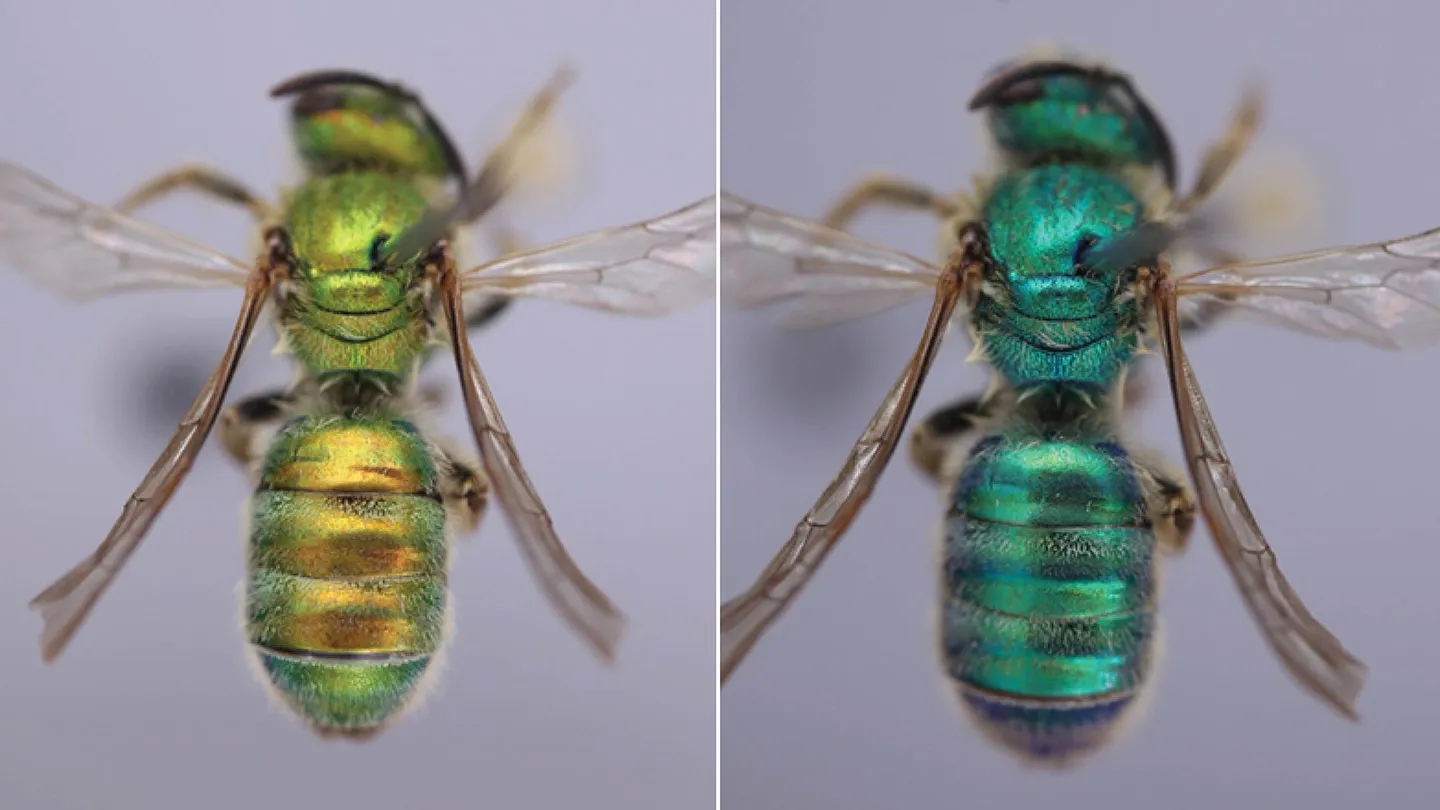
North American sweat bees change color depending on the surrounding humidity, shifting from a blue-green hue in dry conditions to a coppery green in muggy weather, according to research published April 22 in Biology Letters. This reversible, mood ring–like effect is driven by moisture-induced structural changes in the insects’ exoskeletons. The phenomenon, observed in fine-striped sweat bees (Agapostemon subtilior), may be more widespread among insects that use iridescence for color.
The study, led by Dr. Madeleine Ostwald of Queen Mary University of London, provides the first experimental proof that humidity can temporarily alter the shimmering hues of certain bee species. Researchers exposed two dozen museum specimens of the sweat bee to high and low humidity conditions for 55 hours each and photographed the results. Under dry conditions—below 10 percent humidity—the bees displayed a rich blue-green color. As ambient humidity increased, their hue shifted toward a coppery green.
To confirm the findings in living insects, the team analyzed over 1,000 photos of sweat bees from the citizen science app iNaturalist, noting the humidity at the time and location each image was taken. They found that ambient humidity significantly predicted color variation across the species’ range, matching the direction of change seen in laboratory experiments. Unlike most animals, whose colors come from pigments, these bees get their color from microscopic structures on their bodies that reflect and scatter light at particular wavelengths.
The same structural color effect creates the iridescent feathers of hummingbirds and the shifting skin colors of cuttlefish. In some animals, these tiny structures swell slightly when exposed to moisture, causing them to reflect redder colors. The researchers believe a similar process may be happening in bees, although more work is needed to fully understand the mechanism.
Sweat bees are known for their bright, metallic greens and blues. Until now, reports that their colors could shift have been anecdotal. This new research provides the first experimental proof that environmental conditions like humidity can drive reversible color changes in these pollinators. The study highlights how microclimate conditions can influence observable traits in insects, even within the same species.
The implications extend beyond bee biology. Understanding how structural color responds to environmental stimuli could inspire new biomimetic materials for sensors or adaptive camouflage. It too raises questions about how climate change, by altering regional humidity patterns, might affect insect appearance and potentially their interactions with predators or pollinators.
Dr. Ostwald and her team plan to investigate whether other iridescent insects exhibit similar humidity-dependent color shifts. They also aim to study the precise biophysical mechanisms behind the exoskeletal changes in sweat bees. For now, the discovery adds a fascinating layer to our understanding of how small creatures adapt to and reflect their immediate environments.
As global humidity patterns shift with climate change, observing such subtle but measurable responses in wildlife becomes increasingly important. This research opens a window into the dynamic interplay between atmosphere, structure, and color in the natural world—one tiny bee at a time.