

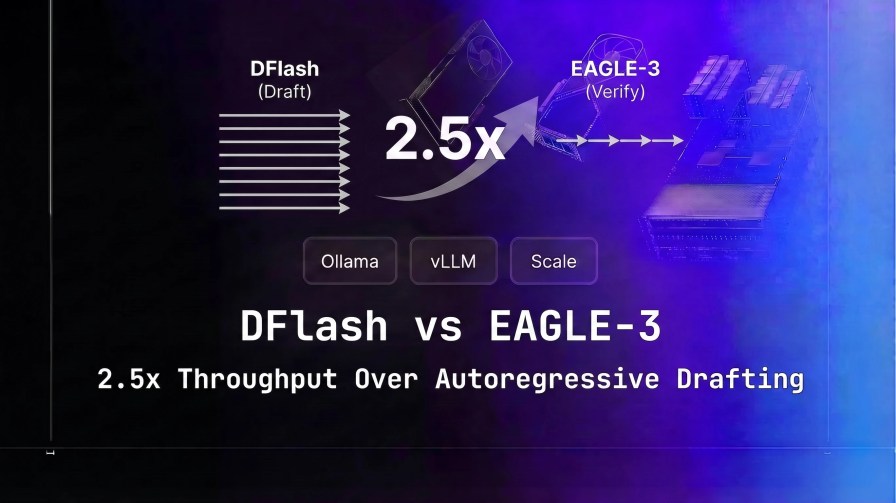
NVIDIA has introduced DFlash block diffusion as a technical strategy to accelerate autoregressive large language model (LLM) performance during latency-sensitive inference tasks. By addressing the inherent sequential bottleneck of token generation, this approach aims to increase GPU utilization and throughput for complex AI workflows. The method builds upon existing speculative decoding architectures, which utilize smaller, lightweight models to predict token sequences before verification by a larger primary model.
Autoregressive models generate text one token at a time, a process that inherently limits the parallel processing capabilities of modern graphics processing units. As AI development shifts from simple, single-turn prompts to coordinated multi-agent systems, this sequential execution often results in significant latency, particularly when high-speed responses are required. According to NVIDIA’s technical documentation, optimizing the efficiency of these inference cycles is essential for maintaining performance in real-time applications.
Understanding the Autoregressive Bottleneck
In a standard autoregressive inference setup, the GPU must wait for the completion of one token before it can begin calculating the next. This dependency prevents the hardware from fully utilizing its massive parallel architecture, leading to under-utilization of computational resources. The latency-sensitive nature of modern AI agents—which must process inputs and generate outputs in milliseconds—makes this efficiency gap a primary challenge for developers.

Speculative decoding serves as a bridge to this problem. By employing a smaller, “draft” model to predict a sequence of tokens in advance, the system can verify these tokens in parallel using the larger, primary model. If the draft tokens are correct, the system effectively generates multiple tokens in the time it would normally take to generate one. DFlash block diffusion acts as an refinement to this process, focusing on how these blocks of tokens are diffused and processed across the hardware architecture to minimize idle time.
How DFlash Block Diffusion Optimizes GPU Throughput
The primary function of DFlash block diffusion is to improve the efficiency of token verification. When a draft model proposes a block of tokens, the primary model must check them for accuracy. If the verification process is slow, the advantage of the draft model is negated. NVIDIA’s approach optimizes the data flow and memory management during this verification stage, ensuring that the GPU spends more cycles on actual computation rather than waiting for data transfers or synchronization.

This optimization is particularly relevant for high-traffic AI services. As noted in industry assessments of GPU performance, the ability to maximize tokens-per-second is a key metric for reducing the total cost of ownership for AI-driven platforms. By streamlining the block diffusion process, developers can maintain lower latency even as the complexity of the underlying models increases.
Impact on Multi-Agent AI Workflows
The transition toward multi-agent workflows—where multiple AI systems interact to solve a single problem—has placed new demands on inference infrastructure. In these scenarios, a single request may trigger a chain of sub-requests, each requiring its own inference cycle. If each link in the chain suffers from autoregressive latency, the cumulative delay can render the entire system unresponsive.
Technical experts often highlight that minimizing the “time-to-first-token” and “inter-token latency” is critical for user experience in these multi-agent environments. By implementing techniques like DFlash, NVIDIA aims to provide a more stable foundation for developers building these complex systems. The methodology aligns with broader efforts in the semiconductor industry to align hardware scheduling more closely with the specific computational patterns of transformer-based architectures.
Next Steps for Developers
Developers looking to integrate these optimizations can monitor the official NVIDIA Developer portal for updates regarding software development kit (SDK) compatibility and library implementations. NVIDIA typically releases performance optimizations through its TensorRT-LLM library, which provides the necessary hooks for custom decoding strategies. Interested parties should review the latest release notes and documentation to determine if their specific model architecture supports block diffusion techniques.
As the field of AI inference continues to evolve, researchers are expected to publish further benchmarks comparing traditional speculative decoding against newer block diffusion methods. Keeping track of these results on platforms like the arXiv preprint server will be vital for engineers aiming to stay at the forefront of LLM deployment efficiency. We encourage our readers to share their experiences with these optimization techniques in the comments section below.