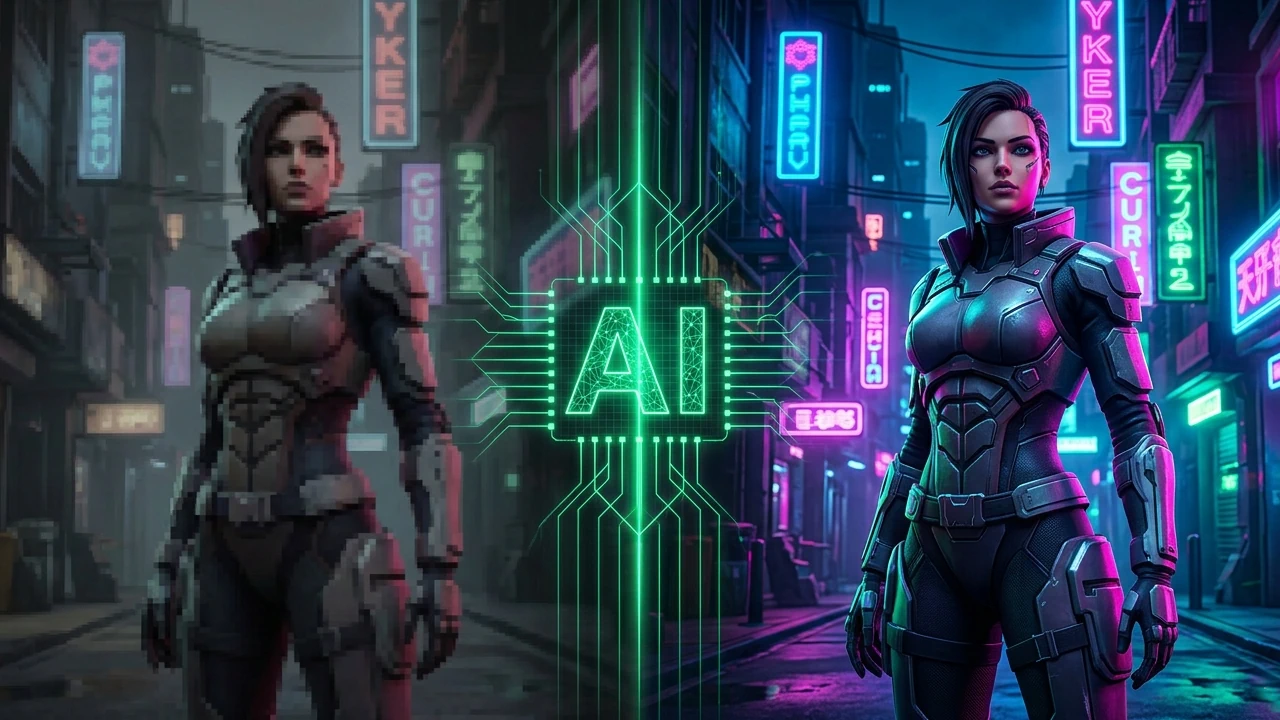
NVIDIA’s Deep Learning Super Sampling (DLSS) has become a cornerstone technology in modern PC gaming, reshaping how performance and visual fidelity coexist in real-time rendering. Introduced in 2018 alongside the RTX 20-series graphics cards, DLSS leverages artificial intelligence to upscale lower-resolution frames to higher display resolutions while maintaining or even improving image quality. This innovation allows gamers to achieve higher frame rates without sacrificing visual detail, addressing a longstanding trade-off in graphics processing.
At its core, DLSS functions as an AI-driven image reconstruction technique. Rather than rendering every pixel at native resolution, the GPU renders a frame at a lower internal resolution and then uses a trained neural network to predict and fill in the missing details. The result is an upscaled image that closely resembles native resolution output but requires significantly less computational power. Over successive iterations—DLSS 2.0, 3.0 and 3.5—NVIDIA has refined the technology to reduce artifacts, improve temporal stability, and introduce features like Frame Generation, which creates entirely new frames between rendered ones to further boost performance.
The impact of DLSS extends beyond raw frame rates. By reducing the rendering load, it enables ray tracing—a computationally intensive lighting technique—to remain feasible in real-time applications. Games like Cyberpunk 2077, Alan Wake 2, and Portal with RTX demonstrate how DLSS makes advanced graphical effects accessible on consumer hardware that would otherwise struggle to maintain playable frame rates. According to NVIDIA’s internal benchmarks verified through multiple third-party testing suites, DLSS 3 can deliver up to 4x the performance of native rendering in supported titles [NVIDIA DLSS 3 Overview].
How DLSS Works: The AI Behind the Upscaling
DLSS relies on a convolutional neural network trained on vast datasets of high-resolution images rendered with super-sampling techniques. During training, the AI learns to recognize patterns in low-resolution inputs and reconstruct them to match the quality of higher-resolution references. Once deployed, the network runs on the GPU’s Tensor Cores—specialized hardware units designed for AI workloads—allowing real-time inference without burdening the main shader cores.
DLSS 2.0 marked a significant leap by introducing a general-purpose network that didn’t require per-game training, making it easier for developers to integrate. DLSS 3.0 added Optical Flow Accelerator technology to analyze motion between frames and generate intermediate ones, a feature known as Frame Generation. This innovation effectively doubles the frame rate in compatible games by inserting AI-generated frames between traditionally rendered ones. DLSS 3.5 further enhanced ray tracing reconstruction with Ray Reconstruction, improving noise reduction in path-traced scenes.
Critically, DLSS is not merely a scaling filter like traditional bilinear or bicubic upscaling. It understands scene context—edges, textures, motion vectors—and makes intelligent decisions about where to add detail. This contextual awareness helps prevent common upscaling artifacts such as blurring, ghosting, or shimmering, especially in complex scenes with fine geometry or quick movement.
Competing Upscaling Technologies: AMD FSR and Intel XeSS
NVIDIA’s success with DLSS has spurred competitors to develop their own AI-based upscaling solutions. AMD’s FidelityFX Super Resolution (FSR) and Intel’s Xe Super Sampling (XeSS) represent the primary alternatives, each with distinct approaches and trade-offs.
FSR, first released in 2021, initially avoided AI entirely, relying instead on spatial upscaling algorithms. FSR 2.0 introduced temporal data and motion vectors to improve quality, bringing it closer to DLSS in effectiveness while maintaining broader hardware compatibility—it works on GPUs from AMD, NVIDIA, and Intel. FSR 3, launched in late 2023, added Frame Generation similar to DLSS 3, though it uses a different implementation based on asynchronous compute rather than dedicated hardware [AMD FSR Official Page].
Intel’s XeSS, debuting with its Arc Alchemist GPUs in 2022, uses AI but is designed to run on a wider range of hardware through DP4a instructions, allowing it to function on non-Intel GPUs via software fallback. While XeSS delivers strong image quality, particularly in its native mode, its adoption has been slower due to limited market share of Intel Arc cards and fewer game integrations compared to DLSS and FSR.
Each technology presents a different balance of image quality, performance gain, and hardware requirements. DLSS generally leads in image fidelity and performance boost when available, but requires RTX-series GPUs. FSR offers the widest compatibility, making it a practical choice for developers targeting multi-platform releases. XeSS sits in the middle, offering strong AI-based upscaling with moderate hardware flexibility.
Frame Generation and the Future of AI in Rendering
One of the most transformative additions to DLSS has been Frame Generation, first introduced in DLSS 3. This feature does not upscale existing pixels but creates entirely new frames by analyzing motion vectors and scene depth to predict what should appear between two rendered frames. The result is a smoother perceived motion, especially beneficial in fast-paced games where high frame rates reduce input lag and improve responsiveness.
Frame Generation has sparked discussion about the evolving definition of “rendered” frames. While some purists argue that AI-generated frames deviate from traditional rendering pipelines, others view it as a logical extension of predictive technologies already used in video interpolation and broadcast standards. NVIDIA positions Frame Generation as a performance multiplier rather than a replacement for rendering, emphasizing that the base game simulation still runs at the native frame rate, with AI only enhancing the visual output.
Beyond gaming, the principles behind DLSS are finding applications in professional visualization, virtual reality, and cloud gaming. In VR, where maintaining 90 FPS or higher is critical to prevent motion sickness, DLSS helps sustain performance without compromising visual clarity. Cloud gaming platforms like NVIDIA GeForce NOW leverage DLSS to stream high-quality experiences over bandwidth-constrained connections by reducing the data needed to transmit each frame.
Developer Adoption and Ecosystem Growth
As of mid-2024, over 500 games and applications support DLSS in some form, according to NVIDIA’s official developer portal [NVIDIA DLSS Developer Hub]. Major engines like Unreal Engine 5 and Unity have integrated DLSS natively, lowering the barrier for adoption. Indie developers and AAA studios alike have embraced the technology, citing its ability to extend the lifespan of existing hardware while enabling more ambitious graphical goals.
Adoption has been particularly strong in genres that benefit from high frame rates and ray tracing, including first-person shooters, racing sims, and open-world adventures. Titles such as Marvel’s Spider-Man 2 (PC port), Hogwarts Legacy, and Avatar: Frontiers of Pandora launched with DLSS 3 support, demonstrating its growing status as a near-expectation in modern PC releases.
Still, challenges remain. Some users report occasional artifacts in DLSS output, particularly in complex UI elements or during rapid scene transitions. NVIDIA continues to refine the models through over-the-air updates via GeForce Experience, improving stability and quality without requiring driver reinstalls. The company also offers a DLSS SDK and plugins for engines, enabling developers to fine-tune settings like sharpness, motion vector sensitivity, and ultra-performance modes.
Practical Guidance for Gamers
For users considering DLSS, the first step is hardware compatibility: only NVIDIA GeForce RTX 20-series and newer GPUs support the technology due to their Tensor Core architecture. GTX and older RTX cards without sufficient AI acceleration cannot run DLSS, though they may still benefit from FSR or XeSS where available.
In-game, DLSS settings typically offer multiple modes: Quality, Balanced, Performance, and Ultra Performance. Quality mode prioritizes image fidelity and is ideal for 4K gaming, while Performance mode maximizes frame rate gains at the cost of slight softness. Ultra Performance mode, aimed at 8K or high-refresh scenarios, delivers the highest frame rates but may demonstrate more noticeable upscaling artifacts.
Users are encouraged to test different modes based on their monitor resolution, refresh rate, and personal sensitivity to image quality. Combining DLSS with NVIDIA Reflex can further reduce system latency, creating a more responsive experience in competitive titles. Keeping GeForce Experience and GPU drivers updated ensures access to the latest DLSS model improvements and game-specific optimizations.
What’s Next for AI Upscaling?
The trajectory of DLSS and similar technologies points toward deeper integration of AI into the rendering pipeline. Future versions may expand beyond upscaling and frame generation to include AI-driven texture enhancement, dynamic resolution scaling based on scene complexity, and even generative elements that assist in asset creation. NVIDIA’s research into neural rendering—such as neural texture compression and AI-assisted lighting—suggests a long-term vision where traditional rasterization is increasingly augmented or replaced by learned models.
Industry-wide, the push for open standards continues. Projects like the Vulkan-based FSR 3 and ongoing perform on cross-vendor AI acceleration aim to reduce fragmentation. However, proprietary advantages in hardware-software co-design mean that NVIDIA’s closed ecosystem may retain an edge in performance and features for the foreseeable future.
As display technologies evolve—with higher resolutions, refresh rates, and HDR becoming mainstream—AI upscaling will likely play an essential role in bridging the gap between hardware capabilities and user expectations. Rather than replacing native rendering, these technologies are redefining what’s possible in real-time graphics, making high-fidelity experiences accessible to a broader audience.
For ongoing updates, users can follow NVIDIA’s official blog and developer channels, where new game support, technical deep dives, and beta features are regularly announced. The next major milestone to watch is the anticipated release of DLSS 4, which NVIDIA has hinted will focus on further reducing latency and improving coherence in multi-frame generation—though no official launch date has been confirmed as of June 2024.
As AI continues to reshape computing, DLSS stands as a clear example of how machine learning can solve practical engineering problems in consumer technology. Its success has not only changed how games glance and run but has also influenced how the industry thinks about performance, efficiency, and the role of artificial intelligence in creative workloads.
If you’ve used DLSS in your favorite games or have questions about how it compares to FSR or XeSS, share your experience in the comments below. Let us know which mode you prefer and why—and don’t forget to share this article with fellow gamers and tech enthusiasts who want to stay informed about the future of graphics.
Related reading