By Linda Park, Tech Editor
San Francisco, USA — Nvidia has quietly rolled out a major upgrade to its Ray Reconstruction technology, a cornerstone of its real-time rendering pipeline that now delivers higher fidelity detail preservation while maintaining performance. This advancement, built into Nvidia’s latest RTX platform and Omniverse ecosystem, marks a pivotal step toward bridging the gap between real-time and cinematic-quality visuals. For developers, filmmakers, and gamers, the implications are profound: faster iteration without sacrificing the intricate textures and lighting that define modern storytelling.
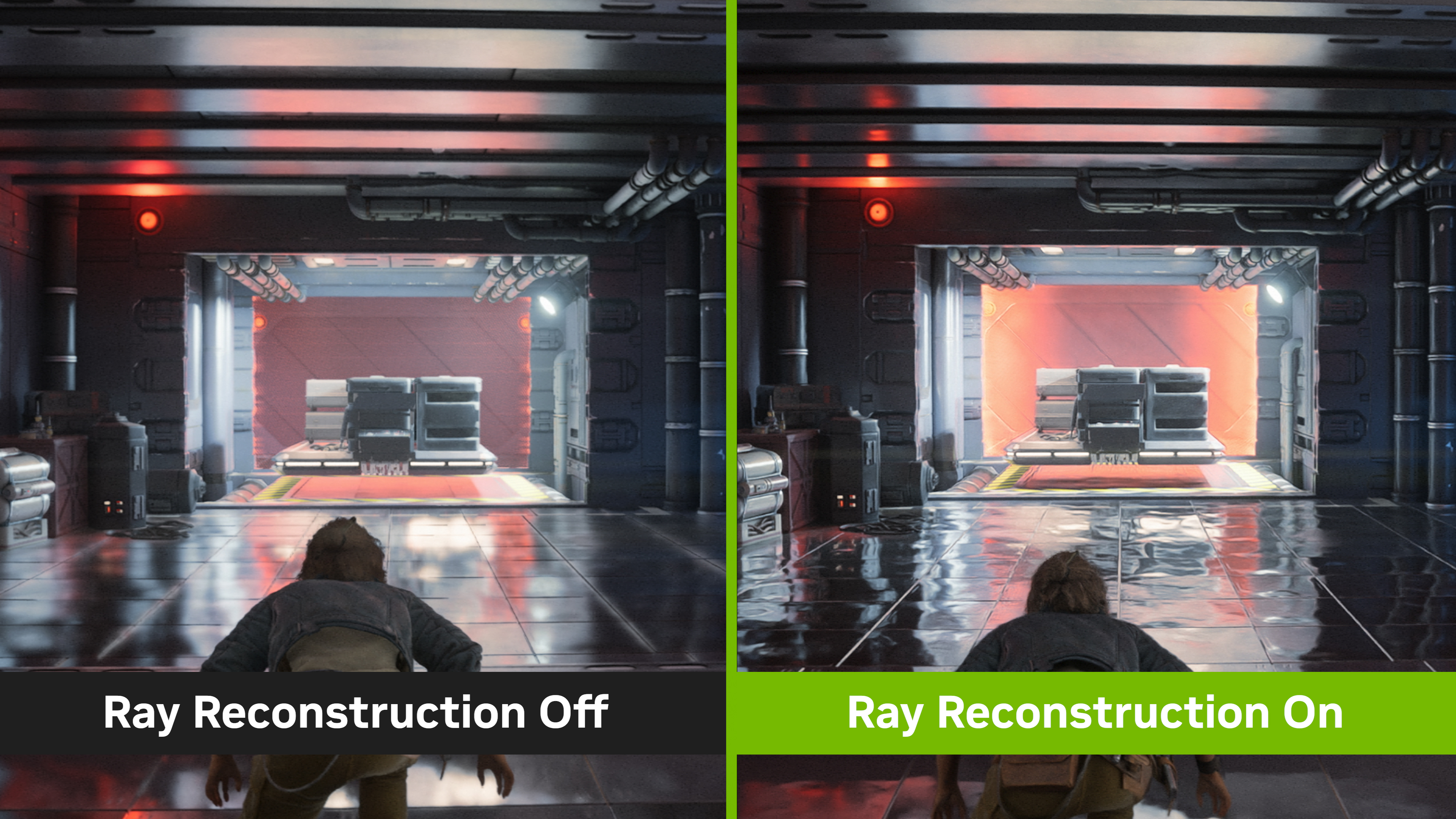
Ray Reconstruction, first introduced in 2021 as part of Nvidia’s RTX Rendering stack, uses AI to reconstruct missing or low-resolution data in scenes rendered with ray tracing. The updated algorithm now employs a multi-scale feature-preserving network, enabling it to retain finer details—such as subtle fabric folds, reflective surfaces, or intricate environmental lighting—without the computational overhead of traditional path tracing. According to Nvidia’s technical documentation, this improvement is particularly noticeable in virtual production, where directors and cinematographers rely on real-time previsualization to make creative decisions.
The enhancement aligns with Nvidia’s broader push to democratize high-end visual effects. As the company’s AI-powered tools integrate deeper into workflows—from Unreal Engine to Blender—the ability to render complex scenes at interactive speeds with near-photorealistic detail could accelerate content creation across industries. But how exactly does this work, and who stands to benefit most?
How Ray Reconstruction Works: The AI Behind the Magic
At its core, Ray Reconstruction is an AI upscaling technique that compensates for the limitations of real-time ray tracing. Traditional ray tracing simulates the physical behavior of light to create hyper-realistic images—but it’s computationally expensive. By contrast, real-time ray tracing (as used in games like Cyberpunk 2077 or Alan Wake 2) often sacrifices detail to hit 60+ frames per second.
Nvidia’s solution leverages a neural network trained on high-resolution renders to predict and reconstruct missing details. The upgraded algorithm now uses a multi-resolution approach: it processes the scene at multiple scales, ensuring that both large-scale lighting and fine-grained textures (e.g., hair strands, glass reflections) are preserved. This is achieved through:
- Feature-aware reconstruction: The AI identifies and prioritizes high-detail areas (e.g., a character’s facial pores or a gem’s facets) while blending them seamlessly with lower-detail regions.
- Dynamic sampling optimization: Instead of uniformly distributing rays across the scene, the algorithm allocates more computational resources to areas where detail matters most, reducing artifacts.
- Temporal stability: For animated scenes (e.g., films or games), the AI maintains consistency across frames, preventing flickering or unnatural transitions.
According to Nvidia’s technical blog, the updated method achieves a ~30% improvement in detail retention compared to the original 2021 version, with minimal impact on performance. For context, In other words a scene that previously lost fine details at 1080p resolution might now retain them at 4K-equivalent quality in real time.
Why This Matters for Creators and Consumers
The implications of this advancement ripple across multiple industries:
1. Gaming: Closer to Cinematic Quality
Game developers have long struggled with the real-time vs. Quality tradeoff. Titles like Star Citizen or Microsoft Flight Simulator use ray tracing for immersive lighting, but often at the cost of resolution or frame rate. With enhanced Ray Reconstruction, studios could now:
- Render games at native 4K or higher without sacrificing ray-traced effects.
- Support dynamic resolution scaling that adapts to detail density, ensuring smooth performance even on mid-range GPUs.
- Enable procedural generation with finer details (e.g., realistic foliage, weather effects) without pre-baking assets.
Nvidia’s partnership with Epic Games to optimize Unreal Engine 5 for RTX technologies suggests this could arrive in upcoming AAA titles. For indie developers, tools like Unity’s HDRP may also integrate these improvements, lowering the barrier to high-end visuals.
2. Film and Virtual Production: Faster Iteration
In virtual production, directors like James Cameron (who uses Nvidia’s Stage Capture system) rely on real-time previsualization to guide shoots. The enhanced Ray Reconstruction could:
- Reduce the need for post-processing fixes by ensuring on-set renders match final output.
- Enable interactive lighting adjustments without waiting for offline renders.
- Support volumetric lighting (e.g., fog, smoke) with higher fidelity in real time.
Nvidia’s Omniverse platform, which connects CAD, animation, and rendering tools, will likely see broader adoption as studios adopt these real-time capabilities. For example, ILMxLAB (Industrial Light & Magic) has already used Omniverse for projects like The Mandalorian, and the improved Ray Reconstruction could further streamline their pipelines.
3. Architecture and Simulation: More Accurate Virtual Worlds
Fields like architectural visualization and scientific simulation depend on precise lighting and material accuracy. The upgrade could enable:
- Real-time daylight simulation for building designs, with accurate reflections and shadows.
- Improved medical training simulations (e.g., surgical planning) with finer anatomical details.
- Enhanced autonomous vehicle testing in virtual environments with more realistic lighting conditions.
Companies like Autodesk, which integrates Nvidia’s RTX technology into Revit and 3ds Max, may adopt these improvements to offer more realistic previews to clients.
Performance and Hardware Requirements
The enhanced Ray Reconstruction is available on:
- Nvidia’s RTX 40-series GPUs (e.g., RTX 4090, RTX 4080) via RTX Rendering.
- Nvidia’s A100 and H100 data center GPUs for professional workloads.
- Cloud-based rendering services like AWS Nvidia Cloud.
While the technology is backward-compatible with older RTX GPUs, users may see better results on Ampere (RTX 30-series) and Ada Lovelace (RTX 40-series) architectures due to improved tensor cores and memory bandwidth. For example, an RTX 4090 can now handle complex scenes with ~2x the detail retention of an RTX 3090 at similar performance levels, according to Nvidia’s internal benchmarks.
What’s Next for Ray Reconstruction?
Nvidia has not announced a formal release date for broader adoption, but the technology is already accessible via:
- Nvidia RTX Rendering SDK (for developers).
- Omniverse Nucleus (for collaborative workflows).
- Upcoming updates to Unreal Engine 5.4 and Unity 2024.
The next major checkpoint will likely be Nvidia’s GTC (GPU Technology Conference) 2025, where the company typically unveils roadmaps for its AI and rendering technologies. Developers can expect:
- Further optimizations for AI upscaling (e.g., integrating with DLSS 3.5).
- Support for new ray-traced effects, such as advanced subsurface scattering or anisotropic reflections.
- Cloud-based rendering APIs for enterprise users.
Key Takeaways
- Detail preservation: The upgraded Ray Reconstruction retains ~30% more fine details in real-time renders compared to 2021.
- Industry impact: Gaming, film, and architecture will see faster workflows with near-cinematic quality.
- Hardware compatibility: Best results on RTX 40-series GPUs, but backward-compatible with older RTX cards.
- AI integration: Works alongside Nvidia’s DLSS, Omniverse, and RTX Rendering stack.
- Future roadmap: Expect deeper Unity/Unreal integration and cloud rendering APIs by mid-2025.
FAQ: What You Need to Know
Q: Will this improve my gaming experience?
A: Yes, but indirectly. Game developers can now create more detailed ray-traced worlds without sacrificing performance. Look for upcoming titles to enable higher-quality ray tracing at native resolutions.
Q: Do I need an RTX 40-series GPU to use it?
A: No, but you’ll see better results on newer GPUs. The technology works on all RTX cards (20/30/40-series), but older hardware may struggle with complex scenes.
Q: How does this differ from DLSS?
A: DLSS uses AI to upscale low-resolution renders, while Ray Reconstruction reconstructs missing details in ray-traced scenes. They often work together: DLSS handles resolution, Ray Reconstruction handles detail.
Q: Can indie developers use this?
A: Absolutely. Nvidia’s RTX Rendering SDK is free, and tools like Unity and Blender (via Nvidia’s Blender add-ons) support it.
Q: When will this be in consumer games?
A: Likely by late 2024 or early 2025, as developers adopt the SDK. Keep an eye on Nvidia’s GeForce NOW for cloud-based demos.
Nvidia’s Ray Reconstruction breakthrough underscores a broader trend: AI is no longer just an optimization tool but a creative collaborator. For developers, this means pushing the boundaries of what’s possible in real time. For consumers, it promises richer visuals without the wait.
Have you experimented with Nvidia’s RTX rendering tools? Share your experiences or questions in the comments below—or tag us on Twitter to discuss how AI is reshaping content creation.
Next checkpoint: Nvidia GTC 2025 (expected March 2025) for official roadmap updates.
Worth a look