
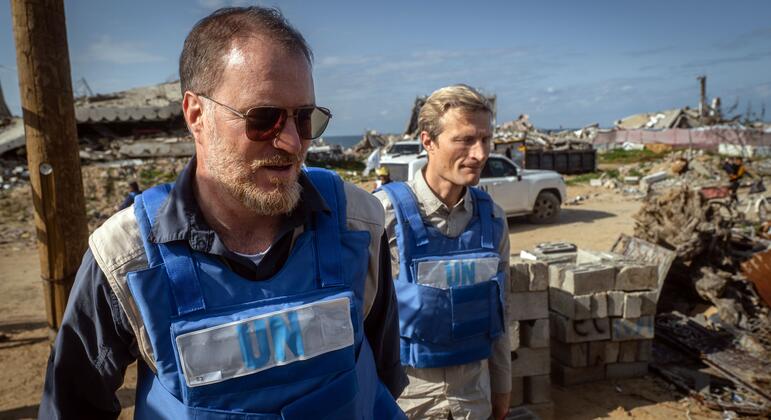
The safety of those who provide life-saving aid in the world’s most dangerous regions has reached a critical breaking point. In a stark warning delivered to the United Nations Security Council, officials revealed that over 1,000 humanitarians have been killed in three years, signaling a dangerous erosion of the protections traditionally afforded to aid workers under international law.
The data presented to the Council underscores a growing trend of violence against neutral parties. According to reports, at least 326 humanitarians were killed in the line of duty across 21 countries during 2025 alone, contributing to a three-year death toll that now exceeds 1,010 individuals UN News.
Representing the International Committee of the Red Cross (ICRC), officials warned the Security Council that the world is “losing our humanity in war.” This plea highlights the increasing difficulty of maintaining humanitarian space in active conflict zones, where the distinction between combatants and neutral aid providers is being systematically ignored.
The Escalating Toll on Humanitarian Personnel
The scale of the loss is staggering. The fact that over 1,000 humanitarians have been killed in three years indicates that the risks associated with delivering aid are no longer incidental but are becoming a systemic feature of modern warfare. The 2025 figures—showing 326 deaths across 21 different countries—demonstrate that this is a global crisis rather than one isolated to a single region.
These figures are not merely statistics. they represent the loss of trained medical professionals, logistics experts, and community workers who are essential for the survival of millions of civilians. When aid workers are targeted or killed, the “humanitarian space”—the operational environment that allows neutral parties to provide assistance—shrinks, leaving vulnerable populations without food, water, or medical care.
The UN Security Council has held multiple sessions to address these trends, focusing specifically on the safety and security of humanitarian personnel UN Security Council. The ICRC’s involvement in these discussions emphasizes the urgency of returning to the core principles of International Humanitarian Law (IHL), which mandates the protection of those not taking part in hostilities.
Protection of Civilians and the Collapse of Neutrality
The crisis facing aid workers is inextricably linked to the broader failure to protect civilians in armed conflict. The Security Council has recently met to discuss the Protection of Civilians (PoC) in armed conflict, recognizing that the disregard for humanitarian personnel is often a precursor or accompaniment to wider atrocities against non-combatants UN Media.
Neutrality is the cornerstone of humanitarian action. By remaining neutral and impartial, organizations like the ICRC and various UN agencies can negotiate access to both sides of a conflict to deliver aid. However, when aid workers are viewed as targets or as extensions of political entities, that neutrality is compromised. The warning that we are “losing our humanity in war” refers to this specific collapse: the abandonment of the basic moral and legal agreement that those helping the wounded and hungry should be safe from attack.
Why This Matters for Global Security
The targeting of humanitarians has immediate and long-term consequences for global stability:

- Reduced Access: As risks increase, agencies may be forced to suspend operations in high-risk areas, leaving millions without essential services.
- Erosion of International Law: The failure to hold perpetrators of attacks on aid workers accountable encourages further violations of the Geneva Conventions.
- Increased Civilian Suffering: When the “last mile” of aid delivery is severed by violence, civilian mortality rates rise sharply due to preventable causes.
The Path Forward: Accountability and International Law
The International Red Cross and UN officials are calling for more than just condemnations. The core of the issue is a lack of accountability. When humanitarians are killed with impunity, it sends a signal to all warring parties that international laws are optional.
The UN Security Council is tasked with maintaining international peace and security, and the current trend of violence against aid workers represents a direct threat to that mandate. Strengthening the legal frameworks that protect humanitarian personnel and ensuring that attacks are investigated and prosecuted are the only viable ways to reverse this trend.
The international community must move beyond rhetoric to ensure that the 21 countries where these killings occurred in 2025 are held to the standards of the laws of war. Without a concerted effort to restore the safety of humanitarian personnel, the ability to provide neutral, impartial aid in the world’s most desperate zones may vanish entirely.
The UN Security Council will continue to monitor the safety and security of humanitarian personnel as part of its ongoing mandate to protect civilians in armed conflict. Further briefings from the ICRC and other humanitarian agencies are expected as the Council seeks to implement more robust protection measures.
We invite our readers to share their thoughts on how the international community can better protect those who risk their lives to save others. Please share this article to raise awareness about the plight of humanitarian workers.