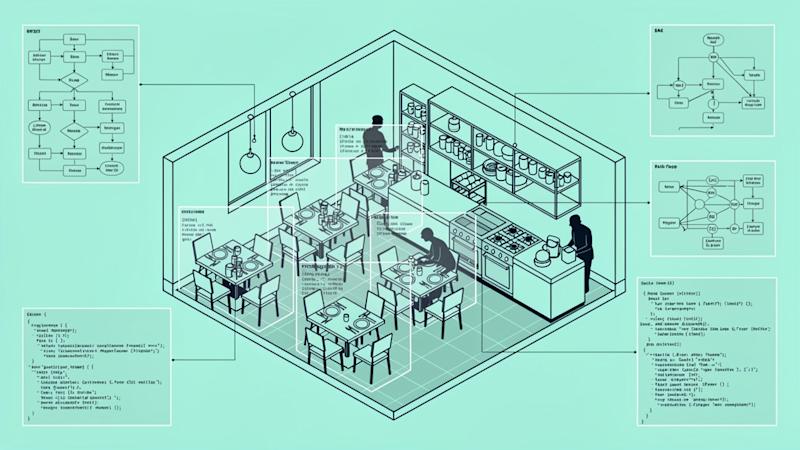
building the Restaurant Operating System: How Palona is Pioneering Specialized AI for Hospitality
The hype around general AI assistants is immense, but the real revolution in enterprise AI isn’t about broad capabilities – itS about depth. At Palona, we’re focused on building specialized “operating systems” for specific industries, starting with restaurants. Our vision is to create AI that doesn’t just respond to requests, but actively runs restaurant operations, anticipating needs and preventing problems before they arise.
This isn’t about replacing human expertise; it’s about augmenting it. As our CEO, Zhang, puts it: “If you’ve got that flavorful food nailed… we’ll tell you what to do.” Here’s a deep dive into the technical challenges we’ve overcome and the principles guiding our approach.
The Problem with “Off-the-shelf” AI in Restaurants
Applying generic AI to the complexities of a restaurant environment quickly reveals its limitations. Simple physics, let alone nuanced customer interactions, can throw these systems off. A dropped phone is a simple exmaple, but in a restaurant, an AI error translates to wasted food, frustrated customers, and potential safety hazards.
The reality is, existing AI tools often aren’t robust enough for the demands of a fast-paced, high-stakes environment like a kitchen or dining room. We’ve seen firsthand how easily these systems can hallucinate data, as demonstrated by recent incidents like the one at Stefanina’s Pizzeria in Missouri, where AI-generated fake deals eroded customer trust.
Muffin: A Custom Memory Architecture for Restaurant Intelligence
One of the biggest hurdles we faced was memory management. A truly helpful AI needs to remember a diner’s “usual” order, their allergies, and their loyalty preferences. Standard AI memory solutions, often based on vector databases, struggle with the structured data inherent in restaurant operations.
To address this, we built Muffin, a proprietary memory management system inspired by web “cookies.” Muffin organizes information into four distinct layers:
* Structured Data: Essential, unchanging facts like delivery addresses and allergy information.
* Slow-changing Dimensions: Loyalty program details and frequently ordered items.
* Transient & Seasonal Memories: Adapting to trends like increased demand for iced tea in the summer.
* Regional context: Automatically adjusting for time zones, language, and local preferences.
This layered approach allows Muffin to handle the diverse and dynamic information flow within a restaurant, delivering a far more accurate and personalized experience. The key takeaway? Don’t be afraid to build custom solutions when off-the-shelf tools fall short.
Ensuring Reliability with the GRACE Framework
Reliability isn’t just desirable in a restaurant – it’s critical. That’s why we developed GRACE, our internal framework for building safe and dependable AI agents:
* Guardrails: Strict limits on agent behavior to prevent unauthorized promotions or actions.
* Red Teaming: Proactive testing to identify and address potential vulnerabilities and hallucination triggers.
* App Sec: Robust security measures,including TLS,tokenization,and attack prevention systems,to protect APIs and integrations.
* Compliance: Ensuring all responses are grounded in verified, up-to-date menu data.
* Escalation: Seamlessly transferring complex requests to a human manager when necessary.
We rigorously test GRACE through massive simulation. We’ve simulated over a million pizza orders, pitting one AI against another to identify and eliminate inaccuracies. This commitment to proactive testing is paramount.
Vision & Workflow: Beyond Chatbots, Towards Restaurant Automation
With the launch of Vision and Workflow, Palona is moving beyond simple conversational AI. We’re building a system that can see what’s happening in the kitchen, hear customer orders, and think through the entire restaurant workflow.
This means:
* Automated Order Taking: Accurately capturing orders, even with complex customizations.
* Real-time Inventory Management: Tracking ingredient levels and alerting staff to potential shortages.
* Proactive Issue Detection: Identifying potential problems – like a delayed order or a forgotten allergy request – before they impact the customer experience.
* Streamlined Operations: Optimizing workflows to improve efficiency and reduce waste.
the Future of Restaurant AI: Specialized Systems, Human
Keep reading