Pamplona’s Monument to the Fallen: Two Finalist Designs Selected for Controversial Redesign
PAMPLONA, Spain — The city of Pamplona has taken a decisive step toward redefining its contentious Monument to the Fallen, selecting two finalists from an international architectural competition to transform the Franco-era mausoleum into a museum-memorial. The proposals, “Harriak Hitz” and “Itzaletik Argira,” will now enter a public participation phase beginning June 10, inviting citizens to shape the final design of what promises to be one of Spain’s most significant memory projects.
The selection marks a turning point in Pamplona’s ongoing efforts to address its Francoist legacy, with both proposals emphasizing symbolic “desactivation” of the monument’s authoritarian presence while preserving its structural integrity. The city received 21 submissions for the competition, but only these two met the jury’s rigorous criteria for architectural quality, symbolic transformation, and civic engagement.
Why it matters: The Monument to the Fallen stands as a potent symbol of Spain’s divided memory, commemorating victims of the Spanish Civil War while also serving as a shrine to Francoist ideology. Its redesign reflects broader societal debates about how to confront historical trauma while creating inclusive public spaces.
The two finalists—”Harriak Hitz” (Basque for “Stone Speaks”) and “Itzaletik Argira” (From Shadow to Light)—represent fundamentally different approaches to memorialization. Both proposals share key objectives: eliminating the monument’s elevated crypta, removing barriers to accessibility, and reorienting the building’s relationship with its urban surroundings. However, their architectural visions couldn’t be more distinct—one favoring austerity and material continuity, the other embracing transparency and modernist intervention.
Joxe Abaurrea, Pamplona’s delegate for Strategic Government, Urban Planning, Housing, and the 2030 Agenda, emphasized in a press conference that “these proposals achieve an exceptional balance between architectural quality and symbolic transformation.” He noted that while all 21 submissions were of high caliber, only these two fully addressed the competition’s four core criteria: breaking the monument’s political hegemony, altering the city’s skyline, democratizing public space, and ensuring universal accessibility.
Competition Overview: The international call for proposals attracted 21 submissions, but only “Harriak Hitz” and “Itzaletik Argira” were selected by unanimous jury decision. Both teams will now engage in a two-week public consultation process beginning June 10, with citizens able to provide feedback through both in-person presentations and an online questionnaire.
Budget Considerations: The jury awarded both proposals top marks for technical and economic viability, with estimated construction costs of €9.8 million for “Harriak Hitz” and €10.5 million for “Itzaletik Argira.” The final selection will be made through a negotiated procedure overseen by a technical committee from Pamplona’s city government.
The Two Finalist Proposals: A Study in Contrasts
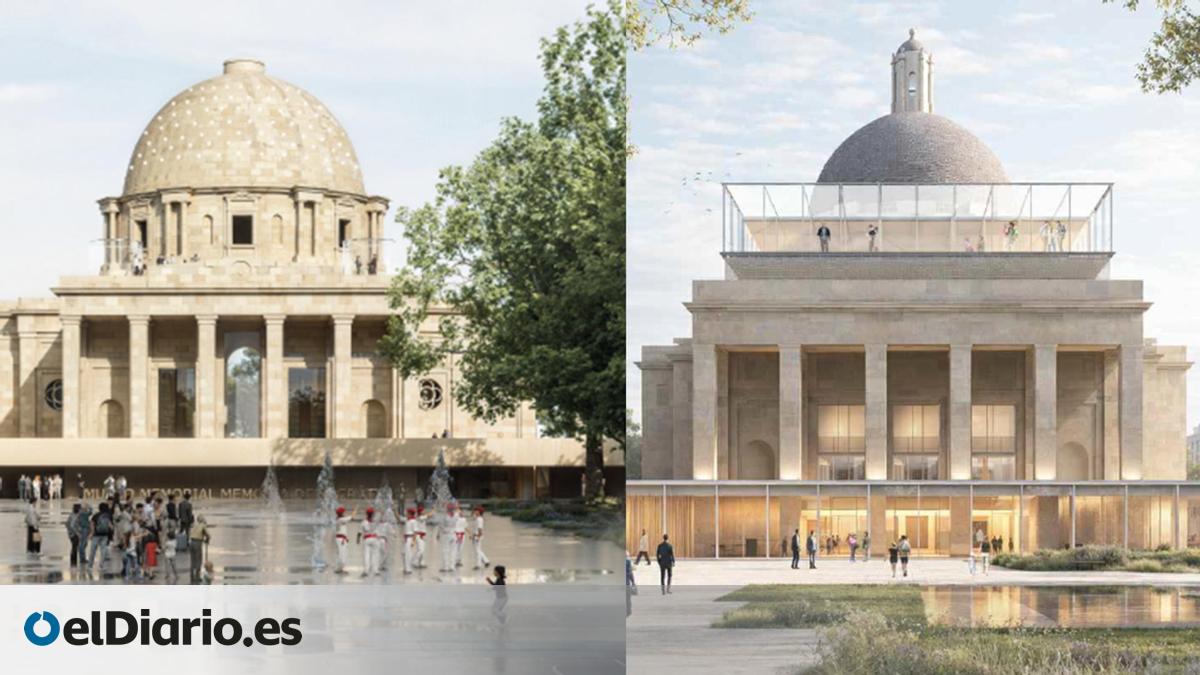
Harriak Hitz: The Austere Recomposition
Led by architect Antonio Vaillo i Daniel and historian Santiago de Navascués Martínez, “Harriak Hitz” presents a design that prioritizes material continuity and horizontal expansion. The team proposes:
- Crypta Transformation: The underground crypt will be emptied of its current Francoist iconography and repurposed as the museum’s main entrance, with a new access level aligned with the surrounding plaza.
- Cupola Redesign: The signature dome will lose its current lantern and small pavilions, with the slate roofing replaced by stone slabs matching the building’s original façade—creating visual harmony while eliminating the structure’s most overtly monumental elements.
- Horizontal Expansion: A substantial transverse plinth will be added at crypt level, creating pedestrian pathways beneath the existing arcades and connecting adjacent plazas (Libertad and Serapio Esparza).
- Symbolic Strategy: The jury highlighted the proposal’s “asymmetric zócalo” as a masterstroke of symbolic desactivation, using horizontal elements to counter the building’s vertical dominance.
The team’s approach reflects a deep engagement with Pamplona’s historical memory, with Navascués Martínez bringing specialized knowledge of the region’s Civil War-era repression. Their design aims to “neutralize the building’s political charge” while preserving its architectural heritage—a delicate balance that has resonated with the jury.
Visual Reference:
Itzaletik Argira: The Transparent Intervention
Presented by a consortium including OM ARQ SLP, voilà! estudio, and Tesela SL, “Itzaletik Argira” takes a more interventionist approach, using glass and light to fundamentally alter the monument’s perception:
- Arcade Removal: The building’s lateral arcades will be eliminated to create open pedestrian connections between Pamplona’s Ensanche district and the Lezkairu neighborhood.
- Glass Volume: A new crystalline structure will be inserted at crypt level, serving as both the museum entrance and a visual counterpoint to the original dome.
- Cupola Mirador: The dome’s base will feature a glass-enclosed observation deck, fundamentally altering the building’s skyline profile and creating a new urban landmark.
- Sustainable Integration: The proposal includes a green roof with potential for semi-transparent photovoltaic panels, demonstrating commitment to modern environmental standards.
The jury praised this design’s “perceptible transformation of the skyline,” noting that the glass interventions would create “effective transversal permeability” between different parts of the city. However, they flagged concerns about the cost and complexity of replacing the dome’s slate roof with glass—a change that, while visually striking, may not offer sufficient symbolic or functional benefits.
Visual Reference:
Shared Principles: How Both Proposals Address Core Challenges
Despite their architectural differences, both finalists converge on several key objectives that reflect Pamplona’s broader goals for the project:

- Democratization of Space: Both proposals eliminate the current elevated crypt entrance, replacing it with ground-level access that meets universal accessibility standards. The jury specifically commended this as a crucial step toward “breaking the monument’s political hegemony over the city.”
- Urban Integration: Each design seeks to reintegrate the monument into Pamplona’s fabric rather than treating it as an isolated landmark. “Harriak Hitz” does this through horizontal expansion, while “Itzaletik Argira” uses vertical transparency.
- Symbolic Desactivation: Both teams employ strategies to reduce the building’s overtly monumental character—whether through material uniformity (“Harriak Hitz”) or visual fragmentation (“Itzaletik Argira”).
- Memorial Function: While the competition focused on architectural transformation, both proposals inherently support the museum-memorial function by creating flexible exhibition spaces within the existing structure.
The Public Participation Process: How Citizens Will Shape the Final Design
The next phase of the project will be the most democratic to date, with Pamplona’s city government committing to extensive civic engagement. The process will unfold as follows:
- June 10 Presentation: Both finalists will present their proposals at the Monument to the Fallen. Due to limited capacity (200 seats), attendance will require advance registration via the city’s 010 information line (948 420 100) starting May 26. The event will also be streamed live for broader access.
- Two-Week Exhibition: From June 10-24, detailed models and information about both proposals will be displayed at the monument site during evening hours (17:00-20:00).
- Citizen Feedback: Registered Pamplona residents aged 16 and older can submit opinions through an online questionnaire during the exhibition period.
- Technical Negotiation: The city government will analyze all feedback to develop a final technical specification, which will then be negotiated between the two finalist teams.
- Final Selection: A technical committee from the city council will make the definitive choice based on the negotiated proposals and public input.
Participation Details: For those wishing to engage:
- Registration: Call 010-948 420 100 starting May 26 for in-person event tickets
- Streaming: Available via Pamplona City Council’s official channels
- Questionnaire: Open June 10-24 for registered residents
- Official Updates: Follow @PamplonaOficial for announcements
Broader Context: Why This Project Matters for Spain’s Memory Debates
The Monument to the Fallen in Pamplona is one of hundreds of similar structures across Spain erected during and after Franco’s dictatorship (1939-1975). These monuments originally served to glorify the regime’s fallen soldiers while downplaying or ignoring Republican victims. In recent decades, many Spanish cities have begun reconsidering these sites, often converting them into spaces for memorialization and historical education.
Pamplona’s approach is particularly significant because:
- Navarre’s Complex History: As the heart of Spain’s Basque Country, Navarre has a unique relationship with both the Francoist regime and the broader Spanish transition to democracy. The monument’s redesign must navigate these sensitivities.
- Urban Integration: Unlike some memorial projects that isolate controversial structures, Pamplona’s plan seeks to reintegrate the monument into the city’s daily life through accessible, democratic design.
- International Precedent: The competition attracted submissions from across Europe, reflecting growing global interest in how to handle controversial heritage sites.
This project builds on Pamplona’s existing efforts to confront its past. In 2025, the city planted a 35-meter “Tree of Memory” near the monument, inscribed with the names of Civil War victims—a gesture that foreshadowed the current architectural competition. The upcoming redesign represents the next phase in this ongoing process of historical reckoning.
What Happens Next: The Timeline for Implementation
The public participation phase is scheduled to conclude by late June, with the city government expected to:
- Finalize the technical specification by July 2026
- Launch the negotiated procedure between finalists by August 2026
- Select the winning proposal by October 2026
- Begin construction in early 2027, with completion targeted for 2028-2029
Official Resources: For those following the project:
- Pamplona City Council – Official project updates
- @PamplonaOficial – Twitter feed for announcements
- Navarre Regional Government – Additional context on memory policies
Key Takeaways
- Dual Approaches: The two finalists represent contrasting philosophies—one favoring material continuity (“Harriak Hitz”), the other embracing modern transparency (“Itzaletik Argira”).
- Public Voice Matters: Citizen participation will directly influence the final design, with two weeks of exhibitions and questionnaires shaping the outcome.
- Budget Realism: Both proposals received top marks for economic viability, with estimated costs under €11 million.
- Symbolic Transformation: The jury emphasized that both designs successfully “desactivate” the monument’s authoritarian symbolism while preserving its structural integrity.
- National Significance: Pamplona’s project serves as a model for how Spanish cities are reimagining Franco-era monuments as spaces for collective memory.
How to Follow the Story
This is an evolving story with multiple opportunities for civic engagement. World Today Journal will continue to monitor developments, including:
- The June 10 public presentation and streaming event
- Citizen feedback analysis by Pamplona’s government
- The technical negotiation phase between finalists
- Final selection announcement (expected October 2026)
We encourage readers to share their perspectives on how controversial historical monuments should be treated in modern democratic societies. What principles should guide their redesign? Should they be preserved as-is, demolished, or repurposed like Pamplona’s Monument to the Fallen? Join the discussion in the comments below.
Keep reading