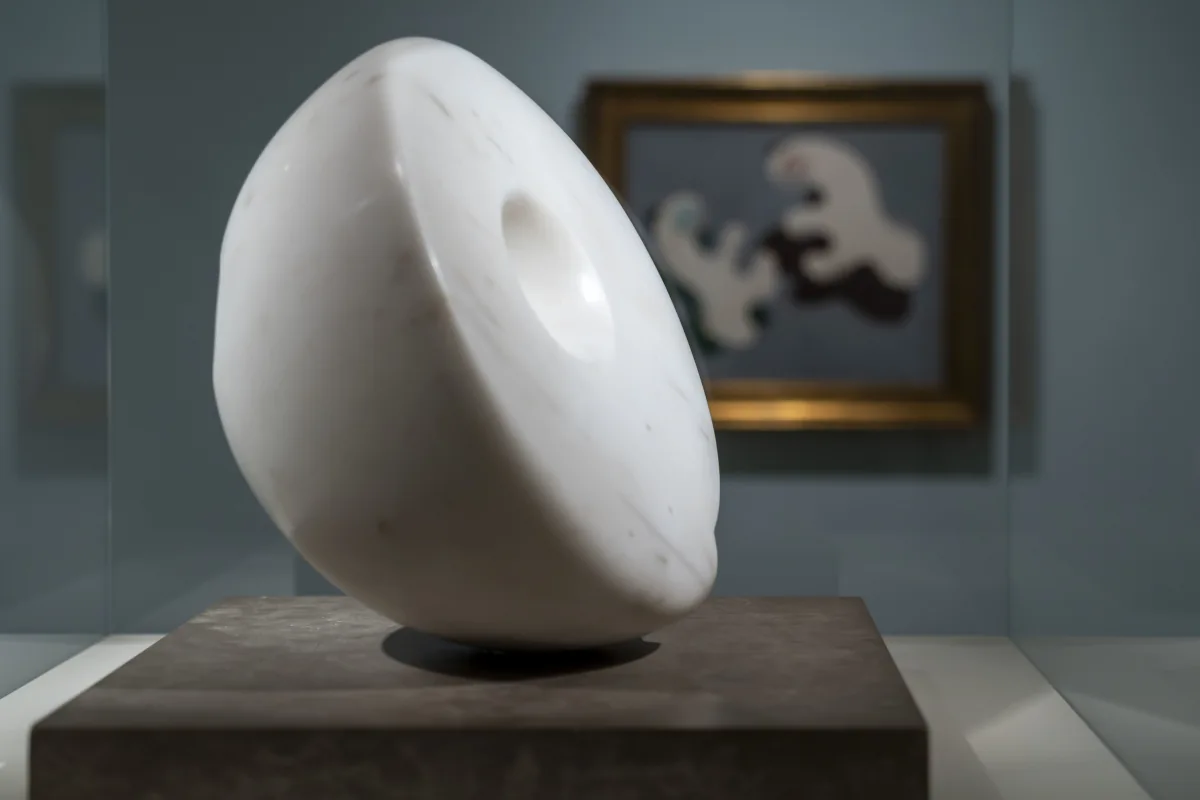
LONDON — In the heart of 1930s London, when the city’s artistic pulse was beating strongest in its avant-garde circles, Peggy Guggenheim was about to make history—not as a seasoned collector, but as a pioneering gallerist. The exhibition Peggy Guggenheim in London: The Making of a Collector, now on view at the Peggy Guggenheim Collection through October 19, 2026, illuminates the transformative 18 months (January 1938 to June 1939) when Guggenheim Jeune, her groundbreaking gallery, reshaped the trajectory of modern art in Britain. This is the story of how a young American heiress, armed with vision and a network of radical artists, became one of the 20th century’s most influential patrons.
Guggenheim Jeune was more than a gallery—it was a manifesto. Opened in 1938 at 30 Cork Street, the space became a magnet for Surrealists, abstract painters, and experimental thinkers fleeing Europe’s political turmoil. Among its walls, Vasily Kandinsky staged his first solo exhibition in London, Jean Cocteau’s work was celebrated in a monographic show, and the UK’s first dedicated collage exhibition challenged artistic conventions. The gallery’s programming was bold: it hosted Barbara Hepworth, Henry Moore, and Sophie Taeuber-Arp alongside lesser-known figures like Rita Kernn-Larsen and Cedric Morris. “This was not just about showing art,” says Gražina Subelytė, curator of the Peggy Guggenheim Collection and co-organizer of the exhibition. “It was about creating a dialogue between European modernism and British innovation.”
Yet Guggenheim’s London venture was more than an artistic experiment—it was a crucible for her future legacy. The exhibition traces how her relationships with figures like Marcel Duchamp, Samuel Beckett, and Mary Reynolds (a fellow collector and confidante) honed her discernment. By the time Guggenheim Jeune closed in 1939, she had already begun assembling the collection that would define her name: works by Picasso, Pollock, and Miró, acquired during this formative period. The show’s curators emphasize that her London years were “the missing link” between her early patronage and her later role as a titan of modern art.
Why This Gallery Changed Art History
Guggenheim Jeune’s impact lies in its audacity. In an era when London’s art scene was dominated by conservative institutions, the gallery’s exhibitions were provocative. Kandinsky’s first UK solo show, for instance, introduced British audiences to the emotional intensity of abstract expressionism—a movement that would later dominate post-war American art. The controversial contemporary sculpture exhibition, meanwhile, pushed boundaries by featuring works that defied traditional aesthetics. “Peggy didn’t just collect art,” notes Simon Grant, guest curator and co-organizer. “She collected ideas, and those ideas traveled with her to Venice, where her collection now resides.”
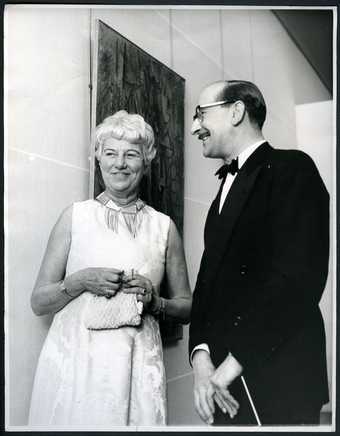
One standout moment was the first group exhibition dedicated to collage in the UK. Organized by Guggenheim Jeune, it featured works by Eileen Agar, whose photomontages blurred the line between fine art and political commentary. Agar’s Black and White: Fantasy of Negatives (1936), shown at the gallery, became a symbol of the era’s radical creativity. “Collage was seen as a democratic medium,” explains Subelytė. “Peggy believed in its power to democratize art—and that belief shaped her entire career.”
A Network That Defined an Era
The exhibition’s second act explores Guggenheim’s social circle—the artists, writers, and thinkers who shaped her taste and, in turn, were shaped by her patronage. Marcel Duchamp, already a legend by 1938, became a mentor figure, while Samuel Beckett (then a rising playwright) and Mary Reynolds (a fellow collector with a sharp eye for emerging talent) offered intellectual sparring. “Peggy was a sponge,” Grant observes. “She absorbed everything—from the Surrealists’ obsession with the subconscious to the Constructivists’ fascination with industry.”
Reynolds, in particular, played a pivotal role. A fellow American expatriate, she introduced Guggenheim to London’s artistic underground, including the Seven & Five Society, a group of abstract painters who became key collaborators. Their influence is visible in Guggenheim’s early acquisitions, such as a 1938 work by Ben Nicholson, a member of the society. “Mary was her sounding board,” says Subelytė. “Together, they decided which artists deserved a platform—and which would define the future.”
From London to Legacy: Where the Story Goes Next
The exhibition will travel to two more iconic venues after its run at the Peggy Guggenheim Collection. From November 21, 2026, it will move to the Royal Academy of Arts in London, followed by a stop at the Solomon R. Guggenheim Museum in New York (April 16, 2027–September 12, 2027). These transitions reflect Guggenheim’s own journey: from a London outsider to a global tastemaker.
For art historians, the show offers a rare glimpse into the “pre-Guggenheim” years—a time when her collecting instincts were still raw but her instincts were unmistakably sharp. “This exhibition isn’t just about Peggy,” Grant reflects. “It’s about the moment when modern art stopped being a European experiment and became a global language.”
Key Takeaways
- Pioneering Platform: Guggenheim Jeune was London’s first gallery to champion abstract art and Surrealism on a large scale, introducing British audiences to movements that would later dominate post-war art.
- Network Effects: Peggy Guggenheim’s collaborations with Marcel Duchamp, Samuel Beckett, and Mary Reynolds were critical in shaping her collecting philosophy and the artistic direction of her gallery.
- Legacy in Motion: The exhibition traces how her London acquisitions—works by Kandinsky, Hepworth, and others—became the foundation of her future collection in Venice.
- Cultural Shift: By 1939, Guggenheim Jeune had redefined London as a hub for avant-garde experimentation, a reputation that would attract further international talent.
- Traveling Narrative: The show’s upcoming stops at the Royal Academy and Guggenheim New York underscore its role in bridging transatlantic modernism.
The next checkpoint for this story is the exhibition’s opening at the Royal Academy of Arts on November 21, 2026. Curators have hinted at new archival discoveries—including correspondence between Guggenheim and Beckett—that may further illuminate her London years. For those unable to attend, the Peggy Guggenheim Collection’s digital archives (link) offer a preview of the gallery’s original exhibition catalogs and visitor lists.
What do you think was Guggenheim Jeune’s most daring exhibition? Share your thoughts in the comments—or tag us on social media with #GuggenheimLondon. For more on modern art’s global journey, explore our Culture & Heritage section.
Related reading