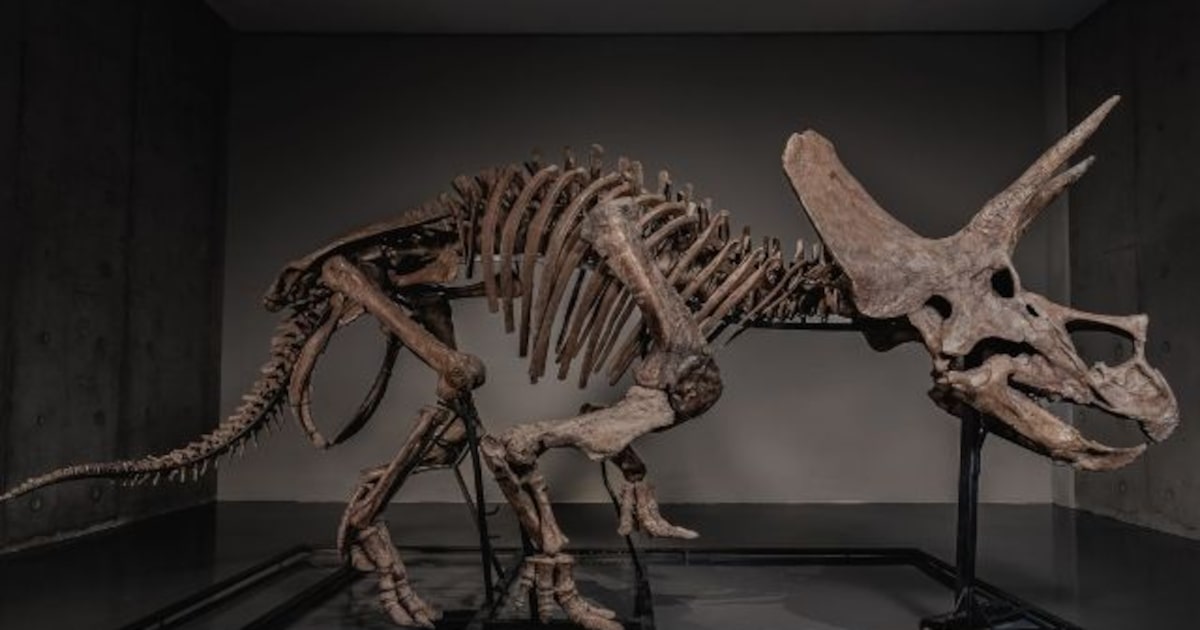
A remarkably well-preserved Triceratops skeleton, nicknamed “Trey,” is heading to auction next month, potentially fetching between $4.5 and $5.5 million. The fossil, which once served as a centerpiece exhibit at the Wyoming Dinosaur Center for three decades, is being offered by Joopiter, the online auction house founded by musician and producer Pharrell Williams. This sale marks a rare instance of a museum-exhibited dinosaur skeleton being offered to private collectors, occurring amidst a surge in the market for prehistoric artifacts.
The impending auction has already generated significant buzz within paleontological and collecting circles. Trey represents a unique opportunity to acquire a scientifically significant specimen with a rich public history. The 66-million-year-old herbivore, dating back to the late Cretaceous period, is estimated to be 5.3 meters (approximately 17.4 feet) long, and 2.21 meters (approximately 7.3 feet) tall, comparable in size to a New York City taxi, according to Joopiter. The auction will take place between March 17th and March 31st, offering potential buyers a chance to own a piece of prehistoric history.
A Legacy Unearthed: The Discovery and History of ‘Trey’
The story of “Trey” begins in 1993, near Lusk, Wyoming. Paleontologist Allen Graffham, credited with discovering over 50 dinosaur species, and fossil hunter Lee Campbell unearthed the Triceratops remains in the Lance Formation, a geological formation known for its rich dinosaur fossils from the late Cretaceous period. The Lance Formation provides a window into the final moments before the Cretaceous-Paleogene extinction event, approximately 66 million years ago. Following its excavation, the skeleton was transported to Germany for meticulous restoration before returning to the United States in 1995, becoming a cornerstone of the newly opened Wyoming Dinosaur Center. Joopiter details the extensive history of the specimen, highlighting its decades-long public display.
For thirty years, “Trey” captivated visitors at the Wyoming Dinosaur Center, becoming a defining symbol of the region’s paleontological heritage. More than one million people encountered the dinosaur firsthand, inspiring a sense of wonder and providing invaluable educational opportunities. The Triceratops, with its iconic frill and three horns, is arguably one of the most recognizable dinosaurs, and “Trey” served as a tangible link to a lost world. The Wyoming Dinosaur Center, a non-profit organization, reportedly decided to auction the fossil to secure its financial future and support ongoing paleontological research and educational programs.
The Rising Market for Dinosaur Fossils
The auction of “Trey” occurs within a broader context of escalating prices for dinosaur fossils. The market has seen a dramatic increase in demand from both private collectors and institutions in recent years. In 2020, a nearly complete Tyrannosaurus rex skeleton named “Stan” sold for a record-breaking $31.8 million at Christie’s, as reported by the Associated Press, demonstrating the immense value placed on these prehistoric relics. More recently, in 2024, Sotheby’s achieved another record with the sale of an Stegosaurus fossil named “Apex” for $44.6 million, becoming the most valuable fossil ever sold at auction. These sales underscore the growing appeal of dinosaur fossils as both scientific specimens and investment opportunities.
The increasing demand has sparked debate within the paleontological community. Some scientists express concern that the commercialization of fossils could hinder scientific research by placing valuable specimens in private hands, limiting access for study. Others argue that private sales can generate funding for further paleontological endeavors. The debate highlights the complex ethical considerations surrounding the ownership and preservation of these irreplaceable pieces of Earth’s history.
What Makes ‘Trey’ Unique?
According to Joopiter, “Trey” is particularly significant due to its extensive documentation and public exhibition history. The auction house emphasizes that it is “the only museum-exhibited Triceratops skeleton ever to come to auction,” as noted by Artnet News. This extensive history adds to its cultural and scientific value. The specimen is described as a sub-adult, meaning it was not fully grown at the time of its death, yet still represents a monumental and visually impressive display piece. Fully grown Triceratops could reach up to 9 meters (approximately 30 feet) in length and weigh as much as two elephants, making them formidable herbivores.
Beyond the fossil itself, the auction includes the rights to intellectual property associated with “Trey,” offering opportunities for branding, licensing, and commercial exploitation. Potential buyers could leverage the dinosaur’s image for merchandise, educational content, animation, film, and live experiences. This adds another layer of value to the acquisition, extending beyond scientific or collector’s interest.
The Triceratops: A Cretaceous Icon
The Triceratops is a genus of herbivorous ceratopsid dinosaur that thrived during the late Cretaceous period, approximately 68 to 66 million years ago. Characterized by its large bony frill and three prominent horns, the Triceratops is one of the most recognizable dinosaurs. Its name, derived from the Greek words for “three-horned face,” accurately reflects its distinctive features. Paleontologists believe the horns and frill served multiple purposes, including defense against predators like the Tyrannosaurus rex, display for mating rituals, and species recognition.
The discovery of Triceratops dates back to 1889, when O.C. Marsh named the genus based on a skull discovered in Wyoming. Since then, numerous Triceratops fossils have been unearthed, providing valuable insights into the dinosaur’s anatomy, behavior, and evolutionary history. The Triceratops played a crucial role in reconstructing Maastrichtian ecosystems, the geological stage representing the final period of the Cretaceous period.
Looking Ahead: The Future of ‘Trey’
The auction of “Trey” represents a pivotal moment for both the fossil and the broader paleontological community. The outcome will likely influence future decisions regarding the sale of museum-exhibited fossils and the balance between scientific access and private ownership. The auction is scheduled to conclude on March 31st, and the final sale price will be closely watched by collectors, scientists, and enthusiasts alike. Interested bidders can participate through Joopiter’s online platform.
The sale also raises questions about the long-term preservation and accessibility of such significant specimens. While a private collector could provide dedicated care and display, concerns remain about limiting scientific research opportunities. The future of “Trey” will depend on the vision and priorities of its new owner.
As the auction draws near, the story of “Trey” serves as a reminder of the enduring fascination with dinosaurs and the importance of preserving these remnants of a bygone era. The sale is a unique opportunity to acquire a piece of prehistoric history, but it also underscores the ongoing debate about the ethical and scientific implications of fossil commercialization.
Key Takeaways:
- A Triceratops skeleton named “Trey,” previously displayed at the Wyoming Dinosaur Center, is going to auction through Joopiter.
- The estimated sale price ranges from $4.5 to $5.5 million.
- The auction reflects a growing market for dinosaur fossils, with record-breaking sales in recent years.
- The sale raises ethical questions about the commercialization of fossils and their accessibility for scientific research.
What are your thoughts on the auction of dinosaur fossils? Share your opinions in the comments below, and be sure to share this article with anyone interested in paleontology and prehistoric life!
Worth a look