The Declaration of Independence of the United States of America remains a foundational document in global political philosophy, marking the formal transition of thirteen British colonies into a sovereign nation. Adopted by the Continental Congress on July 4, 1776, the text serves as both a legal instrument of secession and a manifesto for the principles of natural rights and the consent of the governed, according to the translation provided by Biografieonline.
At its core, the document asserts that all individuals possess inalienable rights—specifically life, liberty, and the pursuit of happiness—and that governments are established solely to secure these interests. When a governing power systematically violates these ends, the document argues that the populace holds both the right and the duty to alter or abolish that government. This philosophy shifts the basis of political legitimacy from monarchical authority to the collective will of the citizens, a concept that continues to influence modern democratic discourse and international human rights frameworks.
Historical Context of the 1776 Secession
The decision to separate from Great Britain was not taken lightly, as the text acknowledges the necessity of “a decent respect to the opinions of mankind” in justifying their break from the British Empire. The text details a long history of grievances against King George III, characterizing his rule as an “absolute tyranny” over the American states. According to the translation provided by Biografieonline, these grievances included the refusal to approve necessary public laws, the dissolution of representative legislative bodies, and the obstruction of judicial administration.
The document systematically lists several abuses, ranging from the imposition of taxes without consent to the deployment of military forces without legislative approval. By framing these actions as a “long train of abuses and usurpations,” the signers sought to demonstrate that the British Crown had forfeited its right to govern the colonies. This meticulous documentation of royal overreach served to provide a legal and moral justification for the independence movement to the international community of the 18th century.
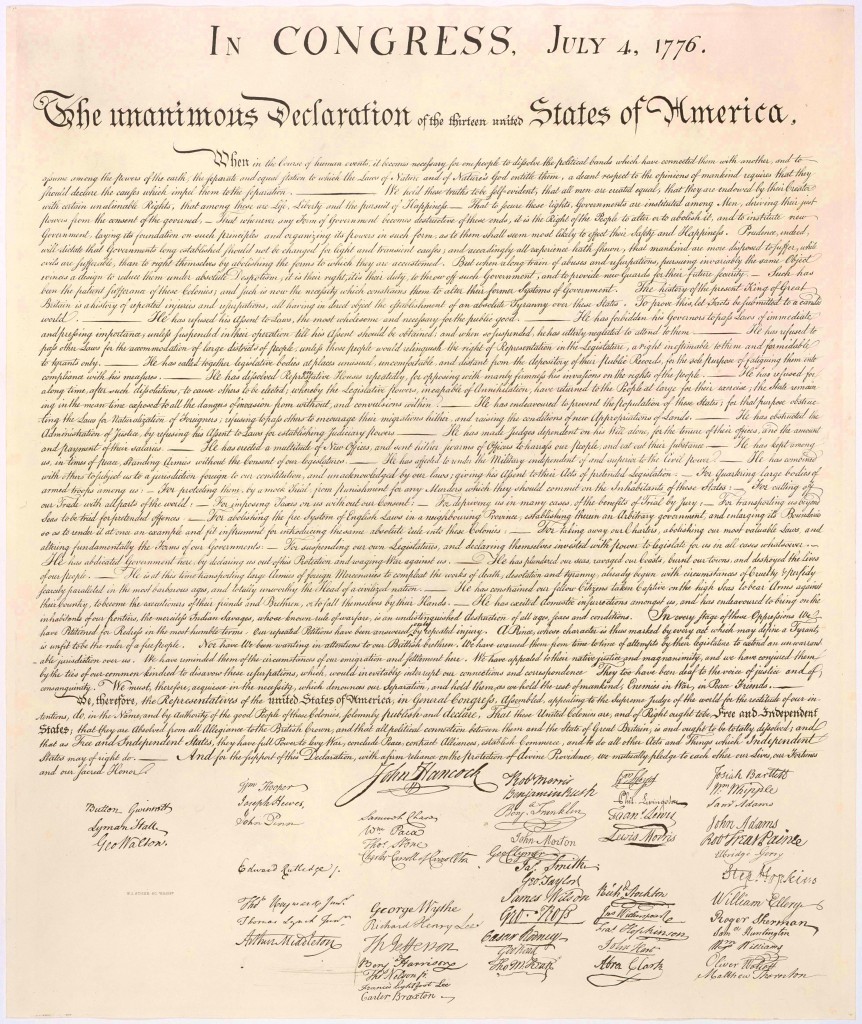
The Declaration is rooted in the concept of “the Laws of Nature and of Nature’s God,” an intellectual framework prevalent during the Enlightenment. This perspective posits that human rights are inherent and predate the formation of any state. By invoking these universal laws, the American founders argued that their independence was not merely a political preference but a fundamental right recognized by natural order. This approach transformed the conflict from a local colonial dispute into a broader struggle for human liberty.
A significant aspect of this philosophical revolution is the assertion that government power is derived from the “consent of the governed.” This principle effectively reversed the traditional power dynamic between the state and the individual. In the view expressed within the text, the state acts as a trustee of the people’s rights rather than a master of their lives. When that trust is breached, the political bond is dissolved, allowing for the creation of a new structure that better ensures the “Safety and Happiness” of the collective, as described by Biografieonline.
The Evolution of Democratic Governance
Related reading