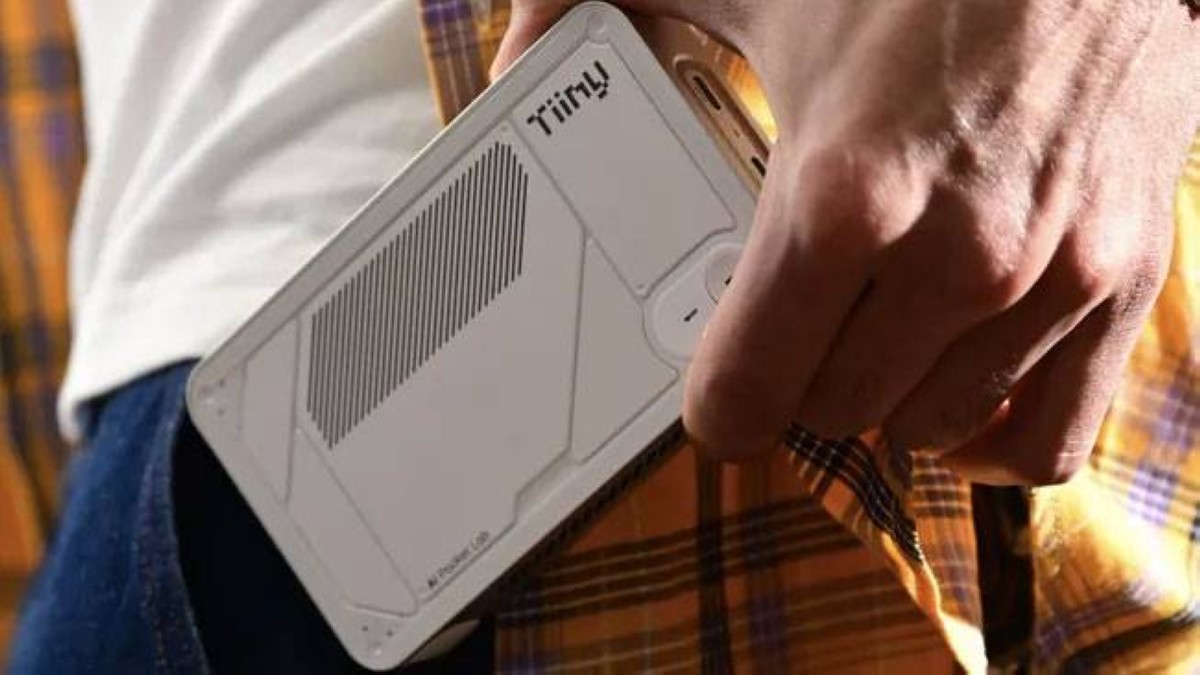
San Francisco, CA – In a significant leap for artificial intelligence and portable computing, Tini AI has unveiled the “Pocket Lab,” a device the company claims is the world’s smallest supercomputer capable of running large language models (LLMs) locally. Weighing just 300 grams – roughly the weight of a smartphone – the Pocket Lab aims to democratize access to powerful AI processing, moving it away from reliance on cloud-based services and addressing growing concerns around data privacy and energy consumption. The device has even earned a Guinness World Records title as the “smallest miniaturized computer (100B LLM locally).”
This isn’t simply a matter of shrinking existing technology. The Pocket Lab represents a fundamental shift in how AI is deployed, offering on-device processing of models with up to 120 billion parameters – comparable to, and in some cases exceeding, the capabilities of larger, cloud-dependent systems. This breakthrough has the potential to impact a wide range of fields, from scientific research and data analysis to personalized healthcare and secure communication. The implications of having such computational power in a handheld device are substantial, potentially reshaping how we interact with and utilize artificial intelligence.
The Pocket Lab’s capabilities are particularly noteworthy given the increasing demand for localized AI processing. Traditional AI applications often rely on sending data to remote servers for analysis, raising concerns about data security and latency. By enabling on-device processing, the Pocket Lab eliminates these issues, offering a more private, efficient, and reliable AI experience. What we have is especially crucial for applications dealing with sensitive information, such as medical records or financial data, where data sovereignty is paramount.
A Technical Deep Dive: Power in a Pocket-Sized Package
The Pocket Lab achieves its impressive performance through a combination of cutting-edge hardware and innovative software optimization. At its core, the device features an ARMv9.2 central processing unit (CPU) with 12 cores, providing a robust foundation for general-purpose computing tasks. Though, the real power lies in its dedicated Neural Processing Unit (NPU), which is specifically designed to accelerate AI workloads. This NPU delivers up to 190 Tera Operations Per Second (TOPS) of AI processing power, enabling the efficient execution of complex machine learning models. Bawaba AI News reports that 48 gigabytes of the device’s 80GB of LPDDR5X RAM is allocated to the NPU.
The device also boasts a substantial 1 terabyte solid-state drive (SSD) for storage, providing ample space for large language models and datasets. Crucially, the Pocket Lab is designed for energy efficiency, operating within a thermal design power (TDP) of 30 watts, with a system power consumption of 65 watts. This balance between performance and power efficiency is essential for a portable device, allowing for extended use without overheating or excessive battery drain. The use of LPDDR5X RAM, exceeding the 8-32GB typically found in laptops, is a key factor in its ability to handle these demanding AI tasks.
Beyond Cloud Dependence: The Rise of Edge AI
The Pocket Lab is a prime example of the growing trend towards “edge AI,” where AI processing is performed directly on the device rather than in the cloud. This approach offers several advantages, including reduced latency, enhanced privacy, and increased reliability. By eliminating the necessitate for a constant internet connection, edge AI enables applications to function seamlessly even in remote or disconnected environments. This is particularly valuable for industries such as agriculture, mining, and disaster relief, where connectivity can be unreliable or unavailable.
Tini AI’s innovation addresses a critical need for data privacy. With the Pocket Lab, users can process sensitive data locally, without the risk of it being intercepted or compromised during transmission to a cloud server. This is becoming increasingly important as concerns about data security and surveillance grow. The ability to maintain control over one’s data is a significant benefit for individuals and organizations alike. The reduced reliance on cloud infrastructure can lead to lower operating costs and a smaller environmental footprint, as data centers are notoriously energy-intensive.
Software Innovations: TurboSparse and PowerInfer
The Pocket Lab’s impressive capabilities aren’t solely due to its hardware. Tini AI has also developed a suite of software optimizations to maximize performance within the device’s compact form factor. One key technology is TurboSparse, which selectively activates only the necessary parts of an AI model during processing, rather than running all parameters simultaneously. This significantly speeds up computations and reduces resource consumption. Albayan details how this approach allows the device to efficiently handle complex models.
Another crucial innovation is PowerInfer, a system that intelligently distributes workloads between the CPU, GPU, and NPU. By assigning tasks to the processor best suited for the job, PowerInfer optimizes performance and minimizes energy usage. This dynamic allocation of resources ensures that the Pocket Lab operates at peak efficiency, even when running demanding AI applications. These software optimizations are critical to enabling the device to run models like GPT-OSS 120B, Phi, and the Llama family of large language models, which typically require powerful server infrastructure.
Potential Applications and Future Implications
The potential applications of the Pocket Lab are vast and varied. Researchers can use it for on-site data analysis in remote locations, eliminating the need to transmit large datasets over unreliable networks. Healthcare professionals can leverage its processing power for real-time diagnostics and personalized treatment plans, while maintaining patient privacy. Financial analysts can utilize it for secure fraud detection and risk assessment. The device’s portability and self-contained nature build it ideal for a wide range of use cases.
The Pocket Lab also opens up new possibilities for AI-powered applications in areas where connectivity is limited or unavailable. Imagine using it for autonomous navigation in remote areas, for real-time language translation during international travel, or for providing educational resources in underserved communities. The device’s ability to operate offline makes it a valuable tool for bridging the digital divide and empowering individuals in areas with limited access to technology.
While the Pocket Lab doesn’t rival the sheer computational power of the world’s largest supercomputers, it represents a significant step towards miniaturizing advanced AI technologies and making them accessible to a wider audience. It’s a tangible demonstration of the potential of edge AI and a glimpse into a future where powerful AI processing is no longer confined to massive data centers, but is readily available in the palm of your hand.
As of March 8, 2026, Tini AI has not announced pricing or availability details for the Pocket Lab. However, the company is expected to release further information in the coming months. Interested parties can follow Tini AI’s website for updates on product launch and specifications. The development of this technology signals a growing trend towards decentralized AI and a future where intelligent computing is more accessible, private, and sustainable.
What are your thoughts on the Pocket Lab? Share your comments below and let us know how you think this technology could impact your field or daily life.
Worth a look