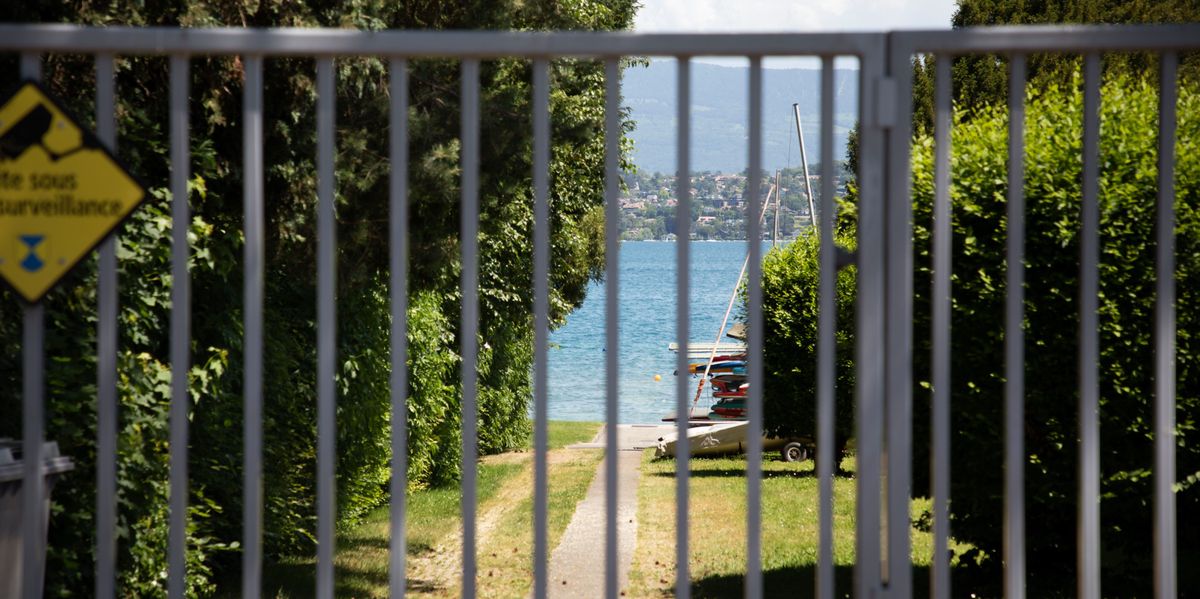
The municipality of Pregny-Chambésy in Geneva is facing ongoing legal disputes over public access to its shoreline, as the local administration continues to restrict access to a beach area in defiance of Geneva’s cantonal laws. Under the Loi sur la protection de la nature (LPN), the shores of Lake Geneva are generally designated as public zones, yet the Pregny-Chambésy beach remains largely inaccessible to the general public.
This conflict centers on the tension between municipal autonomy and the cantonal mandate to ensure that the lake’s edges remain open for all citizens. While most municipalities in the Canton of Geneva adhere to these accessibility standards, Pregny-Chambésy has implemented restrictions that critics and legal observers argue violate the spirit and letter of the law.
The situation has escalated as residents and visitors report being turned away or encountering barriers designed to keep the beach exclusive. This legal friction highlights a broader struggle in the region over the “privatization” of public natural spaces and the enforcement of zoning laws by the state against wealthy communes.
Legal Conflict Over Public Lake Access in Pregny-Chambésy
The core of the dispute lies in the legal status of the shoreline. According to Geneva’s cantonal regulations, the area immediately adjacent to the lake is considered public domain. The Département du Territoire (DT) is responsible for ensuring that these laws are applied uniformly across all municipalities to prevent the creation of “private” lakefronts.
In Pregny-Chambésy, the administration has historically limited access to certain beach segments, citing security concerns or local management needs. However, legal challenges have pointed out that these restrictions lack a sufficient basis in cantonal law. The municipality’s refusal to fully open the beach has led to a stalemate between the local executive and the cantonal authorities.
The impact is felt most acutely during the summer months. While other Geneva beaches are crowded, the restricted areas of Pregny-Chambésy remain sparsely populated, serving as a visible reminder of the ongoing legal battle over who has the right to touch the water’s edge.
The Role of the Département du Territoire and Enforcement
The Département du Territoire has the authority to order the removal of obstacles that block public access to the lake. In previous instances of shoreline disputes, the DT has issued formal notices to municipalities to comply with the LPN. In the case of Pregny-Chambésy, the process has been slower, involving multiple rounds of administrative correspondence and warnings.
The municipality has argued that it is managing its territory in a way that preserves the environment and maintains order. However, the cantonal government maintains that “environmental protection” cannot be used as a pretext to deny the public their legal right to access the shoreline. The law specifies that public access must be guaranteed, and any restrictions must be temporary and justified by a specific, urgent safety risk.
This disagreement reflects a systemic issue in Geneva where some of the most affluent municipalities attempt to maintain a level of exclusivity that contradicts the egalitarian nature of Swiss public land laws. The refusal to comply is not merely a local grievance but a challenge to the authority of the Canton over its municipalities.
Impact on Residents and the Public Interest
For the general public, the restricted beach in Pregny-Chambésy represents a loss of recreational space. In a densely populated canton, access to the lake is a critical component of urban quality of life. The “defiance” of the law by the municipality creates a precedent where local wealth can effectively override regional legislation.
Local residents are divided. Some support the municipality’s efforts to limit crowds and preserve the quiet character of the neighborhood. Others argue that the law is the law, and that the municipality’s actions are an illegal appropriation of public space. The tension is amplified by the fact that the beach in question is one of the few remaining stretches of natural shoreline not heavily developed by hotels or private villas.
The legal battle is now moving toward a phase where the Canton may be forced to implement more stringent enforcement measures, which could include fines or the physical removal of barriers by state agents. This would mark a significant escalation in the relationship between the state and the commune.
Comparison of Shoreline Access Policies
To understand the anomaly of Pregny-Chambésy, it is useful to compare its approach with other Geneva lakeside municipalities. Most communes, such as Cologny or Versoix, have established clear public access points that align with the LPN standards.
| Feature | Standard Geneva Commune | Pregny-Chambésy Approach |
|---|---|---|
| Shoreline Access | Generally open to the public | Restricted/Limited |
| Legal Basis | Compliance with LPN | Local administrative restrictions |
| Enforcement | Cooperation with DT | Ongoing legal dispute with DT |
Next Steps in the Legal Process
The resolution of this conflict will likely depend on a final ruling from the cantonal administrative authorities or a court order forcing the municipality to dismantle its restrictions. The Département du Territoire is expected to continue its pressure on the local council to bring the beach into full compliance with the law.
The next critical checkpoint will be the official response from the Pregny-Chambésy municipal council regarding the latest directives from the Canton. If the municipality continues to ignore these mandates, the state may move toward direct intervention.
We invite readers to share their perspectives on the balance between municipal autonomy and public access in the comments section below.
Related reading