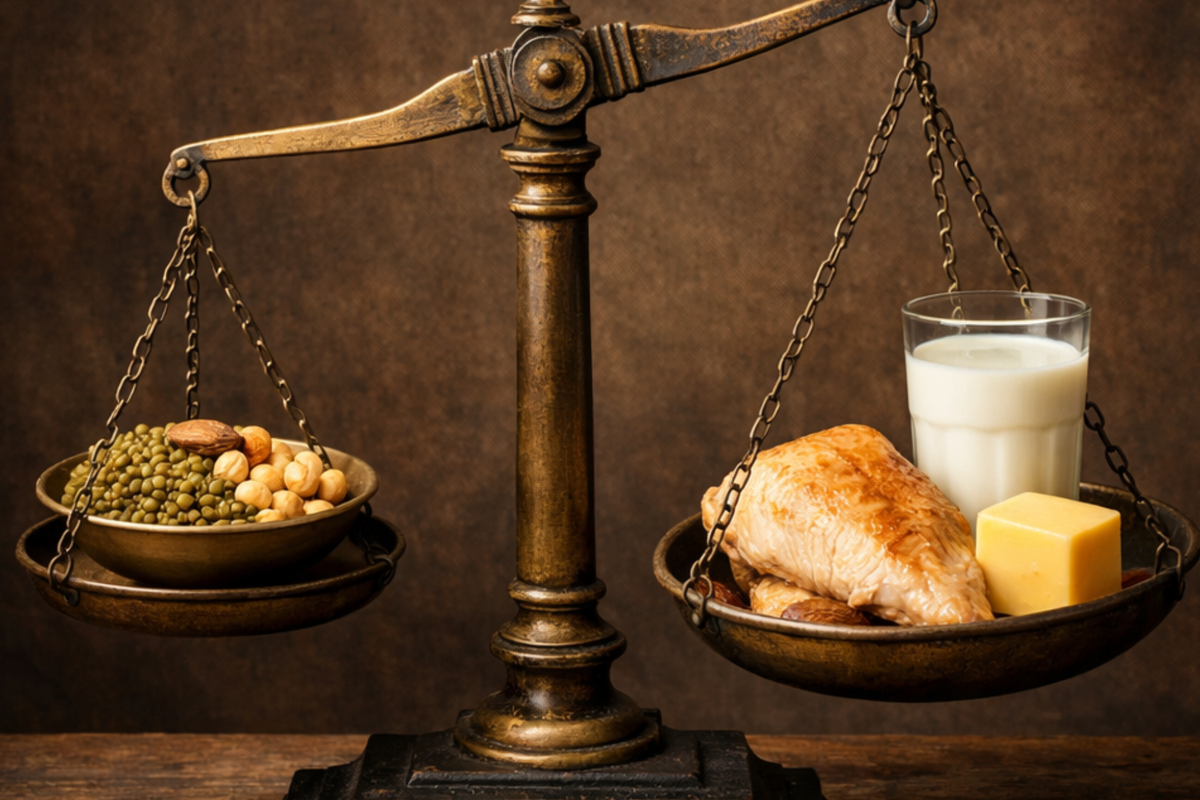
The pursuit of a healthy and sustainable diet is often framed as a simple choice: more plants, less meat. Still, a recent analysis of the Netherlands’ updated Richtlijnen goede voeding 2025 (Good Food Guidelines 2025), published by the Health Council, reveals a surprising disconnect. According to this analysis, strictly adhering to the new guidelines could result in a diet comprised of 60% animal protein – a figure that directly contradicts the nation’s sustainability goals. This apparent paradox raises critical questions about how dietary recommendations are formulated and whether they truly align with broader environmental objectives.
The core of the issue lies in the complex interplay between nutritional science, public health recommendations and sustainability ambitions. The Dutch government, like many others globally, is striving to reduce the environmental impact of food production, with a particular focus on lowering greenhouse gas emissions and land employ associated with animal agriculture. A shift towards more plant-based diets is widely recognized as a key strategy in achieving these goals. However, translating this ambition into concrete dietary advice proves to be a significant challenge, as evidenced by the findings regarding the Richtlijnen goede voeding 2025.
The Health Council’s guidelines are intended to provide evidence-based recommendations for food consumption to prevent chronic diseases such as heart disease, type 2 diabetes, and cancer. These recommendations are built upon a foundation of scientific research examining the effects of various nutrients and food groups on health outcomes. The 2025 update incorporates a more explicit consideration of food safety, factoring in potential risks associated with contaminants like PFAS and heavy metals in certain foods. This focus on safety, while crucial, adds another layer of complexity to the equation.
The Disconnect Between Ambition and Guideline
The confusion stems from the existence of multiple, interconnected documents. In 2023, the Health Council published a report, Gezonde eiwittransitie (Healthy Protein Transition), explicitly endorsing the goal of 60% plant-based protein in the diet. However, the Richtlijnen goede voeding (RGV) serve as the scientific building blocks for these recommendations, providing specific advice on weekly intake of legumes, nuts, fish, and meat, based on proven effects in preventing chronic diseases. The analysis reveals that when these individual “building blocks” are combined, they result in a diet that is surprisingly rich in animal protein.
The Challenging Puzzle for the Netherlands Nutrition Centre
The Netherlands Nutrition Centre (Voedingscentrum) is tasked with translating these scientific building blocks into a complete and practical dietary pattern: the Schijf van Vijf (Wheel of Five). They now face a near-impossible puzzle. They must reconcile the animal protein-leaning Richtlijnen goede voeding with the 60/40 plant-to-animal protein target of the protein transition, while also ensuring the resulting diet is nutritionally adequate and acceptable to consumers. This last point is particularly challenging, as half of the Dutch population currently does not consume legumes or nuts at all, while the new guidelines recommend 250 grams of legumes per week. The Health Council’s report details these challenges.
How Food Safety Complicates Choices Further
A new element in the 2025 guidelines is the explicit consideration of food safety. This acts as a kind of “safety brake” on certain recommendations. For example:
- Fish: While increased fish consumption can be beneficial for heart health, the guideline limits intake to 100 grams per week due to the risk of accumulating harmful substances such as PFAS and heavy metals.
- Dairy: Several portions per day are healthy, but as dairy can also be a source of dioxins and PFAS, consuming more than necessary is discouraged.
This safety brake makes solving the protein puzzle even more difficult. Simply advocating for “more fish instead of meat” is not an option within the current guidelines. The presence of persistent environmental contaminants like PFAS, which accumulate in the food chain, necessitates a cautious approach to dietary recommendations. The Dutch government’s report on the guidelines highlights the importance of food safety considerations.
What Does This Contradiction Mean for You?
As a consumer aiming to eat healthier and more sustainably, this information can be confusing. Does this mean giving up on those goals? Absolutely not. The core message remains clear: the direction of change is vital. A more plant-based and less animal-based diet remains the recommendation for both your health and the health of the planet.
This analysis primarily demonstrates that policymakers and the Netherlands Nutrition Centre face a complex task in uniting all ambitions – health, sustainability, and safety – into a cohesive set of recommendations. For you, as a consumer, the practical translation remains simple: every step towards more plant-based eating counts. Start with one meatless day per week, replace ground beef in your pasta sauce with lentils, or choose a handful of nuts as a snack. Don’t let the policy complexities discourage you from making choices that feel right.
The Netherlands Nutrition Centre is expected to release an updated version of the Schijf van Vijf in the spring of 2026, which will hopefully address these inconsistencies and provide clearer guidance for consumers. The challenge lies in creating a dietary model that is both scientifically sound, environmentally responsible, and practically achievable for the Dutch population. The coming months will be crucial in determining whether these competing priorities can be successfully reconciled.
navigating the complexities of dietary advice requires a critical and informed approach. While official guidelines provide a valuable framework, individual choices should be guided by a broader understanding of the interconnectedness between food, health, and the environment.
Key Takeaways:
- The Netherlands’ new dietary guidelines, while aiming to promote health, may inadvertently lead to a higher intake of animal protein.
- Food safety concerns, particularly regarding contaminants like PFAS, are influencing dietary recommendations.
- The Netherlands Nutrition Centre faces a significant challenge in translating scientific guidelines into a practical and sustainable dietary pattern.
- Consumers should prioritize increasing plant-based foods in their diet, even amidst conflicting recommendations.
The updated Schijf van Vijf is expected in Spring 2026, offering a potentially clearer path forward for consumers seeking to align their diets with both health and sustainability goals. Stay informed about updates from the Health Council of the Netherlands and the Netherlands Nutrition Centre. What are your thoughts on balancing health, sustainability, and food safety in your own diet? Share your comments below.