A single high dose of psilocybin induces long-lasting changes in brain flexibility and alters information flow across neural circuits up to a month after use. Researchers tracked these persistent alterations in healthy adults using functional brain scans and computational models, providing new insight into how psychedelics affect neural dynamics over time.
Brain Flexibility and Information Flow Weeks After Dosing
A single high dose of psilocybin—the active compound found in magic mushrooms,
as Psypost reported—alters how information moves through specific neural circuits for up to a month. By applying computer models to brain scans, investigators observed that the brain adopts more flexible communication patterns, shifting away from top-down control toward bottom-up sensory processing.
These sustained shifts in neural dynamics help clarify why the compound exhibits therapeutic potential across multiple psychiatric conditions. Clinical research currently investigates psilocybin as a potential treatment for debilitating conditions including depression, anxiety, addiction, and eating disorders, with clinical trials indicating that one or two moderate to high doses can enhance mental well-being for up to six months.
The primary molecular target for psilocybin in the brain is the 5-HT2A serotonin receptor. Activation of this receptor triggers immediate psychedelic effects. During the acute phase, brain imaging demonstrates that higher-level cognitive networks lose cohesion, which allows distinct brain regions to communicate more freely. However, scientific understanding regarding how the brain reorganizes itself weeks after the substance wears off has remained limited until now.
Study Design and Controlled Participant Trials
The investigation was structured as a controlled, fixed-order, within-subjects study involving healthy human adults with no prior psychedelic experience. According to Nature, the study cohort comprised 28 participants with an average age of 41 years. Recruitment relied on a convenience sampling approach utilizing study advertisements and referrals.
Ethical approvals for the research were granted by the London-Surrey Research Ethics Committee, with sponsorship from the Joint Research and Compliance Office at Imperial College London. Site-specific approvals were provided by the National Institute for Health Research/Wellcome Trust Imperial Clinical Research Facility. Following an evaluation using an algorithm provided by the UK Medicines and Healthcare products Regulatory Agency, the sponsoring institution confirmed the project was designated as an exploratory, translational study in healthy volunteers rather than a clinical trial.
COMPASS Pathways supplied bottled and encapsulated size-4 psilocybin, which was securely stored under light-protected and temperature-controlled conditions at Imperial College London under a Home Office Schedule 1 Drug License.
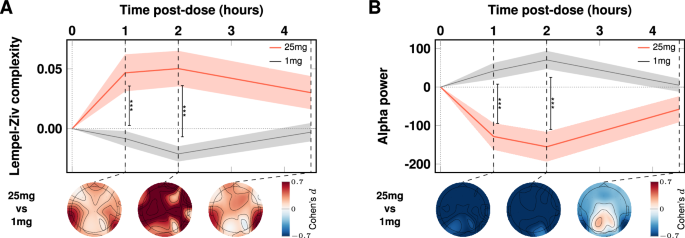
- A control dose of 1 mg of psilocybin administered on the first dosing day, functioning as a subthreshold dose incapable of producing a psychedelic experience.
- A fully active dose of 25 mg of psilocybin administered four weeks later, designated as a high dose capable of inducing profound psychedelic effects.
To maintain blinding and control for expectancy effects, participants were informed they would receive psilocybin on both sessions at a variable dose reaching up to 25 mg, without receiving further details about specific dosages.
Computational Modeling of Frontostriatal Circuits
Researchers examined activity within frontal, striatal, and thalamic brain regions—pathways connecting the frontal lobes to deeper structures involved in rewards, motivation, and sensory processing. While activity showed no statistically significant differences between baseline scans and those taken four weeks after the 1-mg control dose, scans conducted four weeks after the 25-mg dose revealed substantially more variable brain activity over time.
To understand the mechanics behind this increased flexibility, scientists utilized a mathematical computer model simulating the physical wiring of the brain. Normally, this physical wiring restricts how different regions fire together, functioning much like roads guiding traffic. The computer model demonstrated that four weeks post-dosing, the physical wiring exerted a weaker constraining effect on functional activity, permitting brain regions to adopt more diverse and flexible activity patterns.
“Psilocybin has shown remarkable promise in producing rapid and sustained improvements in symptoms across several psychiatric disorders, yet the brain mechanisms underlying these long-term effects remain poorly understood.”
Lorenzo Pasquini, assistant professor in the Department of Neurology at the Weill Institute for Neurosciences at the University of California, San Francisco
Pasquini noted that previous studies in healthy volunteers suggested the compound could induce lasting structural changes in frontostriatal circuits. The research team sought to build on those findings by examining how functional dynamics change over time after a single dose and determining whether computational modeling could clarify the underlying neurochemical mechanisms.
Worth a look