
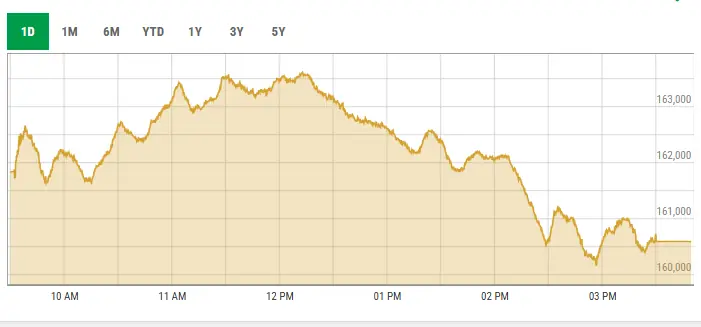
The Pakistan Stock Exchange (PSX) faced a brutal reversal on Monday, as the benchmark KSE-100 index plunged after a weekend of diplomatic hope evaporated. In a session defined by panic selling and extreme volatility, the PSX sheds 6,600 points, erasing gains from a historic rally that had occurred just days prior.
The downturn was triggered by the collapse of critical peace talks in Islamabad between the United States and Iran, followed by a decisive escalation from Washington. US President Donald Trump announced that the US Navy would implement a blockade of all maritime traffic entering and exiting Iranian ports, a move that has sent shockwaves through global energy markets and regional stability via Geo.tv.
The KSE-100 index closed at 160,591.33 points, representing a loss of 6,600.04 points, or 3.95%, from its previous close of 167,191.37 via Geo.tv. The market opened on a weak note, fluctuating wildly throughout the day as investors reacted to the deteriorating geopolitical situation in the Persian Gulf.
The Hormuz Blockade and the Collapse of the Islamabad Accord
The sudden market crash follows the failure of marathon peace talks held in Islamabad, which were intended to secure a lasting breakthrough and a long-term ceasefire. These talks were the cornerstone of the so-called “Islamabad Accord,” a framework brokered by Pakistan Prime Minister Shehbaz Sharif to ease Middle East tensions and reopen the Strait of Hormuz via Times of Islamabad.
The optimism surrounding the accord peaked last Wednesday, when the KSE-100 witnessed its most explosive single-day rally in history, surging nearly 14,000 points as investors bet on a peaceful resolution via Times of Islamabad. Though, that celebratory mood vanished on Monday when the US Central Command announced that forces would commence implementing the blockade of Iranian ports starting at 10 a.m. ET (7 p.m. Pakistan standard time) via Geo.tv.
The Strait of Hormuz is one of the world’s most critical shipping lanes, and any disruption to its traffic poses a systemic risk to global trade. Iran’s Islamic Revolutionary Guards Corps (IRGC) has warned that any military vessels attempting to approach the strait would be considered a violation of the existing ceasefire and would be dealt with “harshly and decisively.”
Market Volatility and the Oil Price Surge
The immediate economic consequence of the failed talks and the US blockade order was a sharp spike in global oil prices. International prices rose by $6 to $7 a barrel, pushing oil back above the $100-per-barrel threshold via Geo.tv. For an economy like Pakistan’s, which is highly sensitive to energy costs, this spike removed the risk premium that had previously supported energy-sensitive equities.
Throughout Monday’s session, the KSE-100 index struggled to find a floor. It reached an intraday high of 163,612.11 points, down 3,579.26 points, before sliding to a low of 160,158.92 points, a drop of 7,032.45 points via Geo.tv. This volatility was driven by broad-based panic selling, particularly in index-heavy stocks.
Market analysts, including AAH Soomro, have noted that investors are naturally disappointed by the inability to secure a long-term ceasefire. The shift in sentiment from “celebratory buying” to “panic selling” occurred almost instantly following the US announcements regarding the maritime blockade via Geo.tv.
A Pattern of Geopolitical Shocks
The current instability is part of a larger trend of extreme volatility at the PSX tied to the US-Israel war on Iran. The exchange has grow a barometer for regional conflict, swinging between record highs and devastating lows based on diplomatic developments.
To understand the scale of Monday’s crash, it must be compared to other recent milestones in the KSE-100’s history:
| Date | Event | Market Movement | Impact |
|---|---|---|---|
| March 2, 2026 | Assassination of Ayatollah Ali Khamenei | -16,089 points (-9.57%) | Steepest single-day plunge |
| May 12, 2025 | Pakistan shoots down seven Indian planes | +10,123 points (+9.45%) | Previous historic record surge |
| April 8/9, 2026 | US-Iran Ceasefire (Islamabad Accord) | +13,925.47 points (+9.18%) | Most explosive single-day rally |
| April 13, 2026 | Talks collapse. Hormuz blockade | -6,600.04 points (-3.95%) | Current session crash |
The record-breaking rally seen last week, which pushed the index to a peak of 165,598.92 points, was driven purely by the easing of Middle East tensions via Times of Islamabad. The subsequent crash on Monday underscores how fragile these gains were, as they were built on diplomatic hopes rather than fundamental economic shifts.
Who is Affected and What Happens Next?
The immediate victims of this volatility are institutional and retail investors who entered the market during the celebratory surge of the “Islamabad Accord.” With the blockade of Iranian ports now in effect, the primary concern shifts to the durability of the remaining ceasefire and the potential for a full-scale maritime conflict.
Financial analysts warn that volatility is expected to continue throughout the week. The market will likely remain on edge until there is further progress in diplomatic channels or a clarification on the duration and intensity of the US Navy’s blockade via Geo.tv.
The situation remains fluid, with the international community watching the Strait of Hormuz closely. Any further escalation by the IRGC or additional restrictive measures from the Trump administration could lead to another significant correction at the PSX.
Next Checkpoint: Market participants are awaiting further updates from the US Central Command and potential responses from the Iranian government regarding the maritime blockade throughout the remainder of the trading week.
Do you think the PSX can recover from these geopolitical shocks, or is the market too dependent on diplomatic volatility? Share your thoughts in the comments below.