
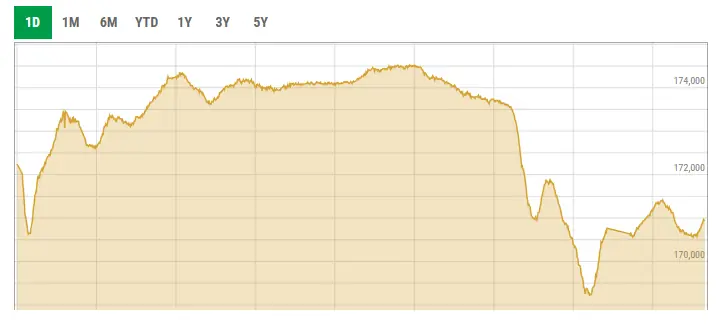
Pakistan Stock Exchange Plunges Over 3,000 Points Amid Geopolitical Uncertainty
The Pakistan Stock Exchange (PSX) experienced a sharp intraday decline on Monday, with its benchmark KSE-100 index falling more than 3,000 points amid renewed concerns over regional stability and potential diplomatic developments. The drop came as market participants reacted to unverified reports suggesting a possible second round of talks between the United States and Iran could be hosted in Islamabad, reigniting fears of escalating tensions in an already volatile geopolitical landscape.
According to data from the Pakistan Stock Exchange, the KSE-100 declined by 3,145.02 points, or 1.81%, to close the session at 170,793.99 points at 1:39 PM local time, down from the previous close of 173,939.01 points. This marked one of the steepest single-day drops in recent weeks, reversing gains made during the prior week when easing Middle East tensions and expectations of softer monetary policy had fueled a rebound.
The sell-off was broad-based, affecting sectors ranging from banking and energy to telecommunications and cement, as investors reassessed risk exposure in light of shifting diplomatic signals. Analysts noted that while no official confirmation had been issued regarding the Iran-U.S. Talks, the mere possibility of such a dialogue—particularly if perceived as a precursor to renewed confrontation—triggered risk-averse behavior across emerging markets.
Despite the intraday plunge, the KSE-100 remains significantly above its pre-war level of 168,062 points, which it surpassed on April 15, according to market reports. That milestone had signaled a recovery in investor confidence following months of volatility tied to regional instability and macroeconomic pressures. However, the index still trades roughly 15,227 points below its all-time high of 189,166.83, recorded on January 23, underscoring the distance yet to be covered to regain peak valuation levels.
Market Reaction Tied to Diplomatic Uncertainty, Not Economic Fundamentals
Financial analysts cautioned against attributing the drop solely to domestic economic factors, emphasizing that Pakistan’s recent macroeconomic indicators have shown signs of stabilization. Inflation has moderated in recent months, foreign exchange reserves have improved slightly due to inflow from international lenders and the State Bank of Pakistan has maintained a cautious but steady monetary stance.
Instead, the primary driver appeared to be sentiment-driven volatility linked to external geopolitical developments. The prospect of renewed U.S.-Iran engagement—whether diplomatic or confrontational—has historically influenced regional markets due to Pakistan’s strategic location, trade ties, and sensitivity to oil price fluctuations. Any escalation could disrupt supply chains, increase security premiums, and affect remittance flows from the Gulf, a critical source of foreign exchange for Pakistan.
Arif Habib Ltd (AHL), one of Pakistan’s leading brokerage firms, noted in a client briefing that while the week-on-week gain of 4% (or 6,748 points) reflected improving sentiment last week, Monday’s reversal highlighted the market’s fragility in the face of unverified but high-impact news. The firm urged investors to focus on long-term fundamentals rather than short-term speculation.
Investors Await Clarity Amid Information Vacuum
Market participants expressed frustration over the lack of official confirmation from either Washington or Tehran regarding the alleged Islamabad talks. Neither the U.S. State Department nor Iran’s Ministry of Foreign Affairs had issued statements confirming or denying the reports by market close, leaving traders to act on speculation—a dynamic that often amplifies volatility in frontier markets.
This information vacuum underscores a recurring challenge for emerging market exchanges: susceptibility to geopolitical rumor mills when official channels remain silent. Regulators, including the Securities and Exchange Commission of Pakistan (SECP), have not issued any market advisories or trading halts in response to the move, indicating they viewed the decline as a function of organic price discovery rather than manipulation or systemic risk.
Still, the episode has reignited calls for greater transparency from diplomatic sources whose discussions—whether confirmed or speculative—can have immediate and material impacts on economies like Pakistan’s, where market sentiment is highly sensitive to regional perceptions of risk.
Technical Levels and Market Outlook
From a technical perspective, the KSE-100’s drop below 171,000 points tested key support levels that had held since mid-April. A sustained break below this threshold could open the door toward the 168,000–169,000 range, revisiting levels seen before the April recovery. Conversely, a rebound above 173,000 would suggest the dip was viewed as an overreaction, potentially setting the stage for a retest of recent highs.
Trading volume remained elevated during the decline, indicating active participation rather than a lack of liquidity. Institutional investors, including mutual funds and foreign portfolio investors, were observed adjusting positions, though no large-scale exodus was reported by custodians or exchange officials.
Looking ahead, market attention will likely shift to upcoming economic data releases, including inflation figures and balance of payments updates, which could provide clearer direction on domestic economic health. Simultaneously, any verified developments regarding international diplomacy—particularly involving Iran, the U.S., or Saudi Arabia—will be closely monitored for their potential to influence risk appetite.
For now, the PSX remains a barometer not only of Pakistan’s economic trajectory but also of the broader interplay between geopolitics and market psychology in fragile, interconnected regions.
As always, investors are encouraged to consult official sources such as the Pakistan Stock Exchange website and the Securities and Exchange Commission of Pakistan for verified updates, and to seek professional financial advice before making investment decisions.
Have thoughts on how geopolitical events are shaping emerging markets? Share your perspective in the comments below, and aid others stay informed by sharing this article on social media.