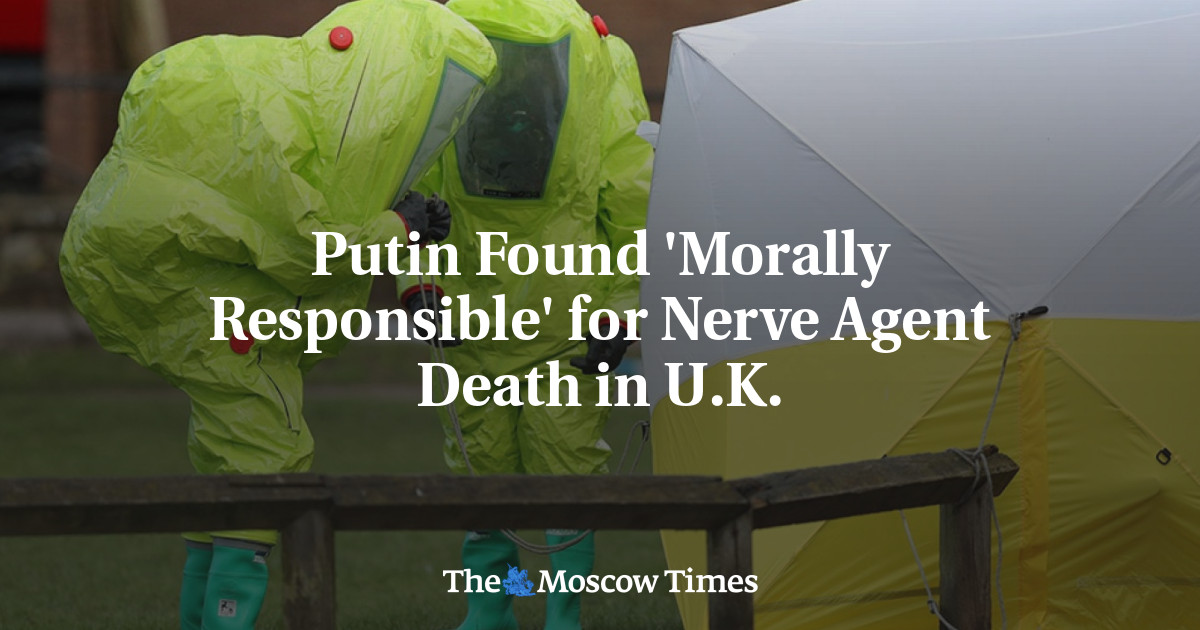
Putin Directly Linked to Salisbury Poisoning: Inquiry Finds “Moral Responsibility” for Dawn Sturgess’s Death
A damning public inquiry has concluded that Russian President Vladimir Putin bears “moral responsibility” for the death of Dawn Sturgess, a British woman who died after being exposed to the nerve agent Novichok in Salisbury, England, in 2018. The report details a brazen assassination attempt on former Russian double agent Sergei Skripal, and the tragic, unintended consequences that followed.
The incident began with Skripal and his daughter, yulia, found unconscious on a park bench. Investigations revealed Novichok, a military-grade nerve agent, had been applied to the door handle of Skripal’s home. This wasn’t a random act; the inquiry found the attack “must have been authorized at the highest level, by president Putin.”
Two suspects, identified as Alexander Petrov and Ruslan Boshirov – believed to be operatives of the Russian military intelligence agency, the GRU – were tracked bringing the novichok-laced perfume bottle to Salisbury. The report emphasizes the operation demonstrated “considerable determination” and was intended as a “public demonstration of Russian power.”
A Tragic Chain of Events
Sturgess and her partner, Charlie Rowley, unknowingly came into contact with the contaminated bottle months after the initial attack. Sturgess tragically died four months later after falling ill, becoming an innocent victim of the Kremlin’s actions. The inquiry chair, former senior judge Anthony Hughes, stated unequivocally that Petrov, Boshirov, their GRU superiors, and ultimately Putin, were “astonishingly reckless.”
The amount of Novichok contained within the perfume bottle was sufficient to poison “thousands,” highlighting the sheer scale of the potential disaster. Hughes stressed that Sturgess’s death was a direct result of “cruel and cynical acts.”
UK Response and International Fallout
The UK government has responded decisively.Prime Minister Keir Starmer declared the report “clear: moral responsibility lies with putin.” London immediately summoned the russian ambassador and imposed sanctions on the GRU “in its entirety.”
Russia, predictably, has dismissed the findings and sanctions as “illegitimate” and reserved the right to retaliate. This incident triggered the largest-ever expulsion of diplomats between Western nations and Russia, alongside a limited round of sanctions.
A Pattern of Kremlin-Linked Violence
This isn’t an isolated incident. A 2016 British inquiry previously found that Putin “probably approved” the 2006 poisoning of ex-spy Alexander Litvinenko with radioactive polonium in London. These events underscore a disturbing pattern of Kremlin-linked violence targeting perceived enemies on foreign soil.
While the inquiry acknowledged some “failings” in the security arrangements for Skripal, it concluded that British intelligence had no reasonable grounds to anticipate a high risk of assassination. However, the family of Dawn Sturgess expressed dissatisfaction with the report, arguing it left unanswered questions about whether the tragedy could have been prevented.
deepening Freeze in UK-Russia Relations
The Salisbury poisoning, and now this damning inquiry, have further cemented the deep freeze in relations between London and Moscow. This situation is compounded by Russia’s ongoing war in Ukraine,leaving little prospect for improved ties in the foreseeable future. The incident serves as a stark reminder of the risks posed by opposed state actors and the importance of vigilance in protecting national security.
Disclaimer: This article is based on publicly available information and reporting as of november 24, 2023. It is indeed intended for informational purposes only and does not constitute legal or political advice.
Related reading