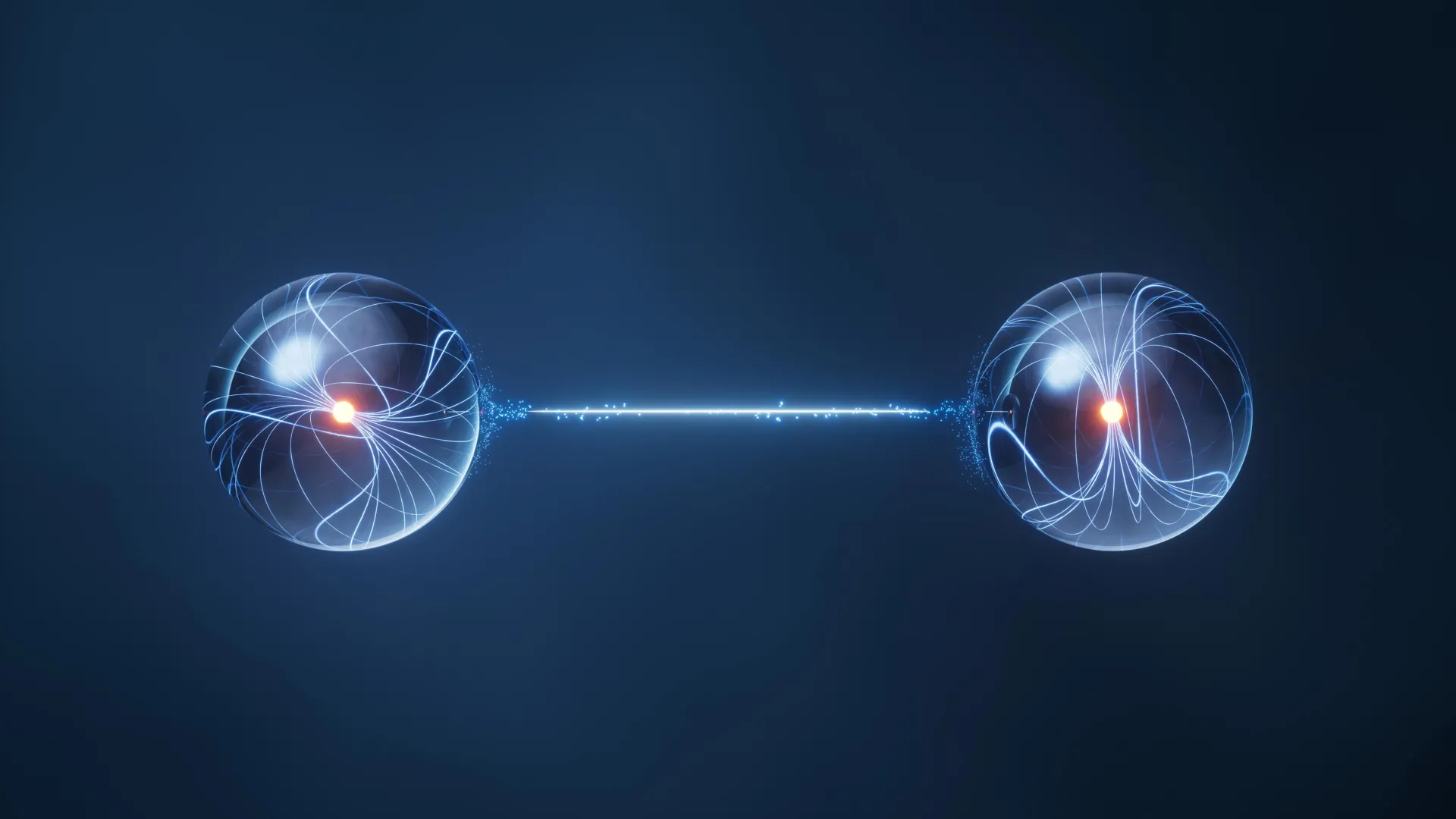
Quantum Leap Towards a Global Quantum Internet: Breakthrough Extends Coherence Times for Long-Distance Communication
For decades, the promise of a quantum internet – a network leveraging the bizarre and powerful principles of quantum mechanics for unparalleled security and computational capabilities – has remained largely theoretical. Now, a team led by researchers at the University of Chicago‘s Pritzker School of Molecular Engineering (PME) has achieved a significant breakthrough, dramatically extending the coherence time of entangled atoms, bringing the realization of a global-scale quantum network within tangible reach. This advancement, recently recognized with the prestigious Sturge Prize awarded to lead researcher Professor Zhong, represents a pivotal moment in the evolution of quantum technology.
The Challenge of Quantum Distance: Why Coherence is key
Unlike classical networks that transmit data as bits (0s and 1s), a quantum internet relies on qubits – quantum bits - wich can exist in a superposition of states, enabling exponentially faster and more secure communication. However, maintaining the delicate quantum state of thes qubits, a phenomenon known as quantum coherence, is incredibly challenging. Any interaction with the surroundings causes decoherence, effectively destroying the quantum information.
The distance over which quantum information can be reliably transmitted is directly tied to coherence time. The longer qubits remain entangled and coherent, the further apart quantum computers can be connected. previously, limitations in coherence time restricted potential connections to relatively short distances. The team’s recent work addresses this fundamental hurdle head-on.
From Milliseconds to Potential Kilometers: A Tenfold Increase in Coherence
Professor Zhong’s team has successfully increased the coherence time of individual erbium atoms – a crucial component for building quantum repeaters - from a mere 0.1 milliseconds to over 10 milliseconds. In optimized experiments, they achieved an impressive 24 milliseconds of coherence. This seemingly small increase has profound implications.
“This enhancement could enable communication between quantum computers separated by roughly 4,000 km,” explains Professor Zhong. “That’s the distance between our lab here at UChicago PME and Ocaña,Colombia.” This opens the door to connecting quantum computers across continents, fundamentally changing the landscape of global communication and computation.
A Revolutionary Manufacturing Approach: Atomic-Scale Precision with Molecular-Beam Epitaxy
The team’s success wasn’t achieved through the discovery of new materials, but through a radical reimagining of how those materials are made. Traditionally,rare-earth doped crystals – essential for quantum entanglement – are created using the Czochralski method,a “melting pot” approach involving high temperatures (over 2,000°C) and slow cooling. This process, while effective, introduces imperfections and impurities that limit coherence.
Rather, the researchers turned to molecular-beam epitaxy (MBE), a technique borrowed from advanced materials science. MBE is akin to 3D printing at the atomic level,meticulously layering atoms to build the crystal structure with unparalleled precision.
“We start with nothing and then assemble this device atom by atom,” says Professor Zhong. “The quality or purity of this material is so high that the quantum coherence properties of these atoms become superb.” This bottom-up approach, previously unexplored for these specific materials, allows for the creation of crystals with significantly reduced defects, dramatically enhancing coherence. The collaboration with materials synthesis specialist assistant Professor Shuolong Yang at UChicago PME was instrumental in adapting MBE to this specific submission.
Expert Validation and Scalability Potential
The significance of this work has been recognized by the wider scientific community. Dr. Hugues de Riedmatten,a Professor at the Institute of Photonic Sciences (and not involved in the study),lauded the research as “highly innovative.” He highlighted the potential for scalable qubit production, stating that the approach “can lead to the realization of single rare-earth ion qubits with excellent optical and spin coherence properties…all in a fiber-compatible device architecture.” This fiber compatibility is crucial for integrating these qubits into existing telecommunications infrastructure.
From Lab to Global Network: Rigorous Testing and Future Deployment
The next critical step is validating these theoretical gains in real-world conditions. Professor Zhong’s team is meticulously preparing for a series of rigorous tests.
“Before we actually deploy fiber from, let’s say, Chicago to new York, we’re going to test it just within my lab,” explains Professor Zhong. The team is currently building a local quantum network within their laboratory, utilizing three dilution refrigerators (“fridges”) and 1,000 kilometers of coiled fiber to simulate long-distance communication. This controlled environment will allow them to verify the system’s performance and identify any unforeseen challenges before scaling up to larger
Related reading