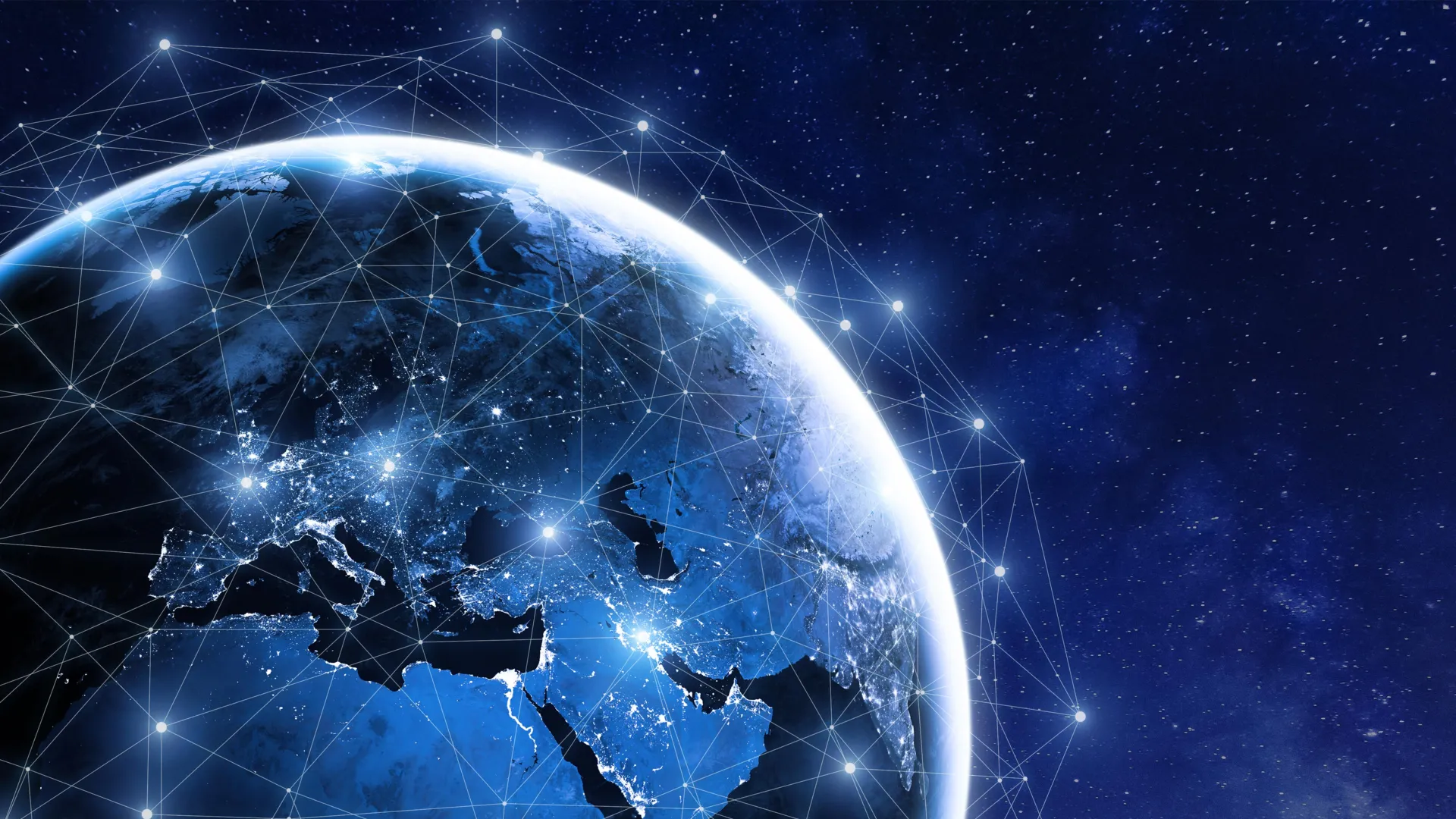
Breaking the Barrier: Earth-to-Satellite Quantum Communication Paves the Way for a Scalable Quantum Internet
For years, quantum satellite communication has focused on a single direction: sending entangled photons down from orbit to ground stations, enabling ultra-secure data transmission.Now, a groundbreaking study from the University of Technology Sydney (UTS) is challenging that paradigm, demonstrating the feasibility of transmitting quantum signals up to satellites - a concept previously dismissed as impractical. This advancement represents a meaningful leap forward in building the infrastructure for a future quantum internet, offering solutions to limitations currently hindering the progress of global quantum networks.
The Quantum Communication Landscape: From Secure Keys to Quantum Computing Networks
Quantum communication leverages the principles of quantum mechanics to ensure unparalleled security. Current quantum satellite systems,like China’s pioneering Micius satellite (launched 2016) and the subsequent Jinan-1 microsatellite (establishing a 12,900 km link with South Africa in 2025),primarily utilize a “downlink” approach. These satellites generate entangled photon pairs in space,sending one photon to each of two ground stations. This method is highly effective for quantum key distribution (QKD), where even a few photons can establish a secure encryption key.
However, the vision extends far beyond secure communication.The true potential of quantum technology lies in connecting quantum computers themselves,creating a quantum internet capable of processing information in ways unachievable for classical computers. This requires significantly more bandwidth – trillions of photons per second – than current QKD applications demand. This is where the limitations of the downlink approach become apparent.
Why Uplink Was Considered Impossible – and Why UTS Researchers Proved Or else
the conventional wisdom held that transmitting entangled photons from Earth to a satellite was unrealistic.The primary concerns revolved around signal loss, atmospheric interference, and the scattering of light as it traversed the atmosphere. Producing and maintaining the necessary photon flux for a robust quantum link from the ground seemed insurmountable.
Professor Simon Devitt, professor Alexander Solntsev, and thier team at UTS challenged this assumption through rigorous systems modeling. Their research, published in Physical Review Research, meticulously accounted for real-world conditions, including background light from Earth and the Moon, atmospheric effects, and imperfections in optical alignment.
“The idea is to fire two single particles of light from separate ground stations to a satellite orbiting 500 km above Earth, traveling at about 20,000 km per hour, so that they meet so perfectly as to undergo quantum interference. Is this even possible?” explains Professor Devitt. The answer, surprisingly, is yes.Their modeling demonstrated that, with careful engineering, an uplink is indeed feasible.
The Advantages of an Earth-Based Quantum Source
The implications of this breakthrough are significant. Shifting the photon source to the ground offers several key advantages:
* Increased Power: ground-based equipment can utilize significantly more power than satellite-based systems, enabling the generation of stronger signals.
* Simplified Maintenance: Ground stations are far easier to access and maintain than satellites, reducing operational costs and downtime.
* Higher Bandwidth Potential: The satellite’s role shifts from generating entangled photons to interfering incoming photons and reporting the results. This dramatically reduces the complexity and cost of the satellite hardware. Rather of needing to produce trillions of photons per second,the satellite requires only a compact optical unit.
This approach allows for a high-bandwidth quantum link without the prohibitive costs and size constraints associated with generating massive photon fluxes in space.
From Drones to a Global Quantum Network: The Path Forward
The UTS team is already planning the next steps, proposing initial testing using drones or balloon-mounted receivers to validate their models in a real-world environment. This will serve as a crucial stepping stone towards deploying small satellites in low Earth orbit to create large-scale quantum networks spanning nations and continents.
Professor Devitt envisions a future where quantum entanglement is as ubiquitous as electricity. “In the future,quantum entanglement is going to be a bit like electricity. A commodity that we talk about that powers other things. It’s generated and transmitted in a way that is often invisible to the user; we just plug in our appliances and use it. This will ultimately be the same for large quantum entanglement networks. There will be quantum devices that plug into an entanglement source as well as a power source, utilizing both to do something useful.”
A Collaborative Effort Driving Innovation
This project exemplifies the power of interdisciplinary collaboration, bringing together expertise from the UTS Faculty of Engineering and IT and the Faculty of Science in quantum networking, systems modeling, and photonics. It underscores UTS’s commitment to addressing the moast challenging problems in emerging technology and solidifies its position as a leader in the burgeoning field of quantum communication.
**the UTS research fundamentally alters the landscape of quantum satellite communication. by demonstrating the feasibility of uplink quantum transmission,
Related reading