
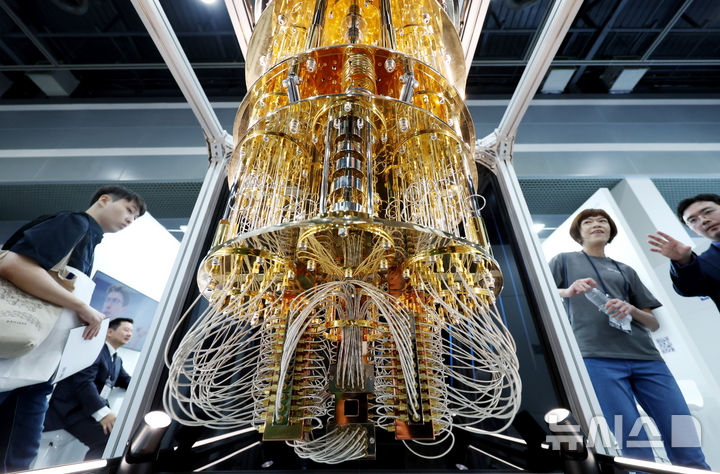
The “Quantum Korea 2026” festival has officially commenced, serving as a comprehensive platform for the latest advancements in quantum computing, communications, and sensing. The event gathers global industry leaders, policymakers, and researchers to outline the current trajectory of quantum technology and its potential to transition from theoretical science into tangible industrial applications.
As the global race for quantum supremacy intensifies, South Korea is positioning itself as a central hub for this technological evolution. According to the Ministry of Science and ICT (MSIT), the nation has prioritized quantum initiatives as one of the “12 National Strategic Technologies,” aiming to secure core competitiveness by 2030. The festival highlights how these complex scientific breakthroughs—long confined to the realm of science fiction—are now being integrated into national infrastructure and commercial sectors.
Defining the Quantum Landscape
Quantum technology operates on the principles of quantum mechanics, utilizing phenomena like superposition and entanglement to process information at speeds unattainable by classical binary computers. At the core of the 2026 event are three primary pillars: quantum computing, quantum communications, and quantum sensing. Each field addresses a different facet of the digital future, from encryption security to ultra-precise medical diagnostics.
Quantum computing remains the most widely recognized, yet challenging, aspect of the field. By utilizing qubits, these systems can solve optimization problems that would take current supercomputers thousands of years to calculate. Meanwhile, quantum communications offer a theoretically unhackable method of data transmission, a critical development for national security and financial sectors. Quantum sensing, which provides measurement precision far beyond current limits, is already seeing pilot applications in autonomous navigation and geophysical exploration.
National Strategy and Industrial Integration
The South Korean government has outlined an ambitious framework to foster a “Quantum Economy.” This includes significant investment in R&D and the cultivation of a specialized workforce. As detailed in the National Quantum Initiative, the government is focusing on building a “Quantum Valley” that bridges the gap between academic research and commercial manufacturing. This initiative aims to reduce dependence on foreign technology and build a robust domestic supply chain.
Industry partners at the festival are showcasing prototypes that demonstrate these theories in action. These include quantum-resistant cryptographic keys, which are being tested to protect government communication networks against future threats posed by advanced quantum processors. By moving these technologies out of the laboratory, stakeholders hope to establish a sustainable ecosystem where private companies can thrive alongside state-funded research institutions.
Global Collaboration and Future Outlook
Quantum technology is inherently global, and the 2026 festival emphasizes international cooperation. With major quantum hubs emerging in the United States, the European Union, and China, South Korean officials are actively seeking partnerships to standardize protocols and share best practices. International experts attending the event noted that the lack of global standardization remains the primary barrier to the widespread adoption of quantum networks.

Looking ahead, the next significant milestone for the region involves the deployment of the first large-scale quantum-classical hybrid data center. This project, currently in the pilot phase, is designed to test how quantum processors can work in tandem with existing AI infrastructure to accelerate drug discovery and materials science. Further updates on the progress of these national projects are expected to be released by the MSIT during the next quarterly policy review.
The “Quantum Korea 2026” event continues through the end of the week, with various workshops and public demonstrations scheduled. Readers interested in the latest developments are encouraged to monitor official announcements from the Ministry of Science and ICT for updates on policy shifts and new research findings.