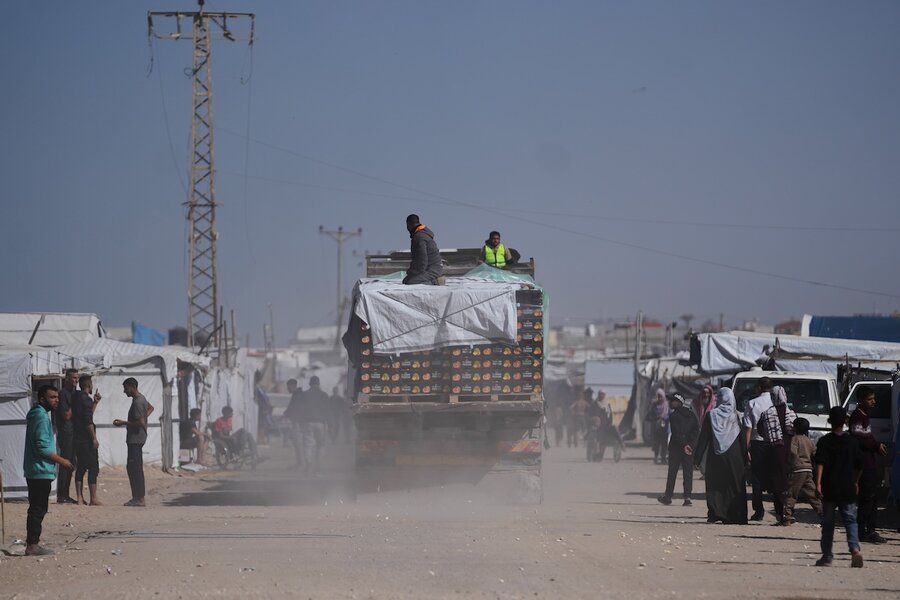
Rafah Border Crossing Reopening Offers Glimmer of Hope for Gaza
Palestinians in Gaza are watching with a mix of hope and apprehension as preparations unfold for the reopening of the Rafah border crossing with Egypt, a crucial link too the outside world. Israel has announced the crossing is slated to resume operations Monday,coinciding with the ongoing ceasefire with Hamas.
While the move is seen as a positive step, concerns remain regarding limitations on the number of people permitted to cross. “Opening the crossing is a good step, but they set a limit on the number of people allowed to cross, and this is a problem,” stated Ghalia Abu Mustafa, a resident of khan Younis.
Initial reports indicate a phased reopening, with onyl a limited number of individuals allowed to travel at first. Residents are urgently seeking access for medical care and the chance to return home. “We wont a large number of people to leave,for it to be open so that sick people can go and return,” said Suhaila Al-Astal,a displaced woman from Rafah whose daughter requires medical attention abroad. “We want the crossing to be open permanently.”
The reopening follows a period of closure since Israel seized control of the crossing in May 2024, and comes after a day of renewed conflict that resulted in the deaths of at least 30 Palestinians, including children, despite the ceasefire.
Approximately 20,000 Palestinians in Gaza require medical care outside the territory, and thousands more seek to return to their homes. Israel plans to initially allow 50 patients to leave daily, each accompanied by two relatives, alongside the return of 50 individuals who previously exited Gaza during the conflict.
The crossing will be jointly monitored by Israeli and Egyptian authorities, with European Union border patrol agents overseeing operations.The process will be evaluated for potential expansion.
meanwhile, Israel has moved to suspend the operations of Doctors Without Borders in Gaza by February 28th, citing non-compliance with new registration requirements for aid organizations. This decision, along with similar actions against over two dozen humanitarian groups, has raised concerns about the impact on Gaza’s already devastated healthcare system. Israel maintains these measures are intended to prevent aid diversion by Hamas, while organizations argue they are arbitrary and detrimental to the civilian population.
The Rafah crossing served as the primary passage for people entering and leaving Gaza before the recent conflict. Its reopening is a critical component of the ceasefire agreement, which also includes the exchange of hostages, increased humanitarian aid, and a partial withdrawal of Israeli troops. The second phase of the ceasefire aims to establish a new governing committee for Gaza, deploy an international security force, disarm Hamas, and initiate reconstruction efforts.
Keep reading