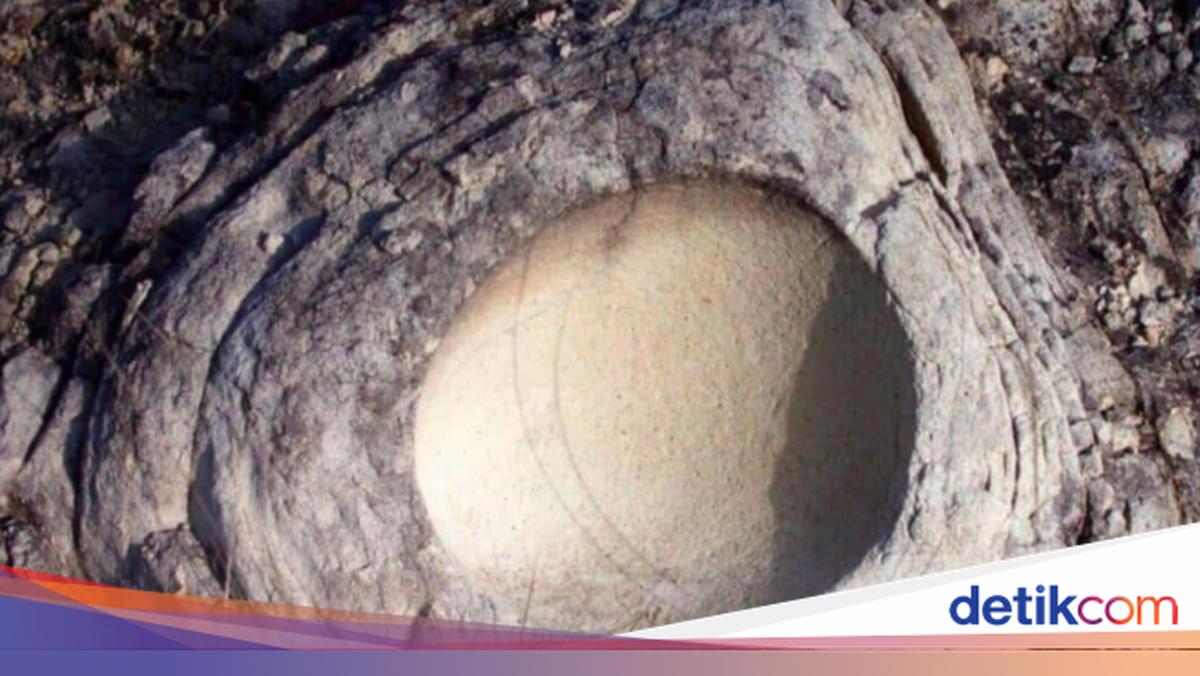
Remarkable Fossil Discovery: Dinosaur Egg-Within-an-Egg Reveals Clues to Reproductive Biology
In a rare and astonishing find, paleontologists in India have unearthed a fossilized dinosaur egg containing another, fully formed egg inside. This unprecedented discovery, originating from the Lameta Formation in Madhya Pradesh, India, offers a unique window into the reproductive strategies of titanosaurs – massive, long-necked herbivorous dinosaurs that once roamed the Earth. The phenomenon, known as ovum-in-ovo, was previously only observed in modern birds, prompting scientists to re-evaluate our understanding of dinosaur reproductive anatomy and its connection to avian evolution.
The Lameta Formation, a sedimentary geological formation associated with the Deccan Traps, is renowned as a significant site for dinosaur fossils, particularly from the Late Cretaceous period. The discovery was made during a field survey in 2017, where researchers uncovered eleven fossilized dinosaur eggs nestled together in a single depression. While initially appearing unremarkable, closer examination of one egg using scanning techniques revealed the extraordinary internal structure – a second, complete egg shell encased within the first. This finding challenges previous assumptions about the reproductive systems of ancient reptiles and provides compelling evidence for a closer evolutionary link between dinosaurs and birds.
Understanding Ovum-in-Ovo: A Bird-Like Phenomenon
Ovum-in-ovo, literally meaning “egg within an egg,” is a relatively rare reproductive anomaly in birds. It occurs when a developing egg is enveloped by another shell before being laid. According to research published in the journal ScienceDirect, the condition typically arises when an egg begins to form, then retreats back into the reproductive tract and becomes coated with a new shell layer. This process is thought to be a physiological response to stress or hormonal imbalances. The discovery of this phenomenon in a dinosaur fossil is particularly significant, as it suggests that titanosaurs may have possessed reproductive systems more complex than previously believed.
The research team, led by Guntupalli Prasad from the University of Delhi, meticulously documented the fossil’s unique characteristics. “The egg exhibits two complete shell layers, one nested inside the other,” the researchers wrote in their scientific report, as reported by The Daily Galaxy. This clear evidence of a double-shelled structure confirms the presence of ovum-in-ovo in a dinosaur, marking the first documented instance of its kind. The Lameta Formation, as detailed by Wikipedia, spans across several Indian states including Madhya Pradesh, Gujarat, Maharashtra, Telangana, and Andhra Pradesh, and dates back to the Maastrichtian age, approximately 70 to 66 million years ago.
Implications for Dinosaur Reproduction and Evolution
For decades, scientists generally assumed that ancient reptiles had relatively simple reproductive systems. This new discovery challenges that notion, suggesting that at least some dinosaur species, like the titanosaurs, may have had more intricate reproductive tracts akin to those found in birds. Prasad explained that the presence of ovum-in-ovo in the titanosaur nest indicates a potential similarity in reproductive anatomy between the two groups. “The occurrence of ovum-in-ovo pathology in titanosaur nests suggests that these dinosaurs may have possessed an anatomy similar to that of birds,” he stated.
This finding further strengthens the widely accepted theory that modern birds are direct descendants of dinosaurs. The shared reproductive characteristics between titanosaurs and birds provide additional evidence supporting their evolutionary relationship. The Bagh Dinosaur National Park region in Madhya Pradesh, where similar fossils have been found, is a key area for understanding this connection. As noted in a recent study published in Geoheritage, the region’s geological formations are of international value for paleontological research.
The Lameta Formation: A Window into the Cretaceous Period
The Lameta Formation itself provides invaluable insights into the environment and life during the Late Cretaceous period. The formation’s location within the Nimar Plains of the Malwa Plateau, a volcanic upland of the Deccan Volcanic Province, offers a unique geological context for understanding dinosaur life in India. The fossilized eggs, along with associated fossilized wood logs and invertebrate fossils, paint a picture of a diverse ecosystem that existed just before the Cretaceous-Paleogene extinction event, which wiped out the non-avian dinosaurs approximately 66 million years ago.
The discovery of ovum-in-ovo in a titanosaur egg also suggests that biological disturbances, similar to those observed in modern animals, could also occur in dinosaurs. This highlights the vulnerability of even these massive creatures to physiological anomalies. The fossilized eggs, with a diameter of approximately 15 centimeters, were found in a uniform shape, indicating a relatively stable nesting environment. The preservation of these fossils within the Lameta Formation is a testament to the unique geological conditions that allowed for their long-term survival.
Key Takeaways
- Rare Reproductive Anomaly: The discovery of an egg-within-an-egg in a titanosaur fossil is the first documented case of ovum-in-ovo in a dinosaur.
- Evolutionary Link: This finding strengthens the evolutionary connection between dinosaurs and modern birds, suggesting shared reproductive characteristics.
- Complex Reproductive Systems: The discovery challenges the assumption that ancient reptiles had simple reproductive systems, indicating that some dinosaurs may have had more complex anatomy.
- Lameta Formation Significance: The Lameta Formation in India continues to be a crucial site for paleontological discoveries, providing insights into the Late Cretaceous period.
This remarkable fossil offers a new perspective on dinosaur reproduction and evolution, opening avenues for further research into the anatomy and physiology of these ancient creatures. Scientists will continue to analyze the fossil and compare it to modern bird reproductive systems to gain a deeper understanding of the evolutionary processes that shaped the avian lineage. Further excavations in the Lameta Formation are planned, with the hope of uncovering more clues about the lives of these magnificent dinosaurs.
The research team plans to continue studying the fossilized eggs and surrounding sediments to gain a more comprehensive understanding of the titanosaur nesting behavior and reproductive strategies. Ongoing research at sites like the Bagh Dinosaur National Park will undoubtedly yield further insights into the fascinating world of dinosaurs and their connection to the birds we see today.
What are your thoughts on this incredible discovery? Share your comments below, and don’t forget to share this article with your friends and colleagues!
Keep reading