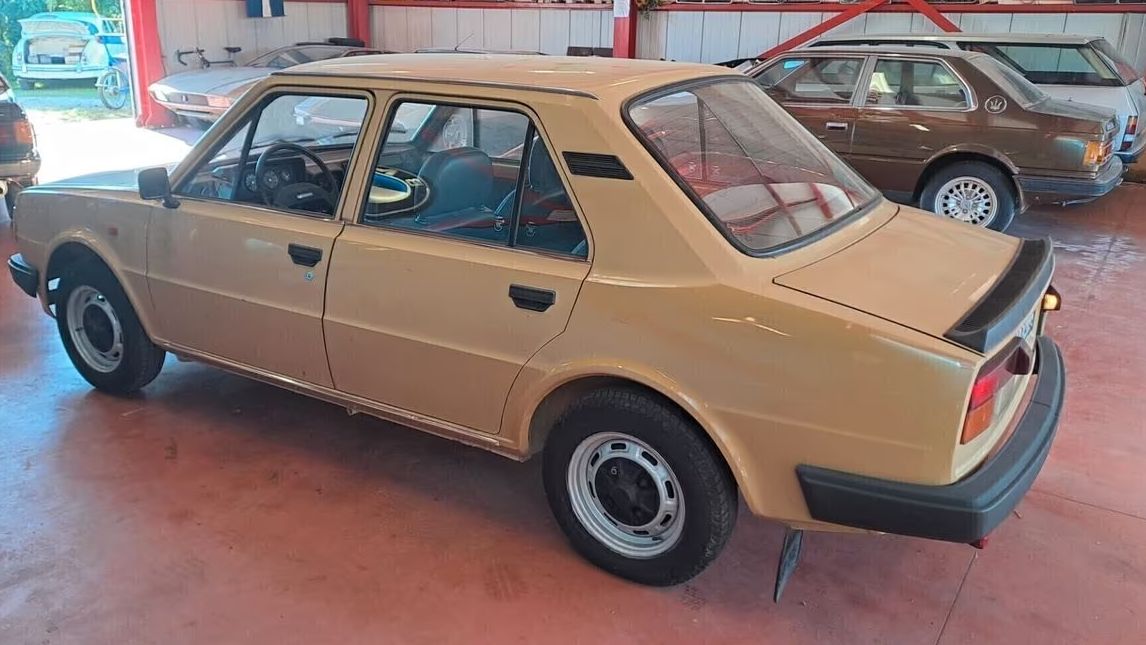
In the world of automotive collecting, the thrill often lies not in the prestige of the brand, but in the improbability of the find. While Italy is globally renowned as the cradle of high-performance machinery from Ferrari and Lamborghini, a recent discovery has surfaced in the Mediterranean country that defies traditional expectations: a rare Škoda 105 in remarkably preserved condition.
The vehicle, a product of the former Czechoslovakia, represents a fascinating intersection of Cold War-era engineering and unexpected survival. For most enthusiasts, finding a well-maintained example of the Škoda 742 family is a rarity; finding one in Italy, preserved by its original owner, is an automotive anomaly that highlights the global reach of socialist-era exports.
This specific discovery serves as a window into a bygone era of motoring, where utility and simplicity reigned. The appearance of such a vehicle on the European market underscores a growing interest in “ordinary” classics—cars that were once ubiquitous on their home roads but have since vanished due to time, rust, and neglect.
An Unexpected Discovery in Italy
The vehicle in question is a 1987 Škoda 105, specifically the “L” version, which is currently listed for sale in Italy. What makes this find particularly striking to historians and collectors is its provenance; the seller claims the car has remained with its first owner since it was new. In a region dominated by the likes of Fiat, Alfa Romeo, and Lancia, the presence of a beige Czechoslovakian sedan is an outlier.

According to the listing, the car is in a extremely good technical state and is notably free of the corrosion that typically plagues vehicles of this era. The odometer shows a relatively low mileage of 23,000 kilometers, suggesting the car spent much of its life sheltered from the rigors of daily commuting via Garáž.cz.
While Škoda vehicles were exported to Western Europe during the socialist period, the survival of a single-owner example in such a state is uncommon. The discovery prompts questions about the original owner’s motivations for keeping the car, as many early adopters of these imports quickly moved on to domestic brands.
The Legacy of the Model 742
The Škoda 105 belongs to the model range known as the 742, which was produced between 1976 and 1990 via Garáž.cz. During its production run, these rear-engine cars were among the most common sights on Czechoslovak roads, serving as the primary transport for thousands of families.
The 742 series was designed to be robust and easy to maintain, fitting the economic and social needs of the Eastern Bloc. However, the natural decay of these vehicles has been rapid. Most examples suffered from severe oxidation and mechanical wear, making the discovery of an original, rust-free specimen a significant event for vintage Czechoslovak cars enthusiasts.
The transition of these cars from everyday tools to collector’s items reflects a broader trend in the automotive world. As the generation that grew up with these cars enters retirement, there is a nostalgic drive to preserve the tangible remnants of 1980s automotive history.
A Collector’s Market: Low-Mileage Rarities in Czechia
The Italian find is not the only instance of an exceptionally preserved Škoda 105 surfacing. In the Czech Republic, the domestic market has seen several “time capsule” cars emerge through specialized auctions, such as the Retro Garáž event. These vehicles often command prices that far exceed their original utility value due to their near-zero mileage.
One such example is a white 1985 Škoda 105 S, which appeared at auction with a staggering odometer reading of only 834 kilometers. This vehicle was confirmed by a court expert to be original, with a chassis in nearly perfect condition, save for some anti-corrosion paint applied to bolts by the original owner. The starting bid for this specimen was set at 250,000 CZK via Auto.cz.
Even more extreme is a green Škoda 105 S, nicknamed the “užovka” (grass snake) due to its narrow track. This car remained unused for 42 years, stored on blocks in a garage. With only 684 kilometers on the clock and accompanied by its original invoice and warranty card, it was presented with a starting price of 300,000 CZK and an auction reserve of 400,000 CZK via Aktuálně.cz.
These examples demonstrate that for the right collector, the value of a rare Škoda 105 lies in its “untouched” state. While these cars were not designed for performance or luxury, their survival in original condition transforms them into historical artifacts.
Technical Profile of the Škoda 105
Technically, the Škoda 105 was designed for efficiency and reliability over speed. The “L” version found in Italy features a rear-mounted engine with a displacement of 1,046 cubic centimeters. This powertrain produces 33.9 kW (approximately 46 horsepower) and is paired with a four-speed manual transmission via Garáž.cz.
The rear-engine layout provided better traction in winter conditions—a critical feature for the Central European climate—but it also contributed to the car’s distinct handling characteristics. By modern standards, the technology is rudimentary, but for the era, it provided a dependable means of transport that could be repaired with basic tools.
For those interested in the preservation of these vehicles, the key areas of focus are usually the chassis and the brake systems. In the case of the 684 km specimen in Czechia, the vehicle required a brake system overhaul and a general “revival” service to be made roadworthy and pass the STK (technical inspection) via Aktuálně.cz.
Comparison of Notable Škoda 105 Finds
| Location | Model/Year | Mileage | Key Feature | Price/Value |
|---|---|---|---|---|
| Italy | 105 L (1987) | 23,000 km | First owner, no corrosion | Not specified |
| Czech Republic | 105 S (1985) | 834 km | Court-verified original | 250,000 CZK (Start) |
| Czech Republic | 105 S (Unknown) | 684 km | Stored on blocks for 42 years | 400,000 CZK (Reserve) |
The emergence of these vehicles highlights a shift in the automotive market where the “ordinary” becomes “extraordinary.” Whether it is a beige sedan in the Italian countryside or a green “užovka” in a Czech garage, these cars offer a tangible connection to the industrial history of the 20th century.
As these vehicles continue to disappear from the roads, the value of original, low-mileage examples is expected to remain steady among niche collectors who prioritize historical authenticity over performance.
For those tracking the market for vintage European cars, the next major checkpoint for these rarities often coincides with seasonal veteran car events and auctions in Central Europe, which typically open in the spring and close in the autumn.
Do you have a memory of these classic rear-engine cars, or do you think they belong in a museum? Share your thoughts in the comments below.