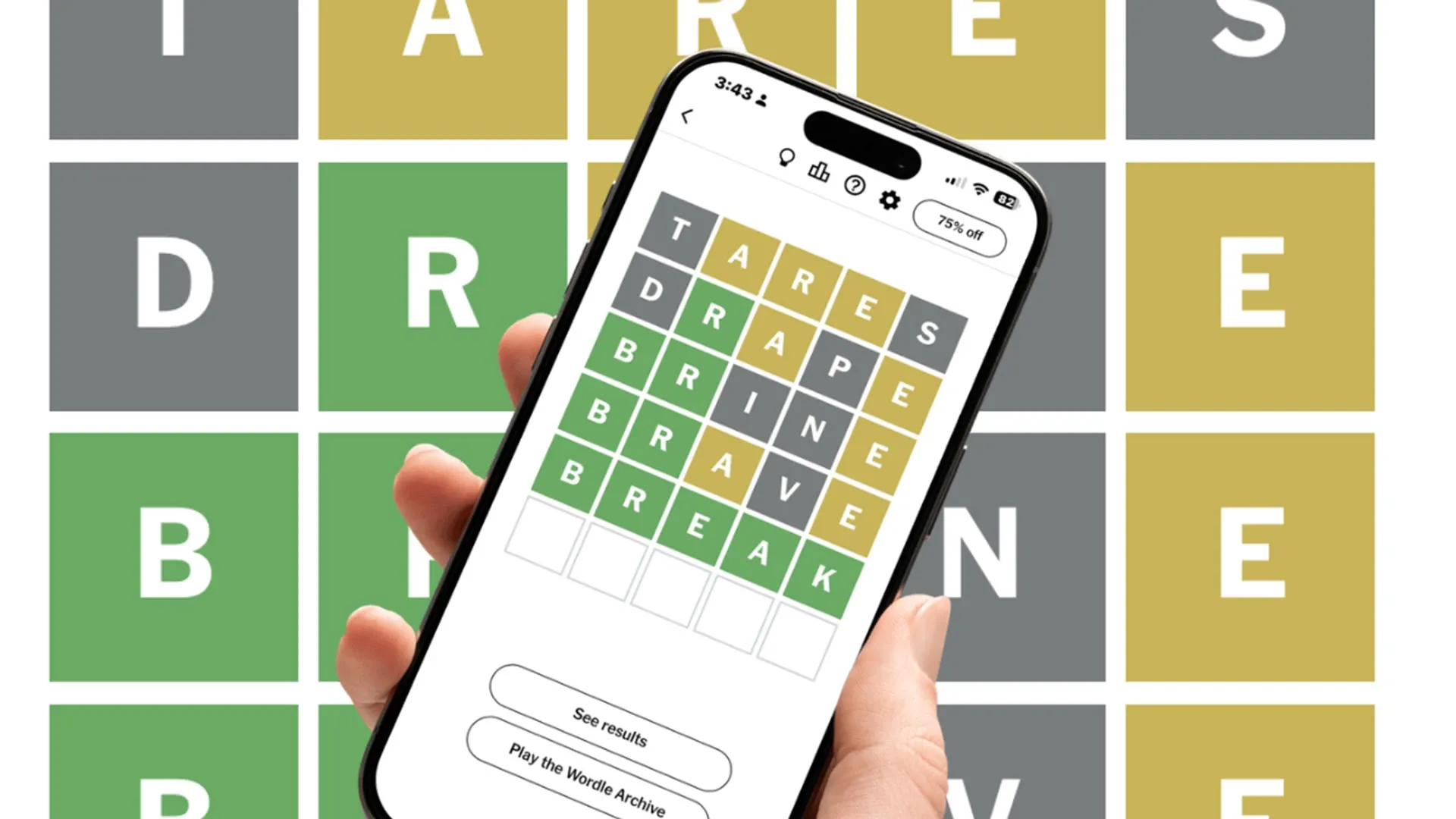
Researchers have identified a mathematical approach that secures a win in the popular daily puzzle game Wordle approximately 99% of the time. By leveraging the principles of Shannon entropy—a measure of information content—the strategy prioritizes guesses that maximize the reduction of uncertainty rather than focusing solely on identifying the correct letters early. This method provides a systematic way to solve the game by evaluating which words effectively prune the remaining possibilities in the shortest number of steps, according to research published by MIT Technology Review.
The core of this strategy lies in information theory, a field popularized by Claude Shannon in 1948. In the context of Wordle, players start with a pool of thousands of potential English words. Each guess acts as a query that returns specific feedback: green for a correct letter in the right spot, yellow for a correct letter in the wrong spot, and gray for a letter not in the word. A player using an entropy-based approach selects the next word that, on average, provides the highest “information gain,” which mathematically equates to eliminating the largest number of incorrect candidates from the remaining pool, as detailed in academic analysis of the game’s mechanics.
How Entropy Changes the Guessing Game
Traditional Wordle strategies often rely on heuristics, such as selecting a starting word with many common vowels like “ADIEU” or “AUDIO.” While these are intuitive, they do not always optimize for the rapid elimination of possibilities. An entropy-driven model, however, treats the game as a search algorithm. By calculating the probability distribution of all possible hidden words based on the feedback received from previous turns, the algorithm identifies the single word that will leave the fewest remaining options for the next turn.

This mathematical rigor is what separates high-performance solvers from casual play. According to The New York Times, which acquired the game in 2022, the average player typically solves the puzzle in about four to five guesses. The entropy-based strategy, conversely, consistently reaches the solution in three to four guesses, maintaining a success rate that approaches perfection over the set of all possible five-letter solutions in the game’s dictionary.
Applying Information Theory to Daily Puzzles
For the average player, applying complex entropy calculations during a morning coffee break is impractical. However, the logic behind the strategy offers a clear takeaway: the best guesses are those that contain a mix of high-frequency letters and provide the most distinct information across different letter positions. Instead of trying to guess the word immediately, the objective is to partition the remaining search space as evenly as possible.
Data suggests that starting with words like “CRANE,” “SLATE,” or “TRACE” serves as a practical approximation of this information-theoretic approach. These words are effective because they contain high-frequency consonants and vowels that are likely to appear in many potential answers, thereby “slashing” the uncertainty of the remaining letter combinations. Researchers note that this is consistent with the behavior of optimal solvers, which prioritize letters that appear in the largest subset of the remaining valid words.
Why This Strategy Matters for Game Design
The success of these mathematical models highlights a fundamental aspect of game design: the balance between player intuition and algorithmic efficiency. Because Wordle relies on a static, finite list of accepted five-letter words, it is susceptible to brute-force and information-theoretic optimization. This has led to an ongoing “arms race” between players using solver scripts and the game’s developers, who occasionally update the word list to maintain difficulty.
As of the most recent updates to the game’s architecture, the official Wordle platform remains a test of both vocabulary and logical deduction. While the 99% success rate is achievable for algorithms, human players continue to utilize these insights to improve their own performance, proving that even simple games are subject to the rigors of information theory. Whether players choose to use a solver or rely on their own intuition, the application of entropy remains the gold standard for achieving consistent results.
The next official update to the game’s word dictionary or mechanics is not currently scheduled, though players can monitor the Wordle homepage for any shifts in game play. We welcome your thoughts on these strategies—do you prefer the mathematical approach, or does it take the fun out of the daily challenge? Share your experiences in the comments below.
Worth a look