
The South Korean financial landscape has reached a historic milestone as the volume of over-the-counter (OTC) derivatives transactions surged to an all-time high. According to data released by the Financial Supervisory Service (FSS) on May 4, 2026, the notional amount of these contracts has climbed to nearly 27 quadrillion won, reflecting a market grappling with heightened volatility in both currency and equity markets.
This unprecedented expansion in the South Korea OTC derivatives record is not merely a sign of speculative fervor but a strategic response to systemic instability. As global trade volumes fluctuate and the Korean won experiences significant swings against major currencies, corporate and institutional investors have aggressively turned to hedging instruments to insulate their balance sheets from unpredictable losses.
The surge is primarily driven by a convergence of two factors: an intensified demand for foreign exchange (FX) hedging amid trade expansion and a spike in equity swap transactions triggered by sharp oscillations in the domestic stock market. For a global economy increasingly intertwined with South Korean semiconductors and automotive exports, the scale of this derivatives market serves as a critical barometer for perceived risk in the Asia-Pacific region.
To understand the magnitude of these figures, This proves essential to distinguish between the notional amount—the total value of the assets the derivatives are based on—and the actual market value or cash exchanged. While 27 quadrillion won is a staggering sum, it represents the face value of the contracts used to manage risk, rather than a direct cash outlay by the participants.
The Catalyst: Currency Volatility and Trade Hedging
A significant portion of the growth in OTC derivatives is rooted in the necessity of currency risk management. South Korea’s economy, heavily reliant on exports, is acutely sensitive to the USD/KRW exchange rate. When the won fluctuates wildly, companies importing raw materials or exporting finished goods face the risk of sudden margin erosion.
The Financial Supervisory Service reported that the expansion of foreign trade, coupled with increased exchange rate volatility, has forced firms to increase their use of FX forwards and swaps. These instruments allow companies to lock in exchange rates for future transactions, providing a predictable cost structure in an unpredictable geopolitical environment.
Market analysts note that the current trend is exacerbated by global monetary policy divergence. As central banks adjust interest rates at different speeds, the resulting currency volatility makes unhedged positions untenable for large-scale exporters. By utilizing OTC derivatives, which are privately negotiated contracts between two parties, firms can tailor their hedges to specific dates and amounts that standard exchange-traded futures cannot provide.
The Rise of Equity Swaps and Market Turbulence
Beyond currency concerns, the domestic equity market has contributed heavily to the record-breaking totals. The FSS highlighted a marked increase in equity swap transactions, which have surged alongside the rapid rise and fall of stock indices.
Equity swaps allow investors to exchange the returns of a specific stock or index for a fixed or floating interest rate. In periods of high volatility, these instruments become attractive for institutional investors seeking to gain exposure to the Korean market—or hedge existing portfolios—without owning the underlying shares directly. This synthetic exposure allows for greater leverage and flexibility, but it also ties the derivatives market closely to the performance of the KOSPI and KOSDAQ.
The correlation between stock market swings and derivative volume suggests that institutional players are increasingly using these tools to manage “tail risk”—the possibility of rare but extreme market crashes. As the equity market experiences sharp corrections, the volume of swaps used to offset these losses tends to spike, contributing to the overall growth of the OTC sector.
Understanding the OTC Market Structure
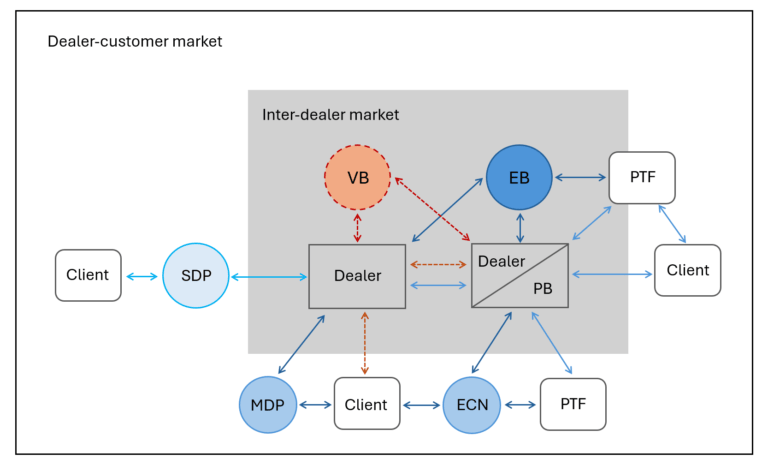
Unlike exchange-traded derivatives, which are standardized and cleared through a central clearinghouse, OTC derivatives are bespoke. They are typically negotiated between a corporate client and a financial institution, such as a commercial bank or an investment firm.
- Customization: Parties can decide the exact expiration date, the underlying asset, and the strike price.
- Privacy: Transactions are not listed on a public exchange, whereas regulatory reporting requirements have increased significantly in recent years.
- Counterparty Risk: Because there is no central clearinghouse for all OTC trades, there is a risk that one party may default on their obligation, a factor the FSS monitors closely to prevent systemic failure.
Systemic Implications and Regulatory Oversight
While hedging is a prudent risk-management tool, the sheer scale of a 27 quadrillion won market raises questions about systemic stability. The primary concern for regulators is the concentration of risk within a few large financial institutions that act as the primary dealers for these contracts.
The Financial Supervisory Service has intensified its monitoring of “notional exposure” to ensure that banks maintain sufficient capital buffers to cover potential losses. If a major corporate client were to fail, the ripple effect through the network of OTC swaps could potentially destabilize the broader financial system.
the shift toward record-high volumes indicates a permanent change in how South Korean firms perceive global risk. The era of relative currency stability has been replaced by a regime of constant fluctuation, making derivatives a core component of corporate treasury operations rather than an optional insurance policy.
Key Takeaways for Global Investors
- Hedging as a Standard: The record volume confirms that South Korean firms are now aggressively hedging against currency and equity risks.
- Volatility Indicator: The growth in OTC derivatives is a direct reflection of the perceived instability in the USD/KRW exchange rate and the domestic stock market.
- Regulatory Focus: The Financial Supervisory Service (FSS) is prioritizing the monitoring of counterparty risk to prevent a systemic event.
- Notional vs. Real Value: The 27 quadrillion won figure represents the total value of assets being hedged, not the actual amount of cash traded.
What Happens Next?
The financial community is now looking toward the next quarterly reporting cycle from the FSS to determine if this peak represents a modern plateau or a temporary spike. Market participants are particularly focused on whether the trend will persist if global interest rate volatility begins to subside.
there are ongoing discussions regarding the further migration of OTC contracts to central clearinghouses to reduce counterparty risk. Any regulatory mandate requiring more OTC trades to be centrally cleared would likely alter the current volume and pricing of these instruments.
The next official update on derivatives market stability and volume is expected in the FSS’s upcoming quarterly financial stability report. We will continue to monitor these filings to provide updates on how South Korean institutions are managing this record-breaking exposure.
Do you believe the surge in derivatives is a sign of prudent risk management or an indicator of deeper market fragility? Share your analysis in the comments below or share this report with your professional network.
Keep reading
- Train de vie | Acheter une nouvelle maison sans sacrifier ses comptes enregistrés – La Presse
- Kundenberater (m/w/d) als Quereinsteiger ohne Ausbildung – Krefeld | Stellenblatt
- Why Nighttime Heat Is Rising Faster Than Daytime Highs in US Cities (daybreakwire.com)
- China’s AI Surge: Market Growth, Tech Distillation, and US Tension (archynewsy.com)