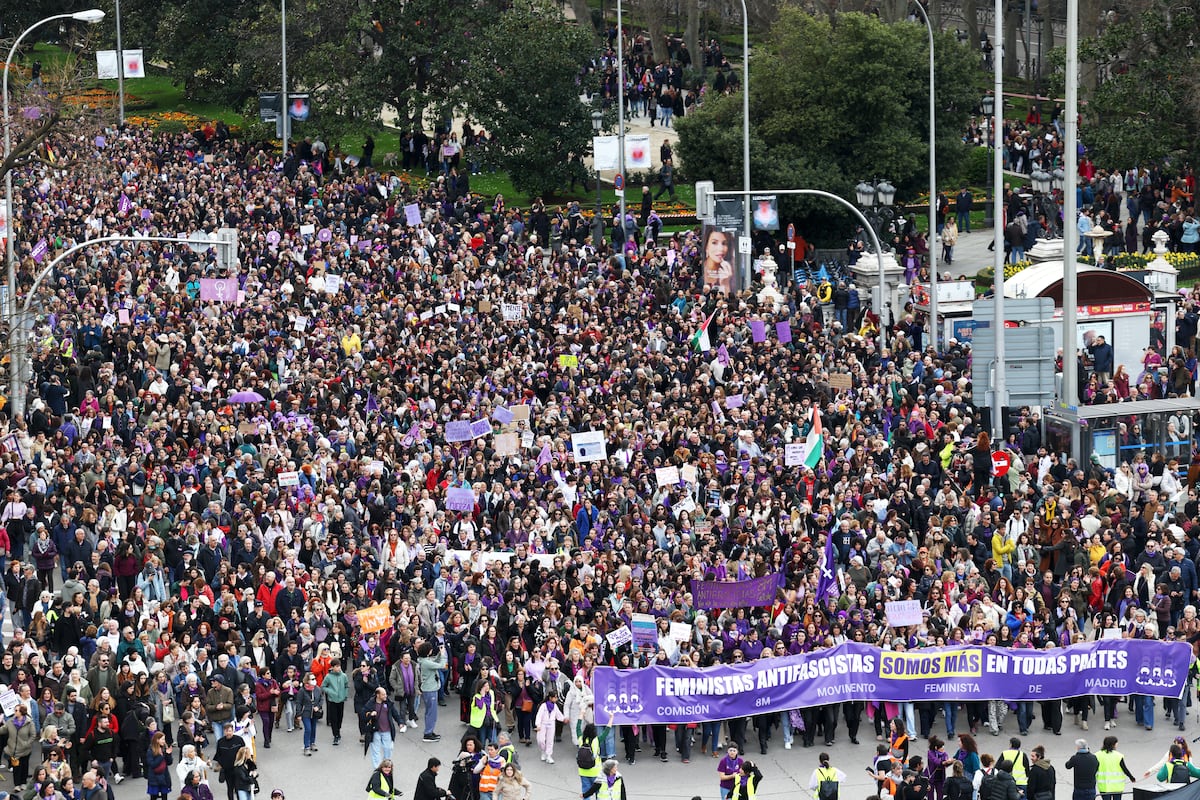
Madrid – Millions across Spain and beyond took to the streets on Sunday, March 8th, 2026, for International Women’s Day, demonstrating for gender equality, reproductive rights, and peace. The demonstrations, often referred to as 8M, saw a significant turnout in major cities including Madrid, Barcelona, Valencia, and Seville, with participants voicing concerns over ongoing gender-based violence, economic disparities, and the global rise in conflict. This year’s marches were particularly notable for their strong anti-war messaging, linking feminist principles with calls for pacifism.
The demonstrations come amid a continuing global conversation about women’s rights and safety. Recent data from the Spanish Ministry of Equality indicates a concerning rise in reported cases of domestic violence and sexual assault, fueling demands for increased protection and preventative measures. Political figures have responded to the demonstrations with varying degrees of engagement, highlighting the complex political landscape surrounding gender equality in Spain.
Madrid’s 8M: A Day of Protest and Political Response
In Madrid, the central demonstration saw a large gathering in the city center, with participants marching towards the Plaza de Cibeles. Notably, Rita Maestre, the spokesperson for Más Madrid in the Madrid City Council, chose not to attend the official event organized by the City Council, instead joining a protest organized by the Platform in Defense of Spaces for Equality. Maestre publicly criticized the event, stating that any statements made by Mayor José Luis Martínez-Almeida would be “bla, bla, bla,” according to reports from Libertad Digital.
Despite Maestre’s criticism, Mayor Almeida addressed her directly during his speech at the official event. He emphasized the importance of respect for all individuals, regardless of political differences, and extended a message of “affection” to Maestre. This gesture, while seemingly conciliatory, occurred shortly after Maestre had voiced her concerns about the city’s policies on equality and criticized Almeida’s potential focus on international issues like Iran while neglecting domestic concerns. Maestre was accompanied by Manuela Bergerot, leader of her party in the Madrid Assembly, and Mónica García, the Minister of Health, demonstrating a united front from Más Madrid.
Maestre too addressed recent personal harassment she has experienced. She spoke out against the “misogynistic harassment” of “right-wing thugs” who have been reportedly gathering outside her home after her address was publicly shared. She stated, “Today, on days when women who decide to speak out suffer the misogynistic harassment of some thugs on the right, It’s a day to tell them all that they will not succeed, that they will not pass, that we are stronger, that we are together, that we are brave, that feminism does not take a step back and that we feminists are here.”
Beyond Madrid: National and International Themes
The 8M demonstrations weren’t limited to Madrid. Barcelona saw a large turnout with a focus on economic equality and the gender pay gap. Valencia’s march highlighted the need for increased resources for victims of gender-based violence, while Seville’s demonstration emphasized reproductive rights and access to safe abortion services. Across the country, a common thread was the intersection of feminist demands with broader calls for social justice and peace.
The anti-war sentiment was particularly strong this year, reflecting growing global anxieties over conflicts in Ukraine and the Middle East. Many protesters carried signs linking the fight for women’s rights with the pursuit of peace, arguing that women and girls are disproportionately affected by armed conflict. This connection underscores a growing understanding of feminism as inherently linked to pacifism and a rejection of militarism.
Political Reactions and Ongoing Debates
The 8M demonstrations have prompted a range of political responses. While many politicians expressed support for the principles of gender equality, there were also criticisms of the demonstrations themselves, with some questioning the tactics employed by protesters. The debate over the role of government in addressing gender inequality continues to be a central theme in Spanish politics.
The Spanish government, led by Prime Minister Pedro Sánchez, has implemented several policies aimed at promoting gender equality, including legislation to combat gender-based violence and promote equal pay. However, critics argue that these measures are insufficient and that more needs to be done to address systemic inequalities. The opposition Partido Popular has called for a more comprehensive approach that focuses on education and economic empowerment.
The Issue of Online Harassment and Safety
Rita Maestre’s experience with online harassment and the subsequent targeting of her home has brought renewed attention to the issue of violence against women in politics. This incident highlights the challenges faced by female politicians who often endure disproportionate levels of abuse and intimidation. The Spanish government has pledged to strengthen laws and provide greater protection for women in public life, but activists argue that more needs to be done to hold perpetrators accountable.
The sharing of Maestre’s address online raises serious questions about data privacy and the responsibility of social media platforms to protect their users from harassment. Experts are calling for stricter regulations and more effective mechanisms for reporting and removing abusive content. The incident also underscores the importance of solidarity and support for women who are targeted by online violence.
Looking Ahead: The Future of Feminism in Spain
The 2026 8M demonstrations served as a powerful reminder of the ongoing struggle for gender equality in Spain and around the world. The diverse range of issues raised by protesters – from economic inequality and gender-based violence to reproductive rights and peace – reflects the multifaceted nature of feminist activism. As Spain continues to grapple with these challenges, the voices of women and feminist organizations will be crucial in shaping the country’s future.
The demonstrations also highlighted a growing sense of intergenerational solidarity, with young women and older feminists working together to advance their shared goals. This collaboration is essential for building a sustainable movement that can address the complex challenges facing women today. The call for a more inclusive and equitable society resonated throughout the country, inspiring hope for a future where all individuals can live with dignity and respect.
The next key date for developments in gender equality policy in Spain is expected to be in late April 2026, when the Ministry of Equality is scheduled to present its annual report on the implementation of the National Plan for Gender Equality. Further updates and information can be found on the Ministry’s official website. https://www.igualdad.gob.es/
What are your thoughts on the 8M demonstrations and the ongoing fight for gender equality? Share your comments below and help us continue the conversation.
Keep reading