
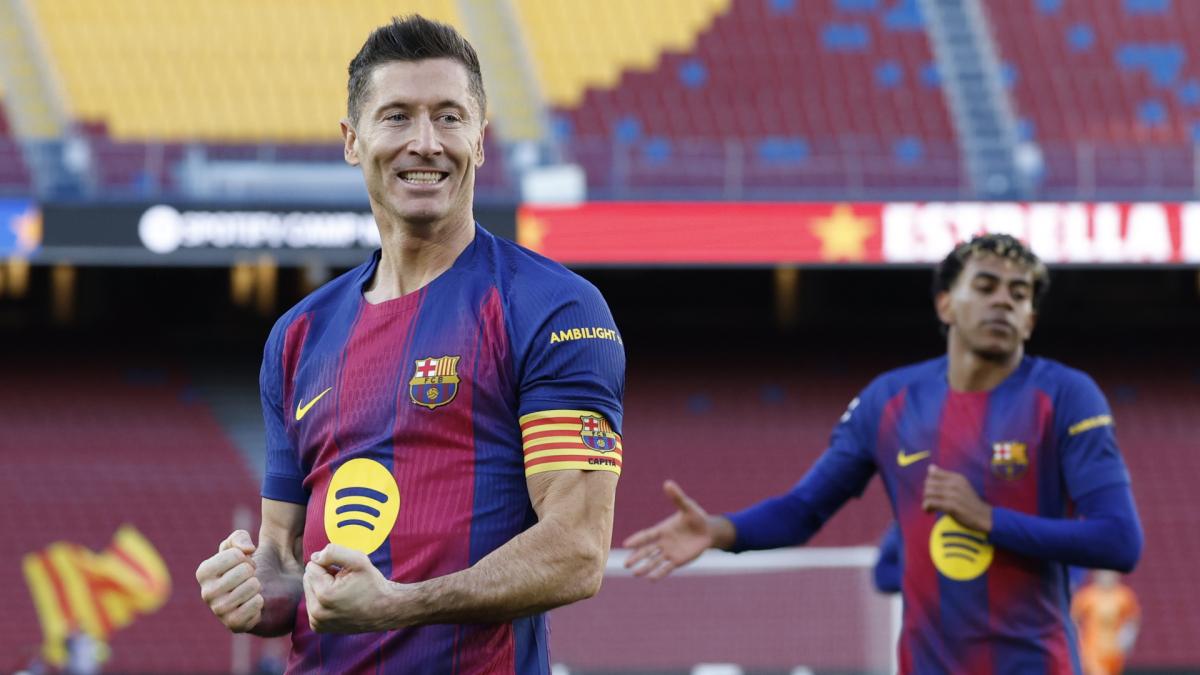
The footballing landscape in Catalonia is currently bracing for a significant shift as speculation intensifies regarding the future of Robert Lewandowski at FC Barcelona. As the club navigates a complex era of financial restructuring and tactical evolution under manager Hansi Flick, the status of the Polish striker has become a focal point for fans and analysts globally.
For several seasons, Lewandowski has served as the cornerstone of the Barcelona attack, bringing a clinical edge and veteran leadership to a squad characterized by emerging youth. However, as the 2025-2026 campaign reaches its climax, reports regarding a potential departure have moved from the periphery of transfer rumors to the center of the sporting discourse.
The intersection of a winding-down contract, the stringent salary cap regulations imposed by La Liga, and a strategic shift in playing style has created a scenario where a parting of ways may be viewed as mutually beneficial. While the striker’s contributions on the pitch remain evident, the broader objective of the club appears to be a transition toward a more sustainable financial model and a modernized offensive approach.
As the summer transfer window approaches, the resolution of Lewandowski’s tenure in Barcelona will not only dictate the club’s tactical setup for the next season but will also free up critical resources that could facilitate the acquisition of new talent to bolster a rebuilding squad.
The Tactical Evolution Under Hansi Flick
The relationship between Robert Lewandowski and Hansi Flick is one of deep professional trust, dating back to their highly successful tenure at Bayern Munich. Flick understands the nuances of Lewandowski’s game better than perhaps any other coach in world football. However, the demands of the modern game, particularly the high-intensity pressing system Flick implements, place a significant physical burden on a veteran striker.
In recent months, the tactical discourse surrounding the team has shifted toward the necessity of a more mobile front line. While Lewandowski remains a master of positioning and finishing, the evolution of the “modern nine” requires a level of defensive contribution and transitional speed that naturally declines with age. The strategic pivot toward younger, more dynamic forwards is not necessarily a critique of Lewandowski’s current form, but rather a forward-looking adjustment to ensure the team remains competitive in the Champions League and La Liga.
This tactical transition is often a delicate process. Integrating new talent while maintaining the goal-scoring output provided by a world-class striker requires a phased approach. By potentially moving toward a post-Lewandowski era, Barcelona can accelerate the development of its academy graduates and integrate new signings who fit the high-tempo profile required by Flick’s system.
Financial Imperatives and the La Liga Salary Cap
Beyond the tactical considerations, the financial reality of FC Barcelona remains a primary driver of personnel decisions. The club continues to operate under the strict scrutiny of La Liga’s financial fair play regulations, which limit a team’s total wage bill relative to its revenue. This “salary cap” has historically forced the club into difficult decisions regarding player registrations and contract renewals.
Lewandowski occupies a significant portion of the club’s wage structure. In the context of Barcelona’s goal to return to the “1:1 rule”—a status that would allow the club to spend every euro it earns on new signings without restrictions—reducing the overall payroll is essential. The departure of a high-earning veteran would provide immediate and substantial relief to the balance sheet.
This liberated “masa salarial” (wage mass) is not merely about saving money; This proves about strategic reinvestment. By offloading one of the highest salaries on the books, the board can allocate those funds toward multiple positions of need, potentially securing a younger striker and reinforcing the midfield or defense. This financial flexibility is critical for a club attempting to regain its status as a dominant force in European football while managing a massive debt load.
Potential Destinations and the Saudi Pro League Factor
Whenever a player of Lewandowski’s stature becomes available, the global market reacts. The most prominent destination in recent transfer cycles has been the Saudi Pro League, which has aggressively recruited aging European superstars with unprecedented financial packages. For a player in the twilight of his career, the prospect of a lucrative final contract in the Middle East is a compelling option.
However, Lewandowski has consistently expressed a desire to compete at the highest level of European football. While the allure of Saudi Arabia is strong, the striker’s professional drive often aligns with projects that offer sporting prestige. Whether he chooses a move to a league where he can maintain a high profile or decides to explore options closer to home, any move will be predicated on the level of competition available.
There is also the possibility of a return to the Bundesliga or a move to another top-tier European league, though these options are less likely given the financial disparity compared to the Saudi offers. Regardless of the destination, the transition marks the end of a chapter where Lewandowski proved he could adapt and thrive in the demanding environment of Spanish football.
The Legacy of a Polish Icon in Catalonia
Evaluating Robert Lewandowski’s time at Barcelona requires looking beyond the goals and assists. He arrived in Barcelona with the weight of immense expectation, tasked with filling the void left by legendary predecessors. In many ways, he succeeded by providing a reliable goal-scoring outlet during one of the most turbulent periods in the club’s history.
His professionalism and work ethic have served as a blueprint for the younger players in the locker room. From his disciplined approach to nutrition and training to his leadership during difficult match stretches, Lewandowski brought a “winning culture” from Bayern Munich that was desperately needed in the Barcelona dressing room. His ability to mentor the next generation of attackers ensures that his influence will be felt long after his departure.
Statistically, he has remained one of the most efficient strikers in the world, consistently ranking among the top scorers in La Liga. His tenure proved that age is a secondary factor when combined with elite conditioning and tactical intelligence. He leaves the club not as a fading star, but as a professional who gave his best years to a project in transition.
What Happens Next?
The immediate future for Robert Lewandowski and FC Barcelona will be determined by the final matchdays of the season and the subsequent negotiations during the summer window. The club’s priority will be to ensure a dignified exit for a player who has given so much, while simultaneously securing the financial margins needed for the next phase of recruitment.
Fans should look for official communications from the club’s board and the player’s representatives in the coming weeks. The key indicator of a departure will be the club’s activity in the striker market; any aggressive pursuit of a new center-forward will likely signal that the decision regarding Lewandowski has been finalized.
For the most accurate and up-to-date information, supporters are encouraged to follow the official FC Barcelona website for formal announcements regarding squad changes and contract updates.
As we witness the potential closing of this chapter, we invite our readers to share their thoughts. Do you believe Lewandowski’s departure is the right move for Barcelona’s financial health, or is his goal-scoring presence too valuable to lose? Let us know in the comments below and share this analysis with your fellow football enthusiasts.