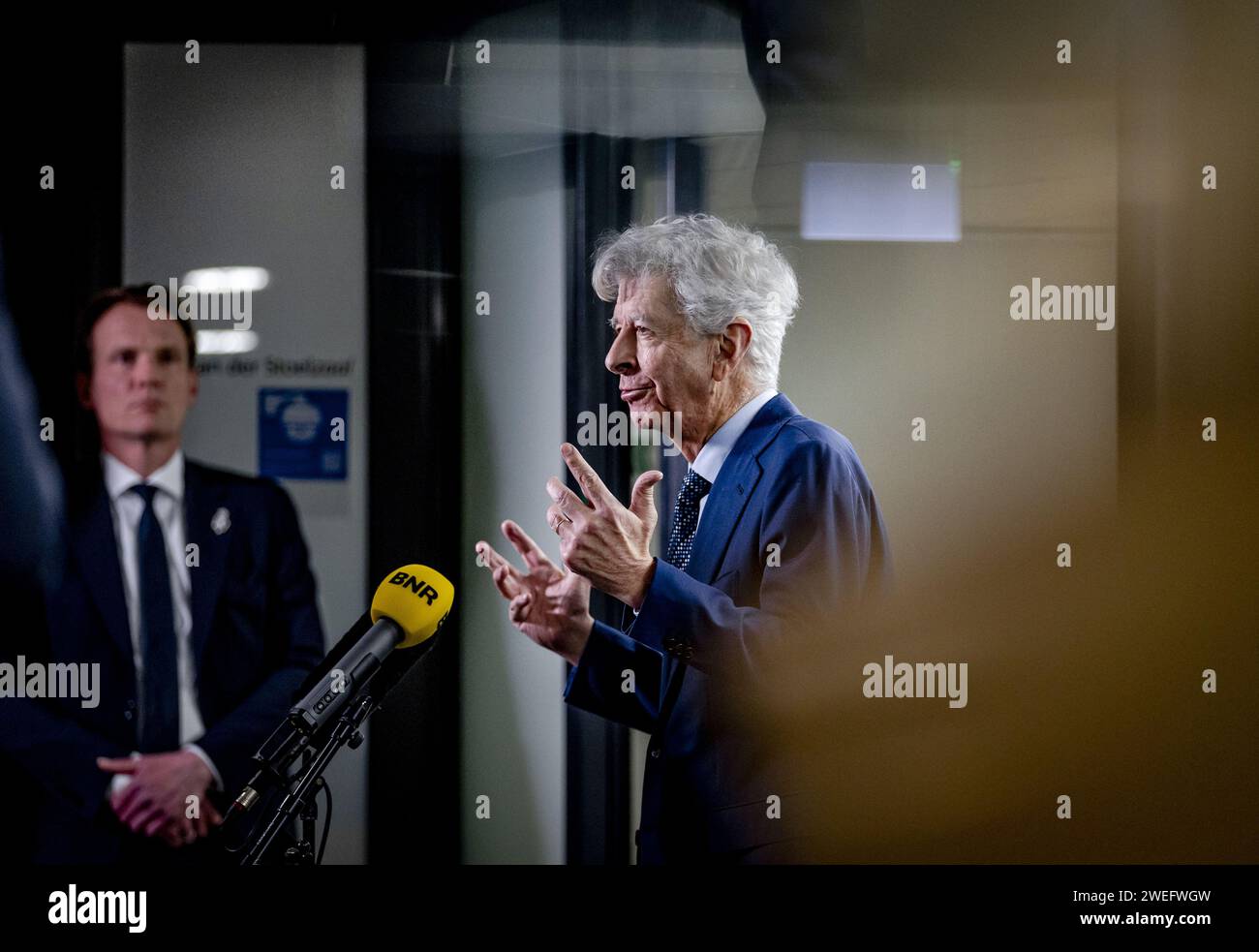
The intersection of scientific rigor and public discourse often reveals a tension between objective data and personal conviction. This tension is at the heart of a recent commentary by Ronald Plasterk, who argues that the quality of public debate suffers when individuals attempt to disguise their opinions as established facts.
Plasterk, a distinguished figure in both Dutch academia and politics, suggests that the path to a more productive dialogue is to discussieer open en eerlijk, in plaats van opvattingen te vermommen als feiten (discuss openly and honestly, instead of disguising opinions as facts). By calling for a clear distinction between evidence-based claims and personal viewpoints, he addresses a growing trend in modern argumentation where “fact-checking” is sometimes used as a weapon to silence opposing perspectives rather than to find the truth.
This call for intellectual honesty comes from a man whose career has spanned the highest levels of molecular biology and government administration. As a former minister and a professor, Plasterk is uniquely positioned to critique how information is presented and contested in the public square, particularly in complex social and scientific debates.
The Academic and Political Profile of Ronald Plasterk
To understand the weight of Plasterk’s perspective on discourse, it is necessary to look at his professional trajectory. He is a PhD biologist specializing in molecular genetics, having served as a professor of Molecular Genetics at the University of Amsterdam from 1997 to 2003, and as a professor of Developmental Genetics at Utrecht University from 2000 to 2007 Ronald Plasterk – Wikipedia. Since October 2018, he has held the position of professor of Novel Strategies for Success to Therapeutics at the University of Amsterdam.
His scientific contributions were recognized early on; in 1999, he received the Spinoza Prize, and the Dutch Organization for Scientific Research described him as one of the most brilliant researchers in molecular biology Ronald Plasterk – Wikipedia. This background in hard science informs his insistence on the distinction between a “fact”—something verifiable and reproducible—and an “opinion,” which is a value judgment or a perspective.
Plasterk’s expertise is not limited to the laboratory. He has a deep history in Dutch governance, serving as the Minister of Education, Culture, and Science from February 22, 2007, to February 23, 2010, and later as the Minister of the Interior and Kingdom Relations from November 5, 2012, to October 26, 2017 Ronald Plasterk – Wikipedia. More recently, in 2023 and 2024, he served as an explorer and informateur for cabinet formations, roles that require navigating intense political disagreements and brokering compromise between opposing ideologies.
Navigating Controversies and Free Speech
Plasterk’s advocacy for honest and open discussion is mirrored in his own experience with the legal boundaries of free speech. As a columnist, he has frequently engaged with sensitive societal topics, leading to legal scrutiny that ultimately reinforced the protections afforded to opinion writers in the Netherlands.
In November 2024, Plasterk authored a column regarding the events surrounding the Kristallnacht commemoration and violent incidents related to a football match between Ajax and Maccabi Tel Aviv. In the piece, he noted that “the antisemitism that always slumbers, has flared up around this Kristallnacht” and suggested that Dutch Muslims should be inspired by the successes of their Jewish counterparts Aangifte van discriminatie tegen Plasterk.
This column led to a formal complaint of discrimination. However, the Public Prosecution Service (Openbaar Ministerie) dismissed the case, concluding that Plasterk’s statements were not criminally punishable. The authorities ruled that suggesting one group be inspired by the success of another does not constitute a criminal group insult, nor is the implication of differing levels of success sufficiently offensive to damage the image of the group in a legal sense Aangifte van discriminatie tegen Plasterk. This case highlights the “exceptionally large freedom of expression” granted to columnists, a freedom that Plasterk argues should be used for honest, transparent debate rather than the manipulation of facts.
The Danger of “Fact-Masking” in Public Debate
The core of Plasterk’s argument is a critique of a specific rhetorical tactic: the attempt to win an argument by claiming the opponent’s facts are wrong, when in reality, the disagreement is about values or interpretations. When an opinion is presented as a fact, it shuts down the possibility of a genuine exchange because it frames the other person not as someone with a different view, but as someone who is factually incorrect.
This is particularly evident in discussions regarding sensitive healthcare and social issues. For example, in discussions concerning transgender children and hormone treatments, the debate often shifts from a discussion of risk-benefit analysis (which involves opinions on acceptable risk) to a battle over who possesses the “correct” facts Transgender kinderen en hormoonbehandeling.
By urging participants to discussieer open en eerlijk, in plaats van opvattingen te vermommen als feiten, Plasterk is calling for a return to a more classical form of dialectic. In this model, parties acknowledge their premises: “Based on these facts, I hold this opinion.” This allows the debate to move forward by either challenging the facts or debating the logic used to reach the opinion, rather than simply accusing the other party of being “wrong” about the world.
Key Takeaways from Plasterk’s Perspective
- Fact vs. Opinion: There is a critical distinction between verifiable data and personal interpretation; blurring the two hinders productive dialogue.
- Intellectual Honesty: Admitting when a position is based on a value judgment rather than a scientific certainty encourages more honest and less polarized debates.
- Freedom of Expression: Columnists and public intellectuals have a wide berth to express provocative views, provided they do not cross into criminal group insults.
- Rhetorical Tactics: Accusing an opponent of “wrong facts” is often a shortcut used to avoid engaging with the actual philosophical or moral disagreement.
The Broader Impact of Scientific Literacy in Politics
Plasterk’s dual identity as a Spinoza Prize-winning scientist and a former cabinet minister provides a blueprint for how scientific literacy can be applied to governance. The ability to distinguish between evidence and opinion is not just a tool for winning arguments, but a necessity for creating effective public policy.
In his transition from the laboratory to the ministry, and eventually to the role of a public columnist, Plasterk has consistently emphasized the importance of clarity. His entrepreneurial ventures, such as the founding of Frame Therapeutics in December 2018 (which was sold to CureVac in June 2022), further demonstrate his commitment to translating complex molecular genetics into practical, real-world applications Ronald Plasterk – Wikipedia.
When this level of precision is missing from public discourse, the result is often a “culture of indignation” where the goal is no longer to persuade or understand, but to delegitimize the opponent. Plasterk’s insistence on honesty in debate is an attempt to steer the public conversation back toward a framework where evidence is respected, and opinions are debated on their own merits.
For those following the evolution of Dutch political discourse and the role of the “scientist-politician,” Plasterk remains a central figure. His career suggests that while facts are the foundation of any argument, the honesty with which we present our interpretations of those facts is what determines the health of a democratic society.
As public debates continue to polarize globally, the call to separate evidence from opinion remains a vital checkpoint for anyone seeking to engage in a meaningful exchange of ideas. The next phase of this discourse will likely involve how these standards of “honest discussion” are applied to emerging technologies and social policies in the coming years.
Do you believe the line between fact and opinion has develop into too blurred in modern political debate? Share your thoughts in the comments below and share this article with your network.
Keep reading