
The landscape of professional medical networking is shifting. For years, physicians have relied on a fragmented array of tools—ranging from traditional professional directories to the chaotic, high-velocity environment of social media—to share clinical insights and peer-to-peer advice. However, a new contender is entering the space with the goal of consolidating this “collective wisdom” into a single, high-trust environment.
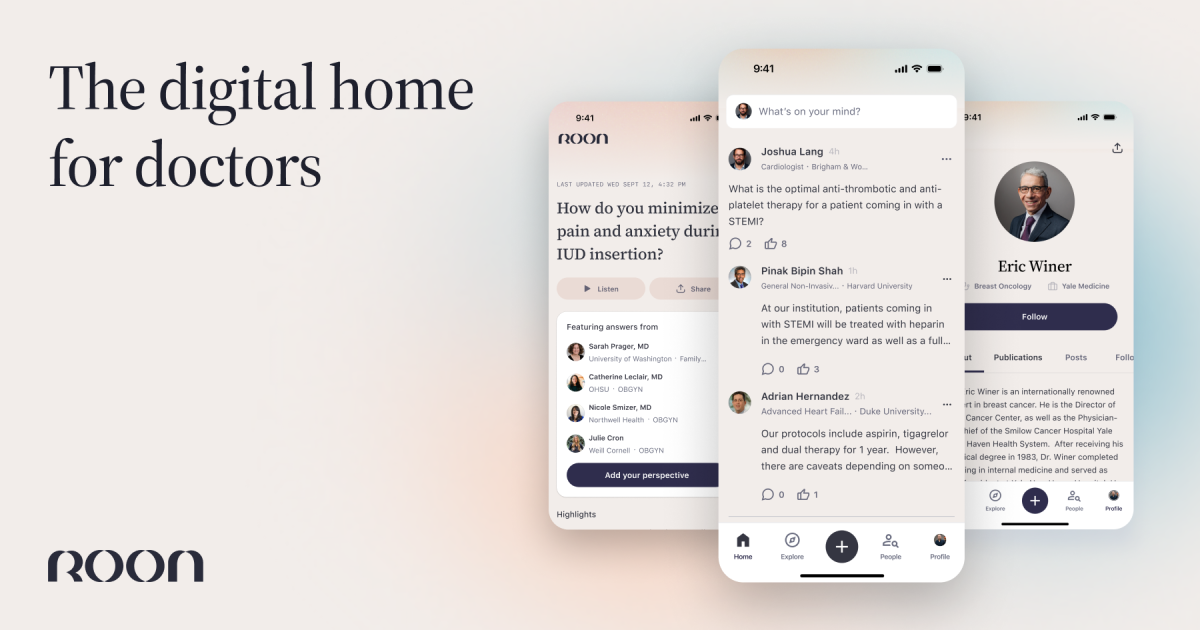
Roon, an AI-native community designed exclusively for physicians, officially launched on April 30, 2026, aiming to provide a dedicated knowledge network built by doctors, for doctors according to a company announcement. By focusing on the nuance of clinical judgment rather than general engagement, the platform seeks to replace the informal and often scattered exchanges that currently occur across disparate online communities.
The platform was founded by a team combining deep clinical expertise with high-scale product experience, including Dr. Rohan Ramakrishna, a neurosurgeon, and Vikram Bhaskaran, the CEO and co-founder who previously served as an executive at Pinterest. Their objective is to capture the “clinical judgment” and “hard-won perspective” that often remains undocumented in traditional medical literature but is essential for real-world decision-making.
Bridging the Gap Between Data and Clinical Judgment
In the current medical ecosystem, there is a distinct difference between available data—such as peer-reviewed studies and clinical guidelines—and the practical application of that data at the bedside. Roon is positioned as a space where this application, or clinical judgment, is documented and debated in real time.
“There’s a layer of medicine that’s never been captured digitally: the clinical judgment, the debate, the hard-won perspective that turns experience and data into decisions. Roon is where that lives. And when those conversations happen at scale, research and insights that once took years to reach the bedside can spread in real-time.” Dr. Rohan Ramakrishna, Neurosurgeon and Co-Founder of Roon
The platform’s design is intended to facilitate several key professional activities that are often cumbersome on general-purpose social networks:
- Complex Case Consultation: Seeking multi-specialty input on challenging clinical cases to extend the reach of peer consults.
- Research Validation: Gathering feedback on draft manuscripts and research from subject-matter experts before formal submission.
- Real-Time Debate: Discussing emerging health policy and new research findings across different practice settings.
- Professional Wellness: Sharing strategies to navigate burnout and the systemic strains of modern medical practice.
The Role of AI in a Physician-Centric Network
Unlike many current trends in healthcare technology that seek to leverage artificial intelligence to automate or replace certain diagnostic functions, Roon is utilizing AI to amplify human expertise. The platform is described as “AI-native,” meaning AI is integrated into the core architecture to assist with onboarding and the discovery of expertise across different institutions.

The influence of the founders’ backgrounds in consumer technology is evident in the platform’s approach to information organization. Vikram Bhaskaran has noted that while platforms like Pinterest demonstrated how the internet could be organized around people rather than just raw information, Roon applies this logic to medical expertise. By placing physicians at the center, the platform uses AI to ensure that the right knowledge reaches the right clinician more efficiently.
This approach addresses a specific void left by the decline of “MedTwitter”—the influential community of physicians on X (formerly Twitter). According to the company, the loss of that ecosystem left a gap for a high-trust environment where clinicians could “think out loud” without the interference of algorithms optimized for viral engagement rather than medical accuracy.
Impact on Global Healthcare Delivery
The potential impact of a dedicated knowledge network for the world’s estimated 14 million doctors is significant. By accelerating the speed at which clinical insights are shared, the platform could theoretically reduce the time it takes for a breakthrough in one region or specialty to be adopted globally. This “living network of expertise” aims to sharpen clinical judgment and, improve patient outcomes.
For the global medical community, the emergence of Roon represents a move toward “professionalized” social networking. Rather than adapting to tools built for the general public, physicians are increasingly demanding tools that respect the privacy, urgency, and complexity of their profession.
Key Takeaways: Roon vs. Traditional Networking
- Focus: Shifts from “engagement” (likes/shares) to “expertise” (clinical judgment and peer review).
- User Base: Strictly physician-only to maintain a high-trust, safe environment for clinical discussion.
- AI Integration: Used for expert discovery and seamless onboarding rather than diagnostic replacement.
- Goal: To move clinical insights from “informal exchanges” to a structured, searchable knowledge network.
As the platform continues to scale following its April 30 launch, the next critical phase will be the integration of more diverse global specialties and the verification of its impact on bedside care. Further updates regarding platform expansion and new feature rollouts are expected as the community grows.
Do you believe a dedicated “knowledge network” can truly replace the informal mentorship and “hallway consultations” of traditional medicine? Share your thoughts in the comments below.
Related reading