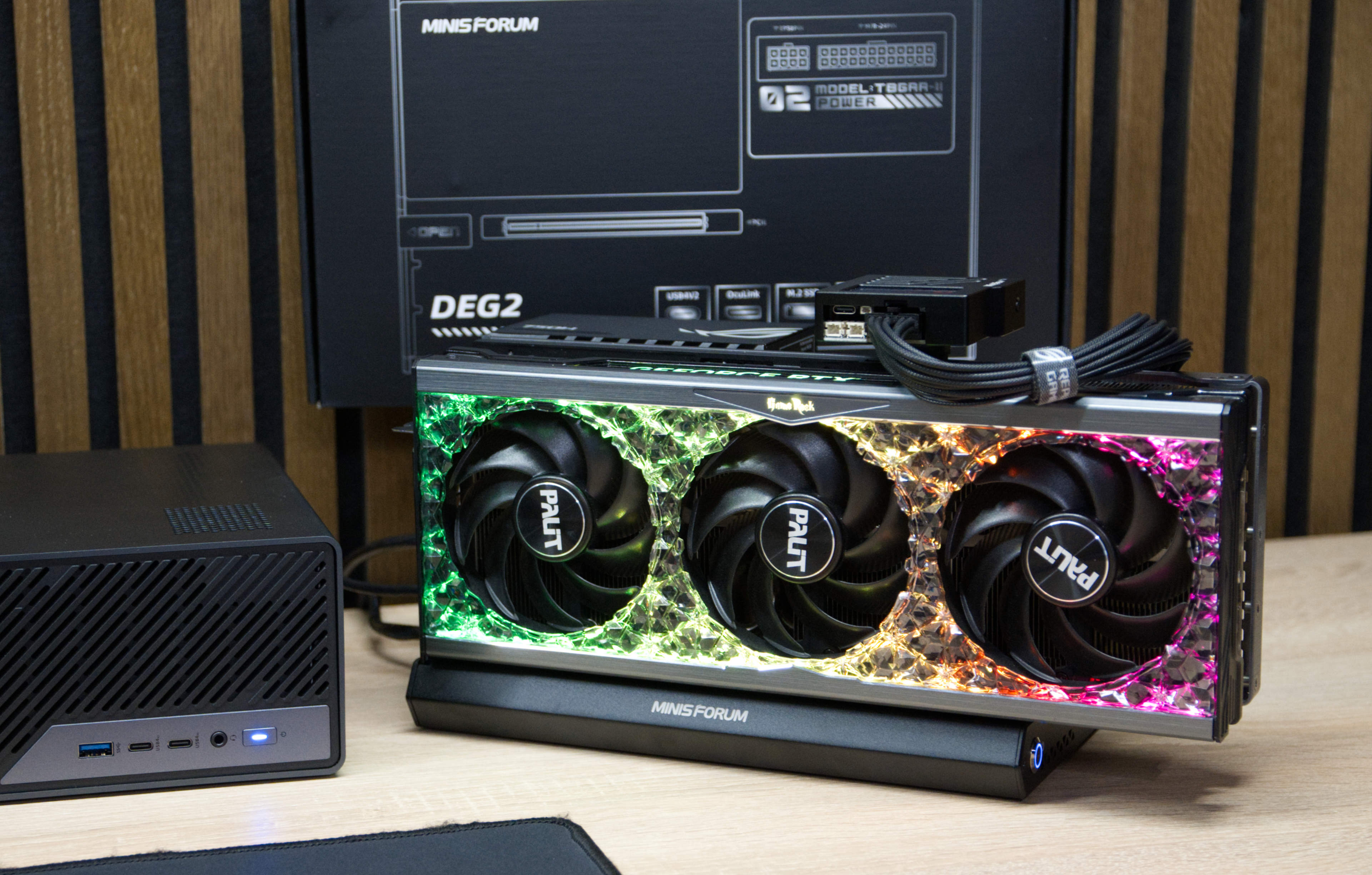
The demand for portable computing power continues to surge, but often at the expense of graphical performance. Gamers, content creators, and professionals requiring significant GPU capabilities have traditionally faced a trade-off between mobility and processing strength. However, a new wave of external graphics card (eGPU) solutions is challenging that paradigm. Minisforum, a company specializing in compact computing solutions, has recently unveiled the DEG2, a device designed to bridge the gap, enabling users to connect desktop-class graphics cards to mini PCs, laptops, and even tablets. This development opens up possibilities for significantly enhanced graphics performance in previously constrained environments.
The core concept behind the DEG2 revolves around providing a robust external connection for a full-sized desktop graphics card. Whereas laptops and small form factor PCs often include integrated graphics or limited dedicated GPUs, the DEG2 allows users to bypass these limitations by housing a powerful, independently powered graphics card. This is particularly appealing for those who already own high-end GPUs and wish to repurpose them for mobile use, or for those who want to upgrade their graphics capabilities without replacing their entire system. The DEG2 utilizes the OCuLink interface, a relatively new standard that offers higher bandwidth compared to traditional USB-based eGPU solutions, though as we’ll explore, the connection method significantly impacts performance.
Understanding eGPU Technology and the OCuLink Advantage
External GPUs aren’t a new concept, but their adoption has been hampered by bandwidth limitations and compatibility issues. Early eGPU solutions relied heavily on Thunderbolt connections, which, while versatile, often presented a bottleneck for high-end graphics cards. The OCuLink interface, however, offers a direct connection to the system’s PCIe bus, bypassing some of the overhead associated with USB-based solutions. AMD’s Ryzen Threadripper 9980X and 9970X processors demonstrate the performance potential of a direct PCIe connection, highlighting the importance of bandwidth for demanding applications.
OCuLink utilizes a PCIe 4.0 x4 connection, offering significantly more bandwidth than older standards. This increased bandwidth is crucial for minimizing performance loss when using a powerful graphics card like the Nvidia GeForce RTX 4090 externally. The RTX 4090, currently one of the fastest consumer graphics cards available, benefits from a native PCIe x16 connection in a desktop environment to fully unleash its potential. The DEG2 aims to replicate as much of that performance as possible in a portable setup. However, it’s critical to understand that even with OCuLink, some performance degradation is inevitable due to the inherent limitations of an external connection.
Performance Implications: Connection Matters
The performance of an eGPU setup, particularly with a high-end card like the RTX 4090, is heavily dependent on the connection method. Testing reveals a clear hierarchy of performance based on the interface used. A native PCIe x16 connection, as found in a traditional desktop, delivers the highest performance. When connected via OCuLink (PCIe 4.0 x4), a moderate performance loss is observed, typically around 20 percent in GPU-intensive 4K gaming scenarios. This loss is often acceptable, as the GPU’s raw processing power remains the primary limiting factor in many games.
However, the performance gap widens considerably when using other connection methods. Connecting the RTX 4090 via USB4 V2 introduces increased latency and reduced effective bandwidth, resulting in an average performance loss of approximately 40 percent in gaming tests. Utilizing a simpler USB4 connection, such as with the Peland Link-S1 dock, leads to even more significant performance drops, with bandwidth effectively reduced to PCIe 3.0 x4. This results in clearly noticeable performance losses, particularly in gaming. These findings underscore the importance of the OCuLink interface for maximizing the potential of an eGPU setup with a high-end graphics card.
Applications Beyond Gaming: Ray Tracing, Rendering, and AI
While gaming is a prominent use case for eGPUs, the benefits extend far beyond entertainment. Applications that demand significant GPU processing power, such as ray tracing, 3D rendering, and artificial intelligence (AI) workloads, can similarly benefit from the increased capabilities offered by an external graphics card. The RTX 4090, even when operating as an eGPU, remains a powerful tool for these tasks. The combination of the Minisforum MS-02 Ultra mini PC and the Nvidia GeForce RTX 4090, facilitated by the DEG2, provides a compelling alternative to a traditional desktop workstation, albeit with some performance concessions.
For professionals working with demanding software like Adobe Premiere Pro, Blender, or various AI development frameworks, the DEG2 can unlock new levels of productivity. The ability to offload computationally intensive tasks to a dedicated external GPU can significantly reduce rendering times, accelerate simulations, and improve overall workflow efficiency. This is particularly valuable for individuals who require portability without sacrificing performance.
Minisforum DEG2: Specifications and Considerations
The Minisforum DEG2 is designed to accommodate a standard-sized desktop graphics card, offering compatibility with a wide range of models. It requires a separate power supply to power the graphics card, which is not included with the device. Users will need to select a power supply unit (PSU) with sufficient wattage to support their chosen GPU. The DEG2 connects to the host system via an OCuLink cable, which is typically included.
Potential users should carefully consider the compatibility of their existing hardware and the power requirements of their graphics card. It’s also important to note that the DEG2 is not a plug-and-play solution; some configuration may be required to ensure proper operation. The physical size of the DEG2 and the graphics card should be taken into account, as the combined setup can be relatively bulky.
Key Takeaways
- The Minisforum DEG2 enables the connection of desktop graphics cards to mini PCs, laptops, and tablets.
- OCuLink (PCIe 4.0 x4) offers superior performance compared to USB4-based eGPU solutions.
- Performance loss is inevitable with eGPUs, but can be minimized with the right connection and hardware.
- eGPUs are beneficial for gaming, content creation, and AI workloads.
- Careful consideration of compatibility and power requirements is essential.
The DEG2 represents a significant step forward in the evolution of eGPU technology, offering a viable solution for users seeking to enhance the graphics capabilities of their portable devices. While not a perfect substitute for a dedicated desktop workstation, it provides a compelling balance of performance, portability, and flexibility. As the OCuLink standard gains wider adoption and more manufacturers embrace eGPU solutions, we can expect to see further innovations in this space, blurring the lines between mobile and desktop computing.
Looking ahead, the continued development of faster and more efficient connection interfaces will be crucial for maximizing the potential of eGPUs. Further research into optimizing software and drivers for eGPU configurations will also play a key role in improving performance and compatibility. The future of portable computing is increasingly reliant on the ability to harness the power of dedicated graphics, and the Minisforum DEG2 is a notable contribution to that ongoing evolution.
What are your thoughts on the DEG2 and the potential of eGPU technology? Share your comments and experiences below, and let’s discuss the future of portable graphics power.
Keep reading