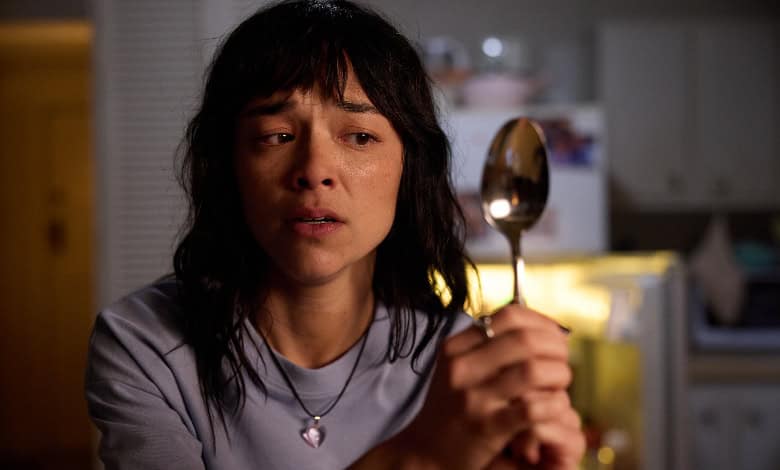
In the evolving landscape of contemporary horror, filmmaker Natalie Erika James has carved out a distinct niche, one that frequently interrogates the fragile boundaries between the human body and the external world. Her latest project, Saccharine, arrives as a visceral exploration of diet culture and bodily autonomy, anchored by a lead performance from Midori Francis. As audiences increasingly look to genre cinema to process societal anxieties regarding health and self-image, this film positions itself as a daring, if unsettling, contribution to the body horror subgenre.
The narrative follows Hana, portrayed by Midori Francis, a medical student whose pursuit of physical transformation leads her into a high-stakes fitness environment. Her motivation initially stems from a personal attraction to her instructor, Alanya, played by Madeleine Madden. However, the story shifts gears when Hana is introduced to a mysterious supplement designed to accelerate her results. The discovery that these pills contain human remains serves as the catalyst for a descent into surreal, grotesque territory that challenges the protagonist—and the viewer—to confront the literal cost of perfection.
For those familiar with James’ earlier work, Saccharine represents a departure from the atmospheric, localized dread of her 2020 feature Relic. While Relic—which explored themes of aging and dementia—was noted for its slow-burn, emotional resonance, Saccharine opts for a more aggressive, visually provocative approach. The film’s focus on the commodification of the body and the obsession with aesthetic control aligns it with other recent entries in the body horror canon, such as The Substance, which similarly utilized extreme physical transformations to critique modern beauty standards.
View this post on Instagram
A post shared by Independent Film Company (IFC) (@independentfilmco)
The Evolution of a Genre Stylist
Natalie Erika James first gained significant critical attention with Relic, a film often lauded for its technical precision and its ability to turn the domestic space into a site of psychological terror. Following that project, she directed Apartment 7A, a 2024 prequel to the classic horror film Rosemary’s Baby. That film, which premiered on the streaming platform Paramount+, showcased James’ ability to work within established mainstream horror frameworks. By comparison, Saccharine is being characterized by critics as a more daring, experimental effort that balances mainstream accessibility with the provocative imagery associated with independent genre cinema.

The film’s effectiveness hinges largely on its visual storytelling. James utilizes tight, uncomfortable close-ups—particularly during sequences involving food and the consumption of the supplement—to evoke a visceral reaction from the audience. These aesthetic choices are intended to disrupt the comfort of the viewer, effectively mirroring Hana’s own loss of agency. The third act, in particular, pushes these themes into a surreal, mythic showdown that serves as the film’s visual and thematic centerpiece.
Body Autonomy and the Horror of Perfection
At its core, Saccharine is an examination of how far individuals will go to exert control over their physical selves. By casting Hana as a medical student, James adds a layer of irony to the proceedings; the character possesses the scientific knowledge to understand the implications of her actions, yet she remains susceptible to the pressures of diet culture. This tension between intellectual awareness and emotional desperation is a common thread in James’ filmography, though We see perhaps most overtly stated here.

While the film is noted for its “gross-out” elements, these are not merely for shock value. They are integrated into the film’s commentary on consumption. The montage of food textures near the end of the film, designed to look alien and repulsive, serves as a final, jarring reminder of the film’s central conceit: that the pursuit of a “perfect” body can lead to the dehumanization of the self and others.
Key Takeaways for Horror Enthusiasts
- Thematic Depth: The film explores the intersection of medical ambition and the psychological toll of fitness culture.
- Performance: Midori Francis delivers a grounded lead performance that anchors the film’s more surreal elements.
- Visual Style: James continues her tradition of using evocative, often heartbreaking imagery to anchor her horror narratives.
- Genre Context: Saccharine fits into the current wave of body horror that prioritizes the visceral experience of the human form as a reflection of societal pressure.
A Divergent Path from Previous Works
Critics have noted that while Saccharine shares some DNA with Relic—specifically in James’ penchant for unsettling, lingering shots—the emotional impact of the two films differs significantly. Where Relic was praised for its ability to leave audiences haunted long after the credits rolled, Saccharine relies more heavily on the potency of its immediate, revolting imagery and its high-energy third-act climax. It is a film that demands to be seen as a challenge to the viewer’s senses rather than a traditional, melancholic ghost story.

The film’s pacing, while generally considered consistent, has been a point of discussion. At just under two hours, some have argued the story feels slightly overextended, yet the intensity of the final act is frequently cited as a redeeming factor that justifies the buildup. James remains a filmmaker who is acutely aware of the power of the final image and Saccharine concludes with a sequence that is as audacious as it is memorable.
As the film continues its release cycle, it is expected to spark conversations about the future of body horror and the role of female directors in reshaping the genre. For those interested in the craft of horror, the film serves as a testament to James’ growth as a director who is unafraid to oscillate between the mainstream and the avant-garde.
We invite our readers to share their thoughts on the evolution of body horror in the comments below. What do you consider the most effective exploration of diet culture in cinema? Your insights are a vital part of our community discussion.