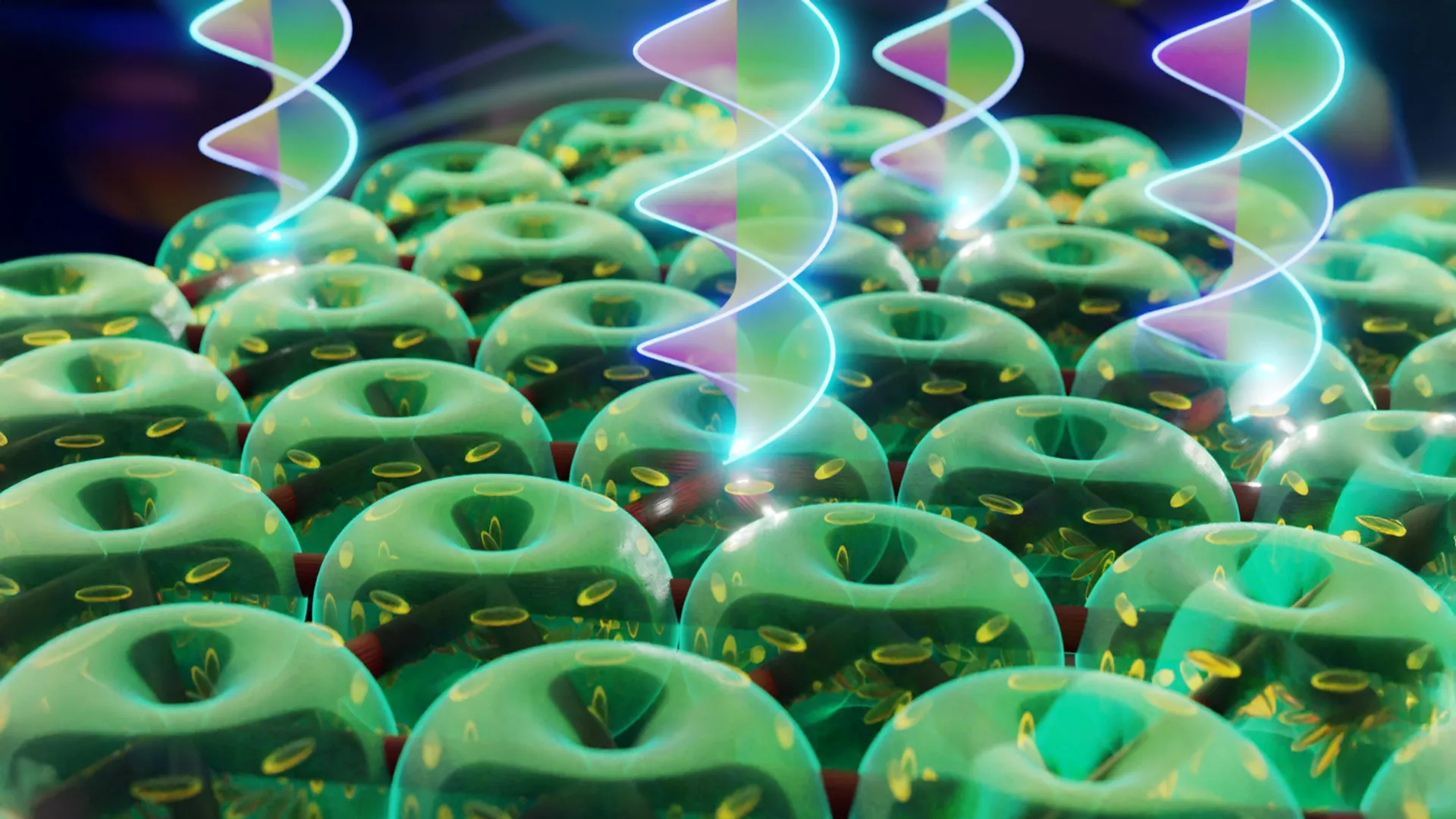
Scientists have created tiny “optical tornadoes” — swirling beams of light that twist like miniature whirlwinds — using a surprisingly simple setup based on liquid crystals. Instead of relying on complex nanotechnology, the team used self-organizing structures called torons to trap and manipulate light, causing it to spiral and rotate in intricate ways. Even more impressively, they achieved this effect in light’s most stable, lowest-energy state, making it far easier to generate laser-like beams with these unusual properties.
The breakthrough, led by researchers from the University of Warsaw, the Military University of Technology, and the Institut Pascal CNRS at Université Clermont Auvergne, demonstrates how light can be made to carry orbital angular momentum in a stable, low-energy configuration. This development could simplify the production of specialized light beams needed for advanced optical communication and quantum technologies.
“Our solution combines several fields of physics, from quantum mechanics, through materials engineering, to optics and solid-state physics,” explains Prof. Jacek Szczytko from the Faculty of Physics at the University of Warsaw, the leader of the research group. “The inspiration came from systems known from atomic physics, where electrons can occupy different energy states. In photonics, a similar role is played by optical traps, which confine light instead of electrons.”
Dr. Marcin Muszyński from the Faculty of Physics at the University of Warsaw and Department of Physics City College of New York, the first author of the study, described the phenomenon: “You can think of it as an optical vortex. The light wave twists around its axis, and its phase changes in a spiral manner. Even the polarization – the direction of oscillation of the electric field – begins to rotate.”
These structured light fields have drawn attention for their ability to encode information and manipulate extremely small objects. By generating such beams in the lowest-energy state, the researchers have removed a major barrier to practical application: the need for complex, energy-intensive systems to produce and maintain the light’s twisted structure.
The key innovation lies in the use of torons — topological defects in liquid crystals that self-organize into stable configurations. These structures act as natural traps for light, guiding it into helical paths without requiring externally imposed patterns or nanofabrication. This self-assembly approach reduces complexity and cost, potentially enabling wider adoption in photonic devices.
Previous methods for generating orbital angular momentum in light often relied on spiral phase plates, spatial light modulators, or metasurfaces — techniques that can be difficult to scale and integrate into compact systems. The liquid crystal approach offers a path toward miniaturization, which is critical for deploying quantum communication technologies in real-world settings such as satellite networks or fiber-optic infrastructure.
The research team emphasized that the stability of the optical tornadoes in the ground state ensures consistent performance over time, a crucial factor for reliable data transmission. Unlike higher-energy excited states, which may decay or require continuous pumping, the ground state maintains its properties indefinitely under suitable conditions.
Experts note that encoding information in the angular momentum of light — rather than just its intensity or polarization — allows for higher data density in optical signals. Each twist can represent a distinct symbol, effectively increasing the alphabet available for communication without increasing bandwidth.
While the current work focuses on demonstrating the principle in a laboratory setting, the team believes the technology could be adapted for use in integrated photonic circuits. Future steps may include coupling the optical tornadoes to waveguides, modulating their properties at high speeds, and testing their performance in actual communication links.
The findings were reported in a peer-reviewed study published in April 2026, though the specific journal name was not disclosed in the available sources. The collaborative effort highlights the growing role of soft matter physics in advancing photonic capabilities, particularly where precision and stability are paramount.
As global interest in quantum-secure communication grows, innovations that reduce the complexity of generating quantum-enhanced light states could play a pivotal role. Optical tornadoes, born from the humble liquid crystal, may yet whirl their way into the heart of next-generation networks.
For ongoing updates on developments in quantum photonics and advanced optical materials, readers can follow announcements from university physics departments and major research consortia focused on photonic technologies.
Related reading