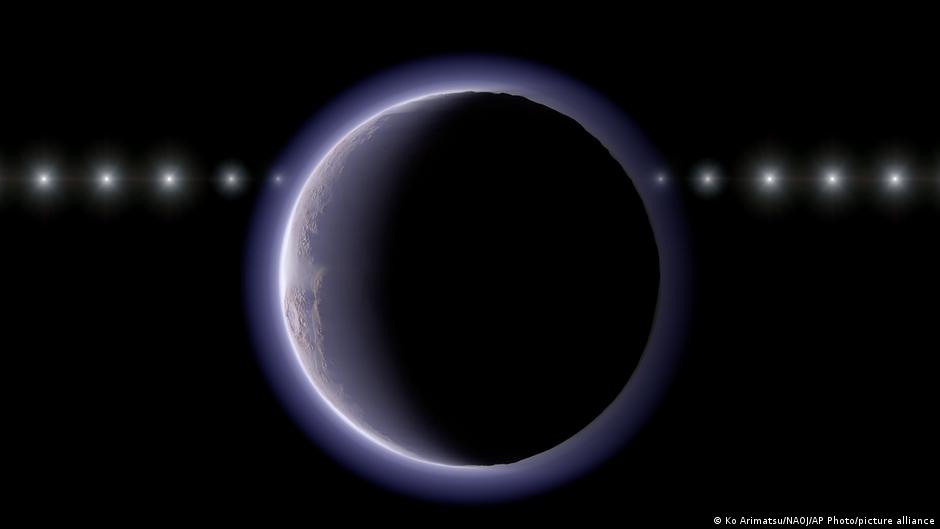
A tiny celestial body in the frigid outskirts of our solar system has upended decades of astronomical thinking. Japanese researchers have detected what appears to be a thin atmosphere surrounding a trans-Neptunian object—one that should be far too small and cold to retain such a feature. The discovery, published May 4 in Nature Astronomy, challenges the assumption that only larger worlds like Pluto could host atmospheres in the Kuiper Belt, a region teeming with icy remnants from the solar system’s formation.
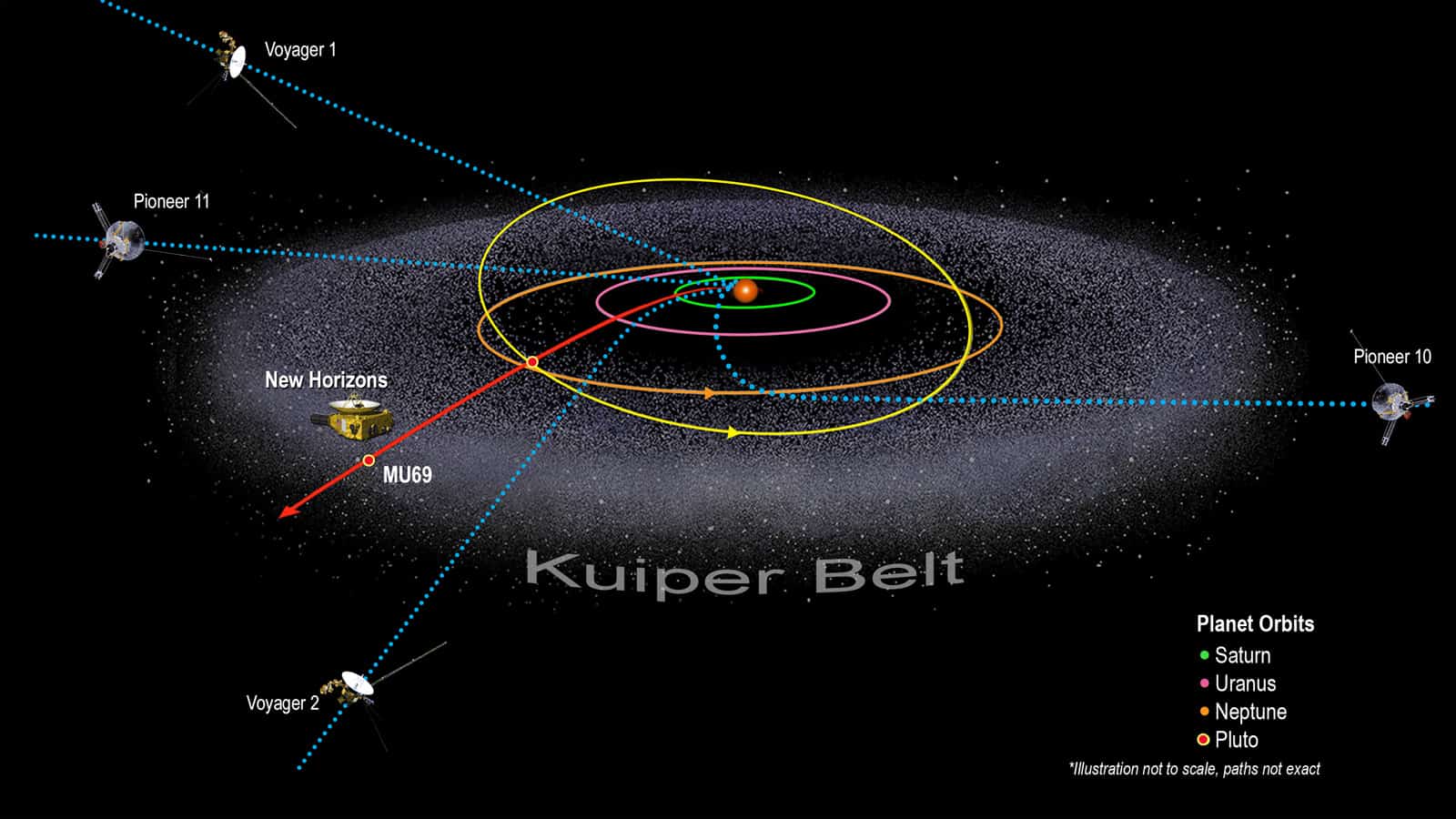
The object, designated (612533) 2002 XV93, spans roughly 311 miles (500 kilometers) across—about one-fourth the diameter of Pluto—and resides in the Kuiper Belt, a donut-shaped zone beyond Neptune populated by thousands of frozen bodies. For years, astronomers believed only Pluto, a dwarf planet, could sustain an atmosphere in this region due to its relatively large size and geothermal activity. Yet observations from January 2024, when the object passed directly in front of a distant star, revealed unexpected atmospheric signatures.
“This is an amazing development, but it sorely needs independent verification,” said Alan Stern, principal investigator for NASA’s New Horizons mission, which explored Pluto in 2015. Stern, who was not involved in the study, emphasized the need for follow-up observations, potentially using the James Webb Space Telescope (JWST), to confirm the findings. The implications, if verified, could reshape our understanding of how atmospheres form and persist in the outer solar system.
Why This Discovery Defies Expectations
The detection of an atmosphere on (612533) 2002 XV93 contradicts long-standing models of planetary science. Here’s why it’s so surprising:
- Size Matters (Or Doesn’t): Traditional models suggest that only bodies with sufficient gravity—like Pluto—can retain atmospheres. At 500 kilometers wide, (612533) 2002 XV93 is far smaller than the threshold previously thought necessary.
- Extreme Cold: Temperatures in the Kuiper Belt hover near absolute zero, making it nearly impossible for gases to escape into space. Yet the object’s atmosphere persists.
- Possible Explanations: Researchers propose two leading theories:
- A recent collision with another icy body (e.g., a comet) could have released gases, temporarily forming an atmosphere.
- Cryovolcanic activity—the eruption of icy slush—might be venting gases from the object’s interior.
- Observational Method: The team used stellar occultation, a technique where astronomers measure how a star’s light dims as an object passes in front of it. Tiny fluctuations in the light curve hinted at an atmospheric presence.
How the Discovery Was Made
The breakthrough came from a collaborative effort between professional and amateur astronomers in Japan. On January 20, 2024, the team observed (612533) 2002 XV93 as it occulted a distant star. By analyzing the star’s light curve—how its brightness dipped and recovered—they detected the signature of a thin, extended atmosphere.

“The occultation method is like a cosmic flashlight test,” explained Dr. Ko Arimatsu, lead author of the study and an astronomer at the National Astronomical Observatory of Japan (NAOJ). “When an object passes in front of a star, any atmosphere will scatter the starlight in a way that’s detectable from Earth.” The team’s findings were published in Nature Astronomy, marking the first time such an atmosphere has been inferred for an object of this size in the Kuiper Belt.
Key Details from the Study:
- Object Designation: (612533) 2002 XV93
- Diameter: ~311 miles (500 km)
- Location: Kuiper Belt (beyond Neptune’s orbit)
- Discovery Method: Stellar occultation (January 2024)
- Atmospheric Composition: Not yet confirmed, but likely nitrogen or methane ices (similar to Pluto’s atmosphere).
What Happens Next: The Race for Verification
The study’s authors acknowledge that their findings require independent confirmation. Several follow-up steps are already underway:
- James Webb Space Telescope (JWST) Observations: NASA and ESA are prioritizing JWST time to analyze the object’s infrared spectrum, which could reveal atmospheric composition and confirm its existence.
- Ground-Based Telescopes: Teams in Chile and Hawaii are planning additional occultation observations to cross-validate the initial results.
- Theoretical Modeling: Researchers are refining models to explain how such a small body could retain an atmosphere, possibly involving cryovolcanism or impact-driven outgassing.
If confirmed, the discovery could force a rewrite of textbooks. “This might mean we’ve been underestimating the potential for atmospheres in the outer solar system,” said Dr. Michele Bannister, a planetary scientist at the University of Canterbury. “It opens the door to studying much smaller worlds in ways we never thought possible.”
Broader Implications: Rethinking Planetary Science
The implications of this discovery extend beyond (612533) 2002 XV93. If small Kuiper Belt objects can indeed harbor atmospheres, it suggests that:
- Atmospheres Are More Common Than Thought: Similar objects may have been overlooked due to their faintness. Future surveys could uncover dozens of atmospheric bodies.
- Geological Activity Isn’t Just for Large Worlds: Even tiny, frozen bodies might experience internal processes like cryovolcanism, challenging the notion that only planets and large moons are geologically active.
- New Tools Are Needed: The success of this study highlights the power of amateur-professional collaborations and occultation methods in uncovering hidden features of distant objects.
For Linda Park, Editor of Tech at World Today Journal, the discovery is a reminder that even in the well-studied solar system, surprises remain. “This is a perfect example of how technology and teamwork—combining professional observatories with backyard telescopes—can push the boundaries of what we know,” she noted. “It’s a humbling moment for astronomy, and an exciting one for the future.”
Key Questions About the Discovery
Here are answers to some of the most pressing questions about this mysterious atmosphere:
- Q: How long has this atmosphere existed?
A: The study does not specify, but if it’s due to a recent collision, it could be temporary—lasting decades or centuries. If cryovolcanic, it might be more stable. - Q: Could this atmosphere support life?
A: Extremely unlikely. The atmosphere is thin, composed of simple gases like nitrogen or methane, and temperatures are near absolute zero. However, studying such environments helps scientists understand the limits of habitability. - Q: Why wasn’t this detected earlier?
A: (612533) 2002 XV93 is faint and distant. The occultation method is one of the few ways to study such small, dark objects without a spacecraft flyby. - Q: What’s the next step for NASA or ESA?
A: Both agencies are prioritizing JWST observations and may propose new missions to study Kuiper Belt objects in greater detail.
A Call to Astronomers: How You Can Follow Along
This story is still developing, and the scientific community is eager for more data. Here’s how you can stay updated:
- Follow Nature Astronomy: The journal will likely publish follow-up studies as verification efforts progress.
- Monitor JWST Announcements: NASA’s JWST website will share updates on scheduled observations.
- Join Citizen Science: Projects like IOTA (International Occultation Timing Association) welcome amateur astronomers to participate in future occultation events.
As for the next confirmed checkpoint, astronomers are targeting late 2026 for definitive results from JWST and ground-based telescopes. Until then, the mystery of (612533) 2002 XV93’s atmosphere remains one of the most intriguing puzzles in modern planetary science.
What do you think? Could this tiny world hold more secrets? Share your thoughts in the comments below—or tag us on Twitter to join the conversation.
Related reading