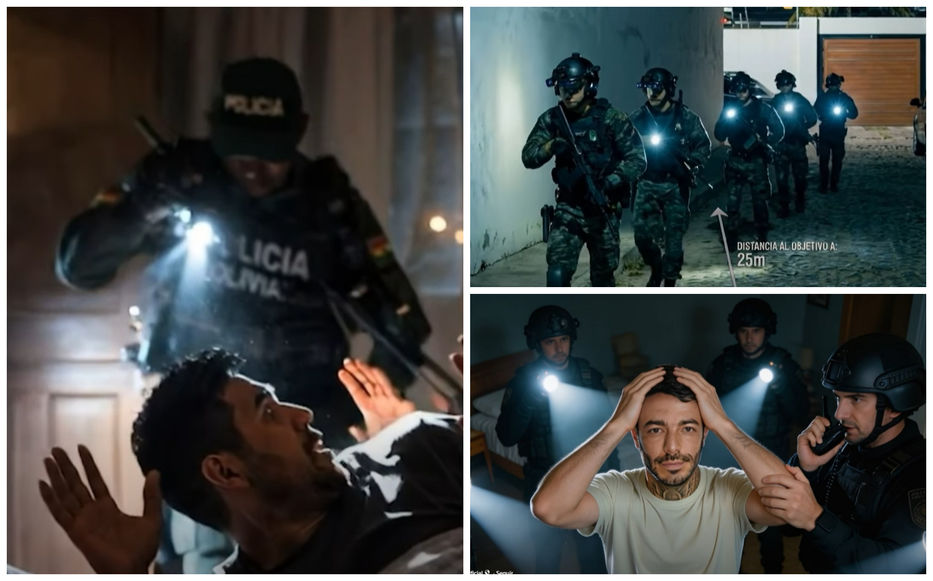
The capture of Uruguayan drug trafficker Sebastián Marset in Bolivia marks a significant development in the regional fight against organized crime. The arrest, carried out on Friday, March 13, 2026, in Santa Cruz de la Sierra, culminated in Marset’s swift extradition to the United States to face charges there. The Bolivian government has released a video, generated using artificial intelligence (AI), detailing the operation that led to his apprehension, offering a visual reconstruction of the events.
Marset, identified as one of the most sought-after narcos in the world, had been a fugitive for nearly three years. He was previously linked to a kidnapping incident involving Bolivian police officers in July 2023, after which he reportedly sought refuge in the Chapare region, receiving protection that, according to intelligence sources, surpassed that afforded to a head of state. The DEA had offered a reward of up to $2 million for information leading to his capture, highlighting the international priority placed on bringing him to justice.
Operation to Apprehend Marset: A Coordinated Effort
The AI-reconstructed video released by the Bolivian government outlines a meticulously planned operation. Authorities located Marset in the Las Palmas neighborhood of Santa Cruz de la Sierra, an upscale area of the city. The operation commenced at 2:30 AM local time, involving simultaneous raids on two properties. One property served as Marset’s residence, while the other functioned as a base of operations for his security detail.
According to the government’s account, intelligence gathering had identified these two locations as key components of the criminal organization’s infrastructure. The security team, heavily armed, was responsible for protecting Marset and providing early warning of any potential law enforcement activity. The initial phase of the operation focused on neutralizing this security perimeter to prevent any escape attempts.
Specialized police units swiftly entered the property housing Marset’s security team, effectively subduing and detaining the guards. This allowed authorities to proceed to Marset’s residence without immediate resistance. The intervention at Marset’s home followed shortly after, resulting in his arrest around 3:00 AM on Friday. Reports indicate that Marset did not offer any resistance during his arrest and remained silent throughout the process.
The operation was praised by Bolivian President Rodrigo Paz, who described it as a “turning point” in the country’s fight against organized crime. He stated that the capture of one of the continent’s largest drug traffickers demonstrated the state’s capabilities, and resolve. Minister of Government Marco Antonio Oviedo emphasized that the intelligence work and surveillance leading up to the arrest were conducted with “absolute discretion” by Bolivian police, clarifying that the DEA did not participate directly in the raid itself, but was involved in the subsequent transfer of Marset to the United States.
The Role of Intelligence and International Cooperation
The successful capture of Sebastián Marset underscores the importance of robust intelligence gathering and international cooperation in combating transnational drug trafficking. The Bolivian police’s weeks-long investigation, as highlighted by Minister Oviedo, was crucial in pinpointing Marset’s location and developing a plan for his apprehension. The involvement of the DEA in the extradition process further demonstrates the collaborative nature of this effort.
According to a high-ranking source within Bolivian intelligence, Marset had remained within Bolivia since the 2023 kidnapping incident, constantly moving between Santa Cruz and the Chapare region. This source likewise indicated that Marset enjoyed a level of protection that was unusually extensive, suggesting deep connections within the region. The AI-generated video released by the government aims to provide a transparent account of the operation, showcasing the tactical precision and coordination involved.
The use of AI to recreate the events is a notable aspect of the Bolivian government’s response. While the video provides a visual narrative of the operation, it’s important to note that We see a reconstruction based on official accounts. The video, available on Facebook, https://www.facebook.com/plugins/video.php?height=314&. href=https%3A%2F%2Fwww.facebook.com%2Freel%2F1246561301012739%2F&show_text=false&width=560&t=0" width="560" height="314" style="border:none;overflow:hidden" scrolling="no" frameborder="0" allowfullscreen="true" allow="autoplay; clipboard-write; encrypted-media; picture-in-picture; web-share, offers a detailed timeline of the events, from the initial surveillance to Marset’s final arrest and transfer to US authorities.
Marset’s Criminal History and the “Primer Cartel Uruguayo”
Sebastián Marset Cabrera is the alleged leader of the “Primer Cartel Uruguayo” (First Uruguayan Cartel), a criminal organization involved in the production and trafficking of cocaine. He has been indicted in both Paraguay and Bolivia on drug trafficking charges, and faces money laundering accusations in the United States. His capture represents a significant blow to the cartel’s operations and a major victory for law enforcement agencies across the region.
Marset’s criminal activities have been under investigation for several years. He has been linked to a network of associates involved in various aspects of the drug trade, including production, transportation, and distribution. The DEA’s substantial reward offer underscores the agency’s determination to dismantle the cartel and bring its leaders to justice. The investigation into Marset’s network is ongoing, and authorities are expected to pursue further arrests and asset seizures in the coming months.
The BBC reported on March 13, 2026, that Marset was immediately extradited to the United States following his arrest in Bolivia. The BBC article details the swiftness of the extradition process, coordinated with the DEA, and highlights the international cooperation involved in securing Marset’s transfer to face charges in the US legal system.
Key Takeaways
- Sebastián Marset, a leading figure in the “Primer Cartel Uruguayo,” was captured in Bolivia on March 13, 2026, after nearly three years as a fugitive.
- The operation was conducted by Bolivian police, with the DEA facilitating his extradition to the United States.
- The Bolivian government released an AI-generated video reconstructing the events of the arrest.
- Marset faces drug trafficking charges in Paraguay and Bolivia, and money laundering charges in the US.
The capture of Sebastián Marset represents a significant victory in the ongoing fight against drug trafficking in South America. The successful operation highlights the importance of international collaboration and the effectiveness of targeted law enforcement efforts. As investigations continue and further arrests are made, authorities hope to dismantle the “Primer Cartel Uruguayo” and disrupt the flow of illicit drugs across the region.
The next step in this case will be Marset’s initial appearance in a US federal court, where he will be formally charged and arraigned. Details regarding the date and location of this hearing are expected to be released by the Department of Justice in the coming days. We will continue to follow this story and provide updates as they grow available. Share your thoughts on this important development in the comments below.
Keep reading